


Ozoxe
Description
This section is from "The American Cyclopaedia", by George Ripley And Charles A. Dana. Also available from Amazon: The New American Cyclopædia. 16 volumes complete..
Ozoxe
Ozoxe (Gr., to smell), an allotropic and particularly active condition of oxygen. Van Marum, toward the end of the last century, while experimenting with a powerful electrical machine, made the first observations on ozone, noticing its peculiar smell and its power of attacking mercury. His discovery attracted no attention for more than half a century, when Schönbein, who first satisfactorily investigated the subject, presented in 1840 a paper to the academy of Munich. He found that in the electrolysis of acidulated water the gas collected at the positive pole had a peculiar odor, like that observed during the passage of a spark from the common electrical machine, or which accompanies a flash of lightning. The gas was found to be oxygen, but with new properties added to it, in consequence of its assuming an allotropic condition. (See Al-lotropism.) He found soon after that the slow oxidation of phosphorus in moist air or oxygen was followed by the appearance of the same body, which was named ozone. Marignac and De la Rive obtained it by passing electric sparks through perfectly dry oxygen. They found, however, that dry air or oxygen did not become converted into ozone by the action of dry phosphorus.
According to De Luca, the oxygen which is evolved by the action of light upon growing plants contains ozone. Schönbein and Phipson have observed that air in contact with juice of fungi becomes changed to ozone; and the latter is of opinion that the processes of fermentation, putrefaction, and decay are always accompanied by the formation of ozone. - Ozone may be conveniently prepared by any of the following processes: 1. By placing two or three sticks of moist phosphorus in a bottle of air or oxygen. In an hour or two the presence of ozone will be manifest by its smell. The sticks of phosphorus may then be taken out, and the ozone washed with water to remove the phosphorous acid with which it is contaminated. This method may be varied by passing a current of moist air through a series of Woulfe's bottles containing sticks of phosphorus, the last bottle containing no phosphorus, but water or a dilute alkaline solution. 2. By subjecting to electrolysis a mixture, according to Andrews, of one volume of sulphuric acid with three of water. According to Baumert, the mixture is more productive when strongly acidulated with both chromic and sulphuric acids.
The apparatus used by Dr. Andrews is shown in fig. 1. "It consists of a bell jar, a, or glass cylindrical vessel, open below and contracted to a neck above, which is suspended in a round cell, b b', of porous earthenware, leaving a space of two inches between its lower edge and the bottom of the porous cell. The whole is placed in a glass jar, c c', of somewhat larger dimensions than the cell; a bundle of platinum wires, p, suspended below the bell jar serves as the positive pole, and a broad ribbon of platinum, n n', placed between the outer glass jar and the porous cell as the negative pole of a voltaic arrangement of three or four couples. A delivery tube hermetically united to the neck of the bell jar conveys the mixture of oxygen and ozone disengaged at the positive pole to a sulphuric acid drying tube, d. From this the gas passes through the connecting tube e, and thence to the other tubes for the purpose of illustrating the properties of ozone. Thus, in the figure it is represented as traversing a tube of hard glass, foil, covered with fine wire gauze, and terminating near the surface of mercury contained in the flask h.
So long as the gas is heated strongly as it passes through the tube foil by the spirit lamps g g', not the slightest change is produced upon the mercury (in consequence of ozone being decomposed by heat); but when the lamps are removed and the tubes allowed to cool, the mercury is rapidly attacked." The oxygen collected at the positive pole contains about 1/250 of its weight of ozone. 3. By the slow oxidation of ether, oil of turpentine, and other essential oils. In 1850 Schonbein found that if a small quantity of ether is poured into a jar, and a clean glass rod heated to about 500° F. is introduced, the presence of ozone is manifested by the usual tests. 4. By transmitting a current of oxygen through a tube into which a pair of platinum wires is sealed, having their points a small distance apart, and connecting one of the wires with the prime conductor of an electrical machine and the other with the ground. 5. A method devised by Siemens employs induction. A long glass tube, fig. 2, has its interior coated with tin foil; a larger tube coated on the exterior with tin foil is passed over the smaller ozone 777 one, leaving a space between the two, through which a current of pure dry oxygen is passed.
This becomes electrified by induction by connecting the two coatings with the terminal wires of an induction coil. It is said that by this means from 10 to 15 per cent, of the oxygen may be converted into ozone. Schön-bein regarded ozone as permanently negative oxygen, and he also entertained the opinion that there was a permanently positive oxygen, which he termed antozone. The idea of the existence of these two distinct varieties was founded on certain differences of behavior of oxygen, according as it was obtained from alkaline peroxides or from the peroxide of manganese or of lead; that obtained from the alkalies having a reducing, that from the manganese and lead oxides an oxidizing action. But according to the experiments of Von Babo, Sir Benjamin Brodie, and others, it is probable that Schönbein's so-called antozone is the peroxide of hydrogen of Thenard. - Properties. Ozone is insoluble in water, alcohol, and ether, although M. Carius asserts that 100 volumes of water will absorb about 0.5 volume of the gas. Its specific gravity is greater than that of oxygen in the proportion of 3 to 2. Air containing ozone has an irritating action upon the lungs when breathed, and when large quantities are present death may be produced.
Experiments made by Dr. Redfern of Queen's college, Belfast, show that the inhalation of oxygen containing only 1/240 of its volume of ozone is rapidly fatal to all animals, while the gas freed from ozone is comparatively harmless. Ozone causes death by producing intense congestion of the lungs, with emphysema and distention of the right side of the heart with blood. From experiments of Mr. Dewar and Dr. McKendrick it appears that atmosphere highly charged with ozone diminishes the number of respirations per minute, lessens the strength of the cardiac pulsations, and lowers the temperature from 5° to 8° F. The blood is found after death in a venous condition. Ozone is an exceedingly powerful oxidizing agent, corroding cork, paper, animal membrane, caoutchouc, and other organic substances, and rapidly oxidizing iron, copper, mercury, and moist silver. M. Houzeau (Comptes rendus, 1872) states that a considerable quantity of it agitated with alcohol causes rapid oxidation, oxygenated water being at the same time produced; and he recommends its employment in a concentrated form as an oxidizing agent in organic chemistry.
An extended series of experiments have since been made by Prof. A. W. Wright of Yale college, to ascertain whether ozone could be advantageously used in the production of acetic acid from alcohol. It was obtained in a variety of ways from alcohol and ether, but not so rapidly as might be expected from M. Houzeau's statement. (" American Journal of Arts and Sciences," March, 1874.) Ozone acts upon organic substances in various ways. Vegetable colors are bleached or altered. Blue litmus is bleached without being first reddened, and the color of sulphate of indigo is discharged when the liquid is agitated with ozone. The processus of bleaching, either the old one of exposing the goods to moisture and sunlight, or the modern one of acting on them with chlorine, depends upon the production of ozonized air, or at least upon the production of nascent, active oxygen. Indeed, it is not improbable that when oxygen combines with a substance it passes into the molecular condition of ozone, either during the act of union or immediately preceding it. When the affinities are strong, as in the case of phosphorus, an atmosphere of ozone may be produced, surrounding the oxidizing body; but in the case of weaker attractions, no sensible evolution of ozone takes place.
The most delicate test for ozone is to expose to its action a strip of paper moistened with a mixture of starch and iodide of potassium, by which the salt becomes decomposed, and the liberated iodine unites with the starch, forming the characteristic blue compound, iodide of starch. It has been supposed that the fact that a paper prepared in this way and exposed to the atmosphere often becomes blued, indicates the presence of ozone; but this conclusion is not justified, because other agents, especially oxide of nitrogen, will also produce the same effect. Schonbein, having found that the air of the country frequently colored delicate ozone test paper, inferred that this body is a normal constituent of the atmosphere, varying in quantity in different localities and under different circumstances; and with its presence or absence he attempted to connect certain catarrhal diseases. Dr. Andrews has prosecuted an extended series of experiments, which, among other conclusions, sustain Schonbein's opinions in regard to the frequent presence of ozone in the air, but not those in regard to its connection with diseases. Ozone is easily decomposed, or reconverted into common oxygen.
It is destroyed by the dust and exhalations of cities, and in general by all matter in a condition to become easily oxidized. It is found in the greatest proportion in the air of mountains, and at the seaside. An elaborate report made by Ebermeyer in 1873 on the physical influence of forests, says that in open fields the air is richest in ozone, and in general in places of great atmospheric moisture. In a forest there is more ozone in the upper stratum of air in the branches of the trees than near the ground, owing to the fact that ozone is absorbed by the decaving matter on the ground. During a fog the quantity of ozone is small, and also during bright weather and northerly winds; a change to southerly winds and rains increases the quantity, and the air is rich in ozone during thunder and snow storms. The assertion that an outbreak of cholera is accompanied with an absence of ozone seems not to be sustained, although such absence is regarded by Dr. Andrews as indicating that the air is adulterated.
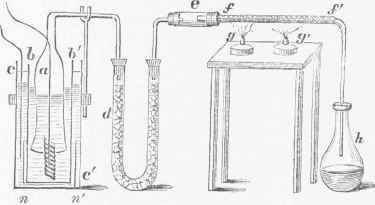
Fig. 1.
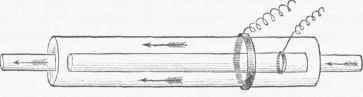
Fig. 2.
Continue to:


My Books

