


Bohemia. Part 15
Description
This section is from the book "Bohemia - John L. Stoddard's Lectures", by John L. Stoddard. Also available from Amazon: John L. Stoddard's Lectures 13 Volume Set.
Bohemia. Part 15

The Cathedral.
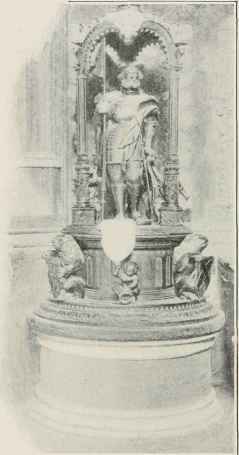
Statue Of Venceslas.
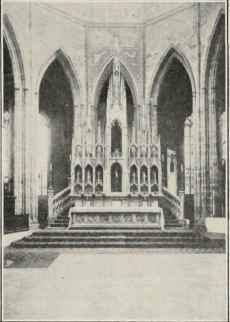
The High Altar Of The Cathedral.
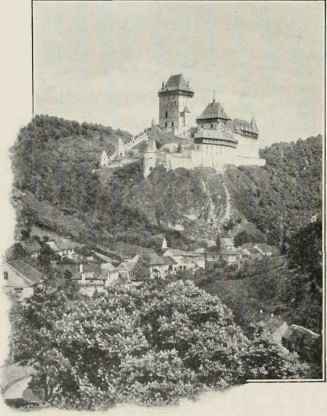
Carlstein.
While Venceslas is deemed the patron of Bohemia, the saintly guardian of Prague is John of Nepomuc, the story of whose death in the Vltava has been told. A prominent place in the cathedral is naturally given to his tomb. This takes the form of an immense sarcophagus of silver, weighing one and a half tons, and valued at one hundred thousand dollars! Within this, in a casket of pure crystal, lies the body of the saint. Around it are suspended twenty-seven silver lamps, among which, like a jewel in a brilliant setting, gleams one lamp of gold. Above the whole, five angels hold outstretched a silken canopy. There is unfortunately little art in this elaborate monument. One also feels that it is inappropriate. Simplicity and unob-trusiveness were what this modest hero would have most desired. Posterity has been unwilling to concede them to him. Hence the effect that one would gladly find in the last resting-place of such a brave and loyal man, is wholly lost. Quite different is the impression made by the superbly decorated oratory of the royal family, connected with the castle by a corridor. This admirable specimen of Gothic art dates from the very beginning of the sixteenth century, and is the more esteemed because it narrowly escaped destruction during the bombardment of the Hrad-schin by the Prussians, in 1757 - an act of vandalism for which Frederick the Great has never been absolved. On that occasion the royal palace received fifteen hundred shells, and the cathedral alone seven hundred and seventy, while nearly a thousand houses in the city were destroyed.
One of these missiles, fastened to the oratory by a chain, recalls this ruthless cannonade, and hardly tends to foster in the Czechs a love for Germany. Another work of art in this cathedral is the royal mausoleum, built of white marble in the reign of Rudolph II., about the year 1589. Beneath it sleeps Charles IV., - that wise and liberal king, of whom Bohemians are justly proud, - in company with his successors, who one by one performed their parts in Prague's eventful drama, and now repose within its national Walhalla. Upon the spacious summit of this monument lie, side by side, the sculptured forms of Ferdinand I., his wife, and son; while at the foot of their pure, marble couch stands a fine statue of the risen Christ, facing the grand high altar, where His death is solemnized. This noble structure was the work of the great Belgian artist, Colin of Malines, creator of those wonderful bronze figures which surround the tomb of the emperor Maximilian in the royal church at Innsbruck. It was indeed in that Tyrolean city that Colin made the statues for this mausoleum, which were conveyed by river as far as Linz, and thence on sledges to Bohemia's capital. We cannot wonder that the Czechs, as they recall the past, walk silently and sadly here among their nation's dead. For if Bohemia had maintained her royal independence, and had retained until the present time a throne and court whose glories would have centred in this capital, the beauty and prestige of Prague might well have been unparalleled. These walls once witnessed, century after century, the coronation of their kings, as Prague's archbishop placed upon their brows the crown of Venceslas, and they took solemn oath to rule with justice, to defend the kingdom, and protect the Church. Now that old, storied crown, the symbol of Bohemia's golden age, lies dust-dimmed and unseen beside the chapel of a patron saint whose arm seems powerless. Saints, bishops, emperors, and statesmen, whose careers so largely shaped their country's history for a thousand years, are sleeping dreamlessly beneath the Gothic roof of what might well be called Bohemia's Westminster Abbey; and until recently, for generations, the whole Czech nation also seemed to sleep, as if in death.
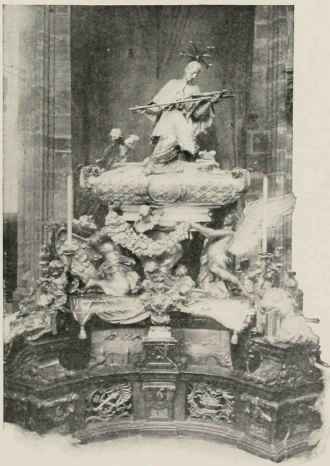
The Tomb Of Saint John Of Nepomuc.
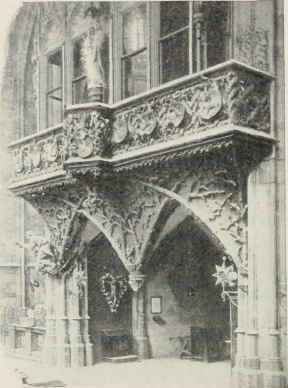
The Royal Oratory.
Continue to:


My Books

