


Bichromate Batteries. Continued
Description
This section is from the book "American Library Edition Of Workshop Receipts", by Ernest Spon. Also available from Amazon: American Library Edition Of Workshop Receipts.
Bichromate Batteries. Continued
The h.p.-hour is 1,980,000 foot-pounds, and as that was practically-obtained with the consumption stated, an estimate of the cost can be easily calculated. Hospitaller states that 5 batteries, of 6 cells each, would suffice to support for 5 hours an arc lamp having carbons fully J in. in diameter, with a current of 7 amperes, and a difference of potential of 40 volts at the terminals of the arc. No attempt was made to reduce the weight of the two batteries employed, which was 148 lb.; but, according to Hospitalier, it would be easy to construct 2 batteries of equal power to weigh not more than 110 lb., or considerably less than an accumulator capable of containing an equal amount of energy.
In working bichromate batteries, never place or leave the zincs in the excitant when the current is not needed; remove them the instant the battery is out of use; and, when in use, do not let them rest in the fluid for 5 minutes without disturbing either the plates or the fluid. The great defect of these batteries is the want of circulation in the fluid, and consequent decrease of the current. By applying heat sufficient to cause agitation, the current will retain its vigour almost till the solution is exhausted. Spent fluid may be evaporated down to recover the chrome-alum usually formed. A very convenient form of compound bichromate battery, is to have the plates attached at top to a support which can be raised by allowing it to depend by strings from a spindle; on revolving the latter, the strings coil on the spindle and raise all the plates at once. As to the number of bichromate cells required to give an electric light: 6 1-qt. cells will give a small light; 12 yield more than double; 24 afford a true voltaic arc and a brilliant light; 50 produce a light of 1500 candle power.
Up to 50 1-qt. cells it is best to connect in series; any greater number should form a separate parallel circuit; and, finally, the negative wire from each series is led to one screw of the lamp and the positives to the other. By this arrangement, the electromotive force of the battery is not increased (that of 50 cells being usually enough), while the resistance of the elements that are doubled is halved. The guiding rule for grouping a given number of elements is to effect it so that the internal resistance shall equal the external. Not more than 1/2 hour's continuous light can be got from any bichromate battery. (Urqu-hart and Webb.)
A voltaic generator, based on a modification of Dr. Byrne's negative plate cells, has been devised by Urquhart, and is described by him as being inexpensive, easily managed, certain in results, cheaply maintained, and very portable. It is simply a potash bichromate cell with negative plates of peculiar construction, and so arranged that a powerful current may be obtained from even 6 cells by the aid of abundant agitation. He thus describes its construction.
Each negative element consists of a copper plate, to one surface of which, as well as to its edges, a sheet of compact platinum foil, free from pin-holes, is soldered, and to the opposite surface a sheet of lead-the three metals being so united that the copper is protected from the action of acids. The leaden back and edges are then coated with asphal-tum varnish or an acid-proof cement; and lastly, the platinum face, being first rubbed over gently with emery cloth, is thoroughly platinised.
To effect this, fill a containing-vessel and a porous cell with acidulated water, and place the porous cell within the large vessel. Tie a strip of zinc by a clean wire to the plate to be platinised; dip the zinc in the porous cell, and the plate in the outer cell, and drop into the outer cell, while stirring, a solution of platinic chloride in water: add it drop by drop, with agitation, until the platinum surface is seen to turn dark, and to have acquired a granular deposit of platinum. Upon this surface depends to a great degree the power of the generator. If any difficulty is experienced in securing a good deposit, dip only a little of the zinc in the solution at first, and increase as the coating is seen to form. Dry carefully, and do not scratch the plate or remove the deposit, as easily happens before it is dry. Each cell contains 2 such plates, between which a single zinc is suspended; and when the elements are immersed so that the exciting fluid reaches to within 1 in. of the top, a large negative surface is brought into action.
Thus the platinum alone is the negative, and the copper core is a conducting body merely; while the lead, being almost passive, serves no other purpose than to protect the copper, so that another (best, a non-metallic) substance capable of resisting the action of bichromate solutions, might, with advantage, replace it. The exciting solution used in this cell is prepared as follows:-
Potash bichromate. . 2 oz.
Warm water . ' . 1 pint.
Sulphuric acid, when cool . 4 oz.
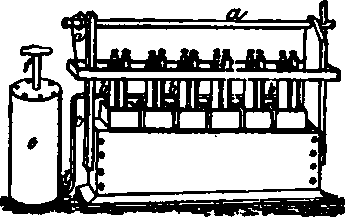
Fig. 31 represents a 6-cell generator of this kind. The ordinary, brown, glazed earthenware, oblong cells should be capable of containing at least 1 pint of the liquid; quarts will be found more economical. There are 3 plates in each cell-2 platinized, and 1 amalgamated zinc between. They are separated at the top edges by slips of wood or ebonite, against which they are securely clamped by stout brass clamps as shown. Thus the brass clamp, being in metallic contact with the lead, with clean scraped surface, represents them both as the positive pole. To the zinc plate in the centre is soldered a common binding-screw. Very stout, soft copper wires, about No. 12, are used to connect the elements in series (zinc to platinum), with clean contacts. The sets of plates are fastened to a wooden framing, made to slide up and down the side uprights, by means of shaft, cords, and handle a, enabling the whole to be withdrawn from the excitant at one action. A ratchet and pawl keeps the plates in position. For quart cells the plates may be 8 in. long and 4 1/2 in. wide.
The air-distributing arrangements are as follow:-b, 1/2-in. leaden piping, fastened to the. back of the framework, whence lead 6 1/4-in. rubber tubes, extending to the bottom of the cells, and running parallel with and directly under the plate edges; their ends are closed, and the horizontal portion is abundantly perforated; c, rubber pipe slipped over the end of b, its other end being made secure to the outlet d of a hand-pump e worked by the handle /. A valve at d closes the passage to b when the handle is drawn up, otherwise the solution would be pumped out of the cells. The whole is screwed to the floor for steadiness. It is better to use a Fletcher's foot-blower.
Fig. 31.
If the elements are simply lowered into the solution, much greater power is obtainable from them than that given by zinc-carbon batteries. The full effect, however, can only be obtained by pumping in air by the small tubes. A great disturbance of the liquid results, and the current is so much augmented in power, that even a 6-cell battery will yield a light equal to that given by a 20-cell Bunsen or Grove. The air disturbance has no effect upon the electro-motive force of the battery, although the volume of current given off is enormously increased, and any other means of effecting the required agitation would probably answer the purpose equally well. The suggestion of Prof. Adams as to the air effecting a free circulation in the fluid, by which the metallic surfaces are kept constantly clear, is undoubtedly the correct explanation. The effects are in great part due to the low internal resistance of the cell, owing to the peculiar arrangement of negative plate, partly to the rapid flow of air upwards through the liquid, and partly to the production of heat. The action of the air-flow is principally mechanical, but by hastening the combustion of the zinc it tends to generate heat, which in turn reduces the resistance.
The mechanical action of the air removes from the neighbourhood of the negative plate the chrome-alum formed there, and from the surfaces of the zinc plate the zinc sulphate, and brings a fresh supply of solution constantly to the surfaces.
With a 10-cell battery a 32-in. long platinum wire of No. 14 gauge (.089-in. diameter) was gradually brought to glowing red heat, which ebbed and flowed with the cessation or renewal of the air-flow. A brilliant electric light is maintained between 2 carbon points, which similarly varies in intensity with the flow of air, so that it is important to pump the air in regularly; and when this can be done by a crank attached to a heavy fly-wheel, almost perfect regu-8 larity is secured. The effects which are ordinarily produced by 60 or 70 Grove or Bunsen cells are obtained from 10 cells of this battery. For every 15 minutes or so of electric light, the solution in the cells will be nearly exhausted. A. 20-cell battery produces a very powerful current, which will be nearly constant if the air-flow is maintained continuously. (Urquhart and Webb.)
Continue to:


My Books

