
![previous page: 20. Ranunculus [Tourn.] L. Sp. Pl. 548. 1753. Part 11](../../../images/nav/page_prev.gif)

![next page: 22. Ficaria [Rupp.] Huds. Fl. Angl. 213. 1762](../../../images/nav/page_next.gif)
21. Batràchium S. F. Gray, Nat. Arr. Brit. Pl. 2: 720. 1821
Description
This section is from the book "An Illustrated Flora Of The Northern United States, Canada And The British Possessions Vol2", by Nathaniel Lord Britton, Addison Brown. Also available from Amazon: An Illustrated Flora of the Northern United States, Canada and the British Possessions. 3 Volume Set..
21. Batràchium S. F. Gray, Nat. Arr. Brit. Pl. 2: 720. 1821
Perennial aquatic or ditch herbs, with alternate dissected or palmately lobed leaves, the segments of the submerged ones often filiform, and solitary rather small white flowers, borne on peduncles opposite the leaves. Sepals and petals usually 5. Petals oblong or oval, the base sometimes yellowish, the claw bearing a small pit. Stamens several or numerous. Achenes oblique, compressed, not margined, beakless or short-beaked, transversely wrinkled. [Greek, referring to the aquatic habitat.]
About 20 species of very wide geographic distribution. Besides the following, several others occur in western North America. Type species: Batrachium hederaceum (L.) S. F. Gray.
Leaves all dissected into filiform segments and lobes. | ||
Leaves 1' - 2' long, flaccid, collapsing when taken from the water. | 1. | B. trichophyllum. |
Leaves 1' long or less, rigid when taken from the water. | 2. | B. circinatum. |
Leaves all reniform or broadly ovate, 3-5-lobed, 5"-10" wide. | 3. | B. hederaceum. |
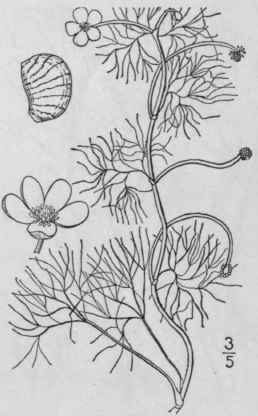
1. Batrachium Trichophyllum (Chaix) F. Schultz. White Water-Crowfoot
Fig. 1927
Ranunculus trichophyllus Chaix in Vill. Hist. Pl. Dauph.
1; 335. 1786. Batrachium trichophyllum F. Schultz, Arch. Fl. France et All. 1: 107. 1848. Ranunculus aquatilis var. trichophyllus A. Gray, Man.
Ed. 5, 40. 1867. R. aquatilis var. caespitosus DC. Prodr. 1: 26. 1824. R. aquatilis capillaceus DC. Prodr. 1: 26. 1824.
Submerged; stems branching, usually 1° long or more. Leaves petioled, 1'-2' long, flaccid and collapsing when withdrawn from the water, repeatedly forked into capillary divisions; flowers white, 6"-9" broad, on stout peduncles 1'-2' long, blooming at the surface of the water; head of fruit globose, 2" broad; receptacle hairy; achenes apiculate.
In ponds and streams, Nova Scotia to British Columbia, south to North Carolina and California. Also in Europe and Asia. Consists, apparently, of numerous races, differing in habit, in size of flowers, number of stamens and shape of petals; several of these have been recognized as species. Water-milfoil. Green eel-grass. Pickerel-weed. June-Sept.
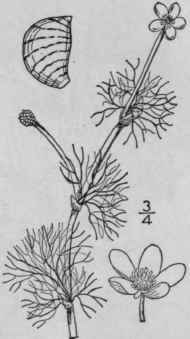
2. Batrachium Circinàtum (Sibth.) Rchb. Stiff White Water-Crowfoot
Fig. 1928
Ranunculus circinatus Sibth.; J. E. Smith, Fl. Brit. 2: 596. 1800. Batrachium circinatum Rchb.; Spach, Hist. Veg. 7: 201. 1839. R. aquatilis var. divaricatus A. Gray, Man. Ed. 2, 7. 1856.
Similar to the preceding species, but the leaves are shorter, less than 1' long, spreading nearly at right angles from the stem, rigid when withdrawn from the water and sessile or nearly so; there appear to be no constant differences in flower or fruit.
In ponds and slow streams, Ontario, New England, northern New Jersey and Pennsylvania, and west to the Pacific Coast, extending south in the Rocky Mountains to Arizona. Also in Europe. Summer. Referred in our first edition to Batrachium divaricatum (Schrank) Wimmer.
Batrachium longiróstre (Godr.) F. Schultz, if distinct from this species, differs in having a longer beak to the achene.
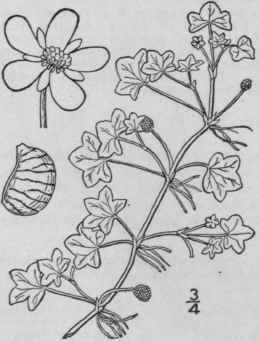
3. Batrachium Hederàceum (L.) S. F. Gray. Ivy-Leaved Crowfoot
Fig. 1929
Ranunculus hederaceus L. Sp. Pl. 556. 1753.
Batrachium hederaceum S. F. Gray, Nat. Arr. Brit. Pl. 2: 721. 1821.
Semi-aquatic, rooting extensively at the joints, branching, entirely glabrous. Leaves floating, or spreading on the mud, semi-circular, reniform or broadly ovate in outline, 3-5-lobed, 3"-6" long, 5"-10" broad, the lobes obtuse; flowers 2" - 3" broad; head of fruit globose, 2" wide; receptacle glabrous; achenes minutely beaked.
In ponds and pools, Newfoundland; southeastern Virginia and Maryland. Naturalized from Europe. June-
Continue to:


My Books

