


9. Dianthus L. Sp. Pl. 409. 1753
Description
This section is from the book "An Illustrated Flora Of The Northern United States, Canada And The British Possessions Vol2", by Nathaniel Lord Britton, Addison Brown. Also available from Amazon: An Illustrated Flora of the Northern United States, Canada and the British Possessions. 3 Volume Set..
9. Dianthus L. Sp. Pl. 409. 1753
[Tunica Boehm. in Ludw. Def. Gen. 298. 1760.]
Stiff perennial (rarely annual) herbs, mainly with narrow leaves. Flowers terminal, solitary or cymose-paniculate, generally purple. Calyx 5-toothed, finely and equally manystriate, tubular, several-bracted at the base. Petals 5, long-clawed, dentate or crenate.
Stamens 10. Styles 2. Ovary 1-celled, stipulate. Capsule cylindric or oblong, stalked, dehiscent by 4 or 5 short teeth at the summit. Seeds compressed, laterally attached. Embryo straight, eccentric. [Greek, the flower of Jove.]
Species about 200, natives of the Old World; one of Siberia extending into arctic America. Type species: Dianthus caryophyllus L.
Annuals; flowers clustered. | ||
Bracts broad, scarious. | 1. | D. prolifer. |
Bracts narrow, herbaceous, long-pointed. | 2. | D. Armeria. |
Perennials. | ||
Flowers solitary; leaves linear, short. | 3. | D. deltoides. |
Flowers clustered; leaves lanceolate or ovate-lanceolate. | 4. | D. barbatus. |
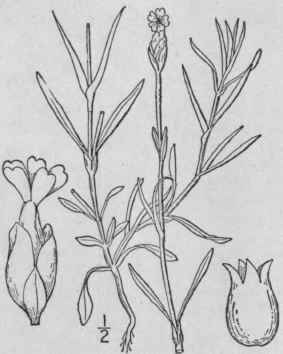
1. Dianthus Prolifer L. Proliferous Or Childing Pink
Fig. 1830
Dianthus prolifer L. Sp. Pl. 410. 1753.
Annual, erect, slender, glabrous, 6'-15' high, simple, or with few erect branches. Leaves distant, linear, erect, acute, 1/2"-1" wide, 9"-15" long; flowers small, pink, clustered in terminal oblong or obovoid heads, and appearing successively from behind the bracts, which are broad, ovate, scarious, imbricated, shining, obtuse or mucronate, equalling and concealing the calyx.
In waste places and ballast, Staten Island, N. Y., New Jersey and eastern Pennsylvania to Ohio and South Carolina. Adventive from Europe. Summer. Childing sweet-william.
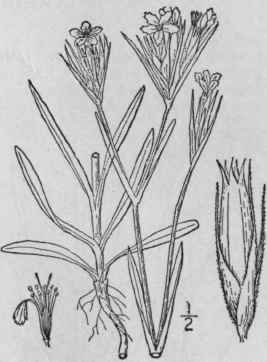
2. Dianthus Armèria L. Deptford Pink. Grass Pink
Fig. 1831
Dianthus Armeria L. Sp. Pl. 410. 1753.
Annual, erect, stiff, finely pubescent, 6'-18' high; branches few, nearly erect. Leaves linear, erect, acute or the lower obtusish, 1'-3' long, 1"-1 1/2" wide; flowers small, pink with whitish dots, borne in terminal often dense clusters; bracts lanceolate-subulate, long-pointed, erect, mostly longer than the sharply-toothed calyx; capsule sometimes 5-toothed.
In fields and along roadsides, Quebec and southern Ontario to Iowa, Michigan, Virginia and Georgia. Naturalized from Europe. Summer.
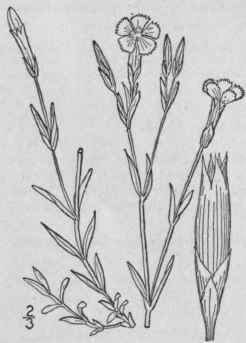
3. Dianthus Deltoides L. Maiden Or Meadow Pink
Fig. 1832
Dianthus deltoides L. Sp. Pl. 411. 1753.
Perennial, tufted, glabrous or somewhat hoary; stems ascending, 6'-15' long; branches usually several, nearly erect. Leaves linear-lanceolate, 6"-g" long, 1" wide, those of the flowering stems erect, acutish, the lower obtuse and spreading; flowers pink or whitish, solitary at the ends of the stem and branches; petals dentate at the end; bracts ovate, pointed, about half as long as the calyx or less.
In waste places, Vermont, eastern Massachusetts and Connecticut to northern New York and Michigan. Adventive from Europe. Native also of western Asia. Spink. Summer.
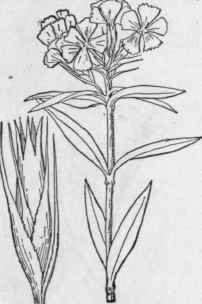
4. Dianthus Barbàtus L. Sweet William. Bunch Or French Pink
Fig. 1833
Dianthus barbatus L. Sp. Pl. 409. 1753.
Perennial, tufted, glabrous, stems erect, rather stout, 1°-2° high, branching above or sometimes unbranched. Leaves lanceolate or ovate-lanceolate, 1 1/2'-3' long, 4"-9" wide, acute or the basal ones oblong or obovate; bracts linear-filiform, about equalling the long-toothed calyx; flowers pink or whitish, in large terminal clusters.
In waste places, escaped from gardens, occasional in the Eastern and Middle States. Introduced from Europe. Snow-flake. London-tuft or -pride. Sweet-johns. Bloomy-down. Summer.
Continue to:


My Books

