


Marriage Customs In Many Lands - Some African Marriages
Description
This section is from "Every Woman's Encyclopaedia". Also available from Amazon: Every Woman's Encyclopaedia.
Marriage Customs In Many Lands - Some African Marriages
A Bridal in Western Congo - The Dues of Courtship - A Paint-bespattered Bride - The Protracted Honeymoon - Goats as a Medium of Exchange - Buying the Bride - A Stately Proposal - The
Mother-in-law In A-kamba
With the influence of European politics in Africa, customs which from time immemorial have been followed in the Dark Continent will, in all probability, change, and perhaps will vanish.
The marriage customs among the different tribes of Africa are very interesting. In the Western Congo, for instance, the young men fix the age for marriage, very practically, at the time when they can first afford to buy a wife. Sometimes parents will betroth their children when they are very young, the boy's father thus guaranteeing his ability to keep a wife ; but in many cases the affair is settled by the mutual consent of bride and bridegroom, so that love matches are quite frequent.
The conventions of courtship are very strictly observed. Thus, the young man goes to call, but, instead of being offered tea, he is greeted by his lady love with the loudest screams of which her lungs will permit, as she turns and flies out of the house and through the fields. It is, of course, his bounden duty to pursue her. According to the nimbleness of her legs and capacity of her lungs the chase lasts ; but in the end she allows herself to be captured.
Practical matters next occupy everybody's attention. He has to buy the bride from her parents. She, on the other hand, has to provide the house, all cooking and cleaning utensils, her trousseau, her dowry, and a feast to which both families are invited.
The mother and daughter are shut up together to arrange the bride's attire. The mother has a quantity of bright red powder mixed with oil, which produces a sticky, shiny red varnish. Of this compound she takes a mouthful, which she then places over the lace of her daughter. The next mouthful is put upon the bride's shoulders, and so on, till the young lady looks rather like a piece of red Japanese lacquer. This operation is repeated every day until the bride is paid for by the suitor, which is sometimes many weeks. All this time the bride is shut up in one room, but she is able to see her friends, and every now and then a love token comes from her fiance, in the form of a thick slice of pork, or a new loin cloth.

A princess of the Congo at Oubiem. In this part of Africa brides are always purchased, and the wedding ceremonies retain many traces of the primitive marriage by capture
Photos, A. Harlingue
The Wedding Day
When the great day arrives, the women of the neighbourhood bring to the bride's house pots and pans for the cooking of the nuptial pig, provided by the bride's parents. Then the bride comes on the scene, bright red as to body, but her face painted white. She indulges in a wild dance of joy, and the feast begins.
Meanwhile, the bridegroom's father has sent the medicine-man of the village to pray to the fetish for a blessing on the marriage. This is the only " religious " ceremony during the proceedings. The next day the bride removes the red paint. At noon many of the neighbouring men come to her, bind her with rope, and carry her to her husband's house, thus maintaining the fiction that she is an unwilling bride. After her comes a train of bridesmaids, dancing and singing. She is left in her new home tied up, but her husband speedily releases her.
A really high-spirited bride will prolong the festivities by running away after a day or two to her home, and being recaptured and beaten by her husband. This is an accepted form of coquetry. In some of the tribes in the Congo marriage by capture in its original form still exists - that is, a man carries off his bride by force from her relatives into the forest, where they both live on the proceeds of his hunting. There {hey stay until she has weaned her first child, when he brings them both home in triumph, and gives her his worldly goods. The honeymoon, therefore, can never be less than eighteen months or so, a dreadful thought to modern England, which has cut down the institution almost to a week-end.
Living Cheques
In East Africa the customs are quite as quaint. In the A-kamba tribe the girls are looked upon simply as living cheques which will purchase so many goats. A rich suitor will probably pay a hundred goats, a poor one only forty. But then the poor one must allow his wife still to work for her family, which equalises things, for if he refused, the father would take his daughter back again, and then the husband would have to work for himself, poor thing !

A Congo belle tattooed in approved native fashion. For a really eligible maiden a suitor will have to pay many goats and much cattle, in addition to other gifts
Photo, A. Harlingue
The courtship is rather stately. The young man talks to the girl frequently ; then he proposes ; then he asks her father's consent, and the father goes away to the young man's parents, and all is done decently and in order. The bridegroom's father, in token of consent to the union, presents the bride's father with two goats ; and at the end of three days with four more goats and some beer, and they then begin to discuss the bride's value in goats.
Instalments of goats arrive at frequent intervals at the bride's home. One day six of these beasts, with their solemn eyes above their waggly beards, will be brought to her delighted father. This is only by way of breaking it gently, however, for another day twenty or forty come all together. The bride's father, now having enough goats, begins to ask for cattle, and two cows and a bull are the next consignment. If the bride is thoroughly attractive, and worth a good deal, three gourds full of a mysterious liquid called tembo are then sent by the bridegroom's father.
It is now the bridegroom's turn to take part in the proceedings. He kills a bullock, and, splitting the carcase in half, presents one portion to the bride's mother, with some cloth, and gives a feast to his friends with the other. Choosing an old man as his spokesman, he goes to visit the bride, who awaits him at the door of her father's hut. Strict silence is observed by the bridegroom, who, when the old gentleman has demanded the girl, turns and departs, followed by the bride under the supervision of her father.
The day after the wedding is rather dismal, for all the bride's girl friends come and cry. They stay for three nights, and on the fourth the bridegroom gives them many presents, and they depart. But the ceremonies, which began with goats, end with goats, for the final present consists of one goat given to the bride's sister. The bride's mother must also be compensated two days after the wedding for the loss of her daughter, by presents of bananas, sheep, and, of course, a goat.
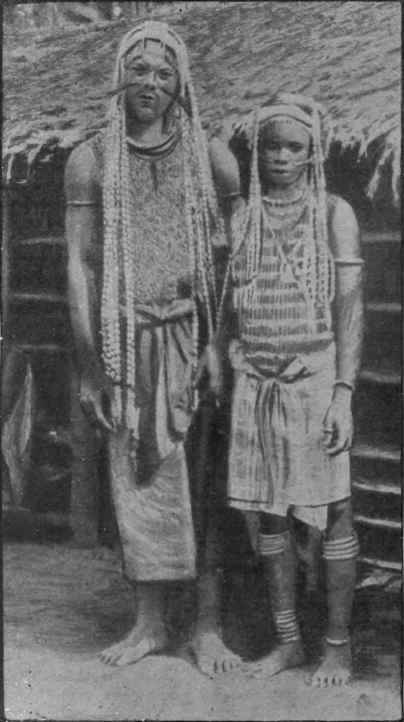
Two interesting examples of gala dress among the women of the Congo. Many tribes have the decorative instinct strongly developed
After the wedding, various social observances come into force. If a man should meet his mother-in-law on the road, each must in silence cover the face, and pass by on the other side. If her husband did not do this, the bride would leave him. Apparently, therefore, the mother-in-law question has never been allowed to rise among the A-kambas. If any business has to be done with the mother-in-law, it is transacted at night, through the door of the hut.
In one African tribe the marriage veil and bridesmaids appear. This is in the Atonga tribe, where the bride is purchased by cloth given to her mother's sister. The would-be bridegroom must build a house close to the bride's father's for her. The bride is taken to her husband's house veiled, accompanied by her girl friends. She will not cross the threshold till she has been given a hoe by the bridegroom, followed by a present of beads and cloth. The beads afterwards become the bridesmaids' perquisites.
According to the bridegroom's generosity in the matter of these beads is his reputation in the eyes of the bridesmaids, and painfully candid are their remarks if he appears to fail in his liberality.
The day after the wedding, the " big women," or matrons of the village, perform the ceremony of removing her head veil, and the husband's brothers, if any, are supposed to give the bride a present.
The girl's father also, if pleased with his new son-in-law, gives the bridegroom's father a hen to keep, but, if he is disappointed with him, a cock, and thus shows that he would prefer the union dissolved and his daughter returned to him, surely a most humiliating experience for the luckless groom, and possibly, too, for the bride.
He, if satisfied, then proceeds to give his daughter a serious exhortation on the duties of her new estate. This, it is to be hoped, she receives with becoming docility, and a resolve to profit by such excellent advice.
Continue to:


My Books

