


Interior View Of Conservatory In The Birmingham Botanic Garden, England
Description
This section is from "The Horticulturist, And Journal Of Rural Art And Rural Taste", by P. Barry, A. J. Downing, J. Jay Smith, Peter B. Mead, F. W. Woodward, Henry T. Williams. Also available from Amazon: Horticulturist and Journal of Rural Art and Rural Taste.
Interior View Of Conservatory In The Birmingham Botanic Garden, England
AN American gardener feels a thrill of interest in reading the descriptions of the finished Conservatories and Botanic collections so famous on the European continent. Whether it is owing to lack of skill, culture or interest here, among American gentlemen, it is yet true, that our merchant princes rarely ever lay out or provide such elaborate display as do the princely families of England and Germany. There may be pecuniary ability, yet an American hates detail, and it is easier to take care of his capital in bank stock, and once led in this line, all income and simple interest follow in the same groove. And yet, while we seem to look long-ingly to the beautiful picture of conservatory wealth and floral treasures across the waters, yet, our English cousins seem to take pride in devoting part of their ample grounds to the American garden. Thus, though copying from each other, yet we are approaching one another in interest and unanimous sentiment.
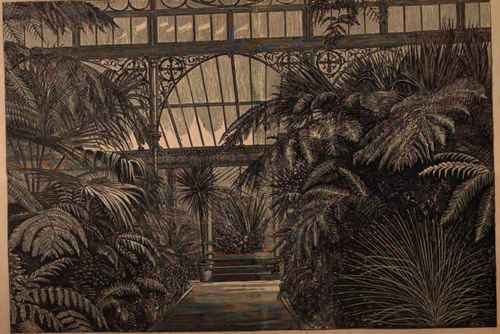
Interior View of Conservatory in the Birmingham Botanic Garden.
Mr. D. T. Fish, writing to the Gardener's Chronicle, a sketch of the plant curiosities at Birmingham, says: Art and Nature have worked together to create a charming variety of terrace and dell, rolling ground and level plains, retired roseries. and such American gardens, smooth archy ground, and freshly exhumed rocks, clothed with ferns and crowned with foxgloves. This admixture of the color of the foxglove with the green of Osmunds regalis and other ferns, was one of the most valuable hints I picked up at Birmingham.
I had introduced this before but not in such bold manner. The effect was charming, and but for the sameness of many of the masses of sandstone rook, it would have appeared most natural. The furnishing of those 12 acres of ground was as varied as their character.
In one spot, the last examples of carpet, summer or spring bedding, or grouping in masses; divided by straight lines, as seen near the conservatory, were formal beds on the terrace, greened down to sobriety by intervening spiral yews; -close by, hanging ribbons on the slope. A few steps more, a fine Picea nobilis, 50 feet high, P. Pinsapo of rare growth or stature, five Thujapsis bar talis, stately Magnolias; Anon vilas in masses, Lilies and Forget-me-Nots; a peep at botanical rarities, in beds or groups on a lower level, and then such masses of Rhododendrons and Asaleas as one seldom sees; while throughout all and connecting all, as a beautiful thought or idea, governing a life, is the green turf in charming sloping glades or widening sweep of beauty, inviting repose.
But the crowning beauty of these most interesting gardens is the great Conservatory, with aquarium in the rear; the former a modern house of great beauty of structure and most elegant proportions. The entire structure is highly ornamental, this beauty being much enhanced by portions being picked out with chocolate and gold.
The furnishing of the Conservatory was in keeping with the outside, and it contained many excellent examples of good cultivation admirably arranged. Among the finest specimens were the following Ferns:
Dioksonia Antartica.
". Sqaarrosa.
" Arborescens, rather rare and noble. Alsophila Australia.
" Excelsa.
" Contaminans.
Cyathea Medullaris.
" Princeps. Cibotium Regale.
" Spectabile.
" Sohiedei.
And enormous plants of Platycerium alcicorne, seldom seen in snob size and condition. What the Dasylirion anotichum was like is seen in the wood cut.
There were likewise very fine plants of Phormium. one of P. tenax variegatum, and of P. Colensoi variegatum, and noble specimens of Cycas revoluta, Latania borbonica, Sabal umbraculifera and other palms. The beautiful Lasiandra maorantha was well done, and quantities of an old-fashioned showy plant, the Diplacus, not puniceus, but glatinosus, made a fine display on the shelves. A charming old plant, Plumbago capensis was also remarkably well flowered. The roof of the aquarium, or Lily home, attached to the Conservatory,.was well covered with climbers; prom-inent among these was a very fine variety of Passiflora quadrangularis, this seemed different and larger than the sort generally grown.
Allamanda, Schottii and the Stephanotis were extremely well done in this house, a good effect was produced by the little used and curious Aristolochia ornithooephali. Bottle and Smoke Gourds were also seen to good effect on the roof in company with the Souly green cucumber. In the tank were some plants of Nymphoea dentata, N. Ccerulea and others, and a seedling of a beautiful and delicate pink, of the size of dentata, said to be a seedling between N. dentata and N. rubra. Over the tank various baskets of Stanhopes were pushing grand masses of flowers, and I got a new idea of basket-furnishing, the bottom and side filled with Epiphyllum crowned with a graceful plant of Adiantum aethiopicum. Among the Palms, were tastefully arranged a fine plant of the very rare Stifftia ckrysantha, and last and best of all, probably, for health and size, a noble specimen of Pandanus utilis. Among the orchids and dendrobinus was D. Speciosum, a hardy New Holland Orchid, very useful for winter flowering.
Moranta, Caladium, Dracaena, were well represented, and the collection of Mexican and other Ferns, was rich and extensive. Among the latter, P. Andromedifolium, an exquisite California Fern. Here, too, I met with the little grown Aspidium, fragrans, whose fronds are as sweet as if perfumed with the essence of violets.
Continue to:


My Books

