


Napoleon Hi. Strawberry
Description
This section is from "The Horticulturist, And Journal Of Rural Art And Rural Taste", by P. Barry, A. J. Downing, J. Jay Smith, Peter B. Mead, F. W. Woodward, Henry T. Williams. Also available from Amazon: Horticulturist and Journal of Rural Art and Rural Taste.
Napoleon Hi. Strawberry
Messrs. G. E. & F. W. Woodward, 37 Park Row, New York City - Gents: Your letters are received, acknowledging receipt of the sample of the strawberry Napoleon III., and we regret to learn that they arrived in such condition as not to enable you to judge of their quality. The fruit is large to very large (the samples sent you giving a fair average size at that time, not having sent the largest or the smallest berries).
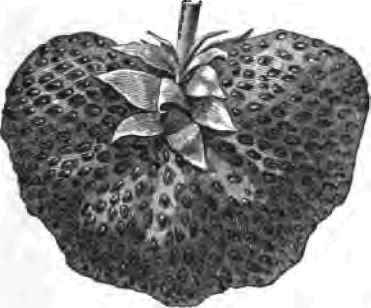
Fig. 140.
The variety may be described as irregular, flattened, varying from oval to cockscomb-shaped, of a handsome rosy-red color, shading to darker red in the sun, and waxy blush in the shade; flesh of delicate, snowy whiteness, rather firm, and of sprightly, high flavor, with a delicate aroma; plant vigorous and healthy, with large dark-green foliage; very productive - exceeding in that respect anything in our collection, except Wilson's Albany; in season later than the Wilson, succeeding it; flowers perfect. For shipping, we fear it may not prove sufficiently firm, but as an amateur berry it is not excelled, and will be especially valuable from its lateness. The variety was obtained from the originator, Mr. F. Gloede, in 1864, and has succeeded admirably with us since. Compared with Jucunda, it is not quite as attractive in color as that beautiful and popular variety, but of much higher flavor, more vigorous growth, and greater productiveness. We inclose photograph of a good-sized berry.
Truly yours, Edw'd J. Evans & Co. York, Penn., July 1. 1867,
Woodbury, Conn., July 15, 1867.
Editors of Horticulturist : The strawberry season is over, and the yield has been a good one. Triomphe de Gand is our favorite, though we are pleased with Agriculturist, Downer, Russell, and last, though not least, Hovey. The raspberry crop is ripening up, and the Antwerps are bearing profusely. The crop of wild red raspberries is the largest in our recollection; the boys and girls are gathering them by the pailsful, which readily sell at eighteen cents the quart. The grape crop looks promising.
The mildew appeared on the Delaware July 1st, and a few days later on Iona, Israella, Adirondac, Allen's Hybrid, and Diana. Catawba, Concord, Hartford, Northern Muscadine, Union Village, and Ives are wholly exempt. I have a few of the first-named vines planted on a thin soil with subsoil of gravel, that the mildew has not attacked. Yours, E. Sperry.
Seeds should be gathered as they ripen, placed in tight, dry paper bags, and laid in drawers or on shelves, where they will not be liable to absorb moisture.
Weeds at this season of the year come rapidly to maturity, and the careful cultivator will watch and destroy them without mercy, knowing that one plant permitted to seed will supply him with much unnecessary labor the coming year. If you have careless neighbors, try and induce them to at least mow the weeds in their grounds before they ripen their seed.
Continue to:


My Books

