


Designs For Improving Country Residences
Description
This section is from "The Horticulturist, And Journal Of Rural Art And Rural Taste", by P. Barry, A. J. Downing, J. Jay Smith, Peter B. Mead, F. W. Woodward, Henry T. Williams. Also available from Amazon: Horticulturist and Journal of Rural Art and Rural Taste.
Designs For Improving Country Residences
To lay out a rural residence satisfactorily, it is necessary to study the form and location of the ground, as well as to consult with, and ascertain the particular requirements of the family. It would be an easy matter to offer a series of designs, many of which might be useful to those in need. I conceive, however, that it will serve a more useful purpose to select occasionally sketches as they occur in practice, as many opportunities are presented of taking advantage of existing features and turn- ing them to account in the general improvement. Individual taste must be recognised in the disposition of the various adjuncts to a dwelling. While some desire the purely ornamental character to predominate, others have more utilitarian objects in view. The most numerous class are those who wish to have a little of every thing - vegetables, fruit, flowers, and ornamental trees - as shown in the following design. It was required to arrange the grounds, although limited in extent, so as to appropriate a small spot for flowers, as well as have a few of the most desirable ornamental trees disposed on the lawn with convenient walks for their inspection.
Flowering shrubs had also to be kept in view; a small space was also desired for cultivating some of the smaller kinds of fruits, and lastly a portion had to be reserved for vegetable culture.
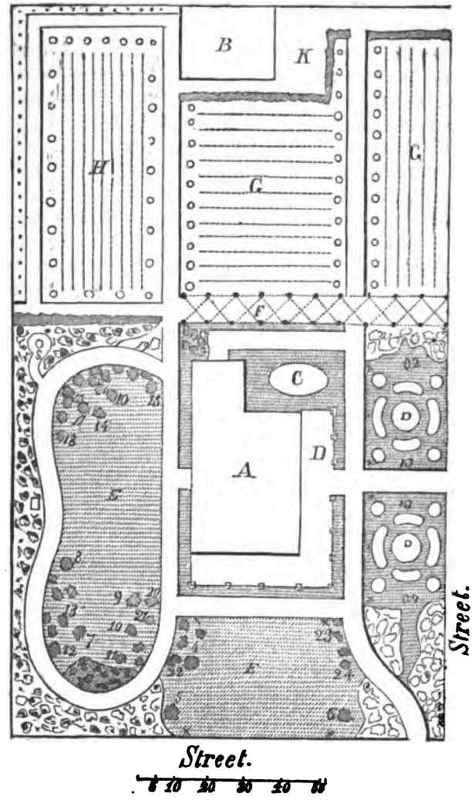
In arranging these various parts, the principle of distinctiveness has been kept prominently in view. On the west side, the short walk leading from the street to the principal entrance of the house leads through a small flower garden, consisting of a few simple figures geometrically arranged. The grape arbor forms a very appropriate division between the ornamental and vegetable ground, and its proximity to the house renders it useful and convenient as a shady resort in summer. The open spaces of grass form % relieving contrast to the groups of trees and shrubs and suggest a feeling of extent; a principle that is seldom adopted in small places, although it is most important; the same space of ground dotted over with plants would appear confused, monotonous, and confined. The fruit gar-den, which is separated from the ornamental planting by an arbor vitae hedge, is adapted for dwarf pear trees, strawberries and raspberries. The pears are arranged parallel to the walks, enclosing a space for strawberries. The raspberries are planted on a narrow border close to the fence.
Currant and gooseberry bushes are planted along the walks in the vegetable garden, the whole being excluded from the stable yard and road by an evergreen hedge.
Designs For Improving Country Residences #1
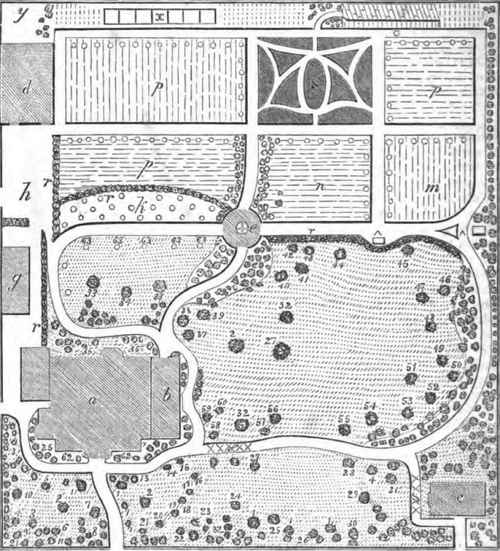
This design represents a place of about one acre and a fourth in extent. Its square form excludes variety of outline, rendering its tasteful improvement more difficult. This place has been planted about five years, and is now beginning to develop the judiciousness of its arrangements. Many of the trees being of large size when transplanted, have now a decided effect The arrangements possess considerable interest, on account of the great variety of trees, both fruit and ornamental, the agreeable yet diversified direction of the walks, the skilful introduction of evergreen hedges as screens, and the occasional breadth of lawn seen in vistas at particular points. The single specimens of choice ornamental trees, also form objects of much interest, placed, as they are, in conspicuous positions.
The front entrance-walk had to take its present outline to avoid cutting down an old tree; the original surface had also to be lowered at this point; a rounded mound was therefore formed at the base of the tree, creating at once a pleasing feature, and an apparent reason for the curve in the walk. A similar reason occasioned the abrupt bend in the walk at the southeast corner of the veranda, b. Both of these old trees are now covered with English ivy, and thus rendered of double interest. The grape arbors are placed to intercept the view on entering; the principal lawn view is, therefore, not seen until the best position is reached at the veranda step. The hedges are ingeniously introduced; they are of American arbor vitae, the best of all plants for quick growing, evergreen hedges. The offices, g, are very completely hid from the walk leading to the stable; the yard is also separated by a thick hedge, which is carried round the dwarf pear-trees at k, to the rustic house, e. The view to the east, from the rustic summer-house, is pleasingly terminated by the pedestal and vase, v, set in a projecting mass of shrubbery; the triangular bed of choice low-growing shrubs in front, also assists in rendering the boundary line indistinct at this point.
A similar feature is seen when looking up the walk, standing at a point immediately in front of the greenhouse. The position of the greenhouse and flower-garden might be objected to, abridging, as it does, the vegetable ground. Had the greenhouse been placed on the spot of ground occupiea by the dwarf pears at k, and the flower garden in front of it, the vegetable ground would have been enlarged, and the whole arrangement more distinct and compact. Such an arrangement was at one time contemplated, but was set aside for the present one, first, because that part of the grounds was too much shaded by the house to admit of that freedom of flowering so necessary in a well-kept flower garden; but, chiefly, on account of the superior beauty of a well-kept lawn in winter, instead of the neglected appearance that flower gardens usually present at that season. In walking through the grounds, the contrast between the vegetable and flower ground is scarcely observed - at all events, it does not appear intrusive. The transition from the lawn through the rustic house to the greenhouse, is rendered appropriate by the masses of flowering shrubbery through which it is carried, and the row of fruit-trees on the left breaks the view in that direction.
It will be observed that the trees in the vegetable ground are placed principally on the south side of the walks. This is a very judicious method, as it throws the shade of them on the walk, and being kept dwarf, they do not interfere with the growth of the vegetables. Other arrangements and details are further explained by the following:
Designs For Improving Country Residences #1
Multum in parvo. These articles of Mr. Saunders are suggestive, therefore valuable. An acre and a quarter of ground, as in this plan, contains a great many family comforts and luxuries in its vegetables and fruits; as well as retirement, and positive enjoyment in its pleasure grounds with its trees, shrubs, and flowers. An effective plan for a given piece of ground and buildings can only be made after an accurate observation of its character in position, variety of surface, views, etc. Limited space, with various requirements, must be embroidered like the one before us*; and, when effectively done, it becomes a beautiful and complete home. Yet the dwelling upon it must not be ambitious; nothing above the cottage. A pretentions house must have ample grounds, and wide plantations, otherwise it appears wonderfully belittled by its petty surroundings.
Continue to:


My Books

