


Fruit In Southern Illinois
Description
This section is from "The Horticulturist, And Journal Of Rural Art And Rural Taste", by P. Barry, A. J. Downing, J. Jay Smith, Peter B. Mead, F. W. Woodward, Henry T. Williams. Also available from Amazon: Horticulturist and Journal of Rural Art and Rural Taste.
Fruit In Southern Illinois
From a record of the Illinois State Horticultural Society, it is estimated there are south of Centralia, on the Illinois Central Railway line, 500 acres in strawberries; 516,400 peach-trees; 78,000 pear-trees, and 208,875 apple-trees; and these are exclusive of the plantings during the past spring, which, from what we learn, have been to the extent of nearly, if not quite, one third more. Raspberries and blackberries are also largely grown there, and grapes have become almost as much an item of care and interest as in the other favored grape sections. -Keyes' Tomato. - The plants of this tomato resemble so closely a kind we have grown before, that we desire to ask of Mr. Keyes a history of its origin. Will he oblige us by giving it? When the seed was sent out last spring, the statement was made that the variety was thirty days earlier than all others. So far from this being the case in our own grounds, we find it to be a week later than Powell's Early, and to ripen at the same time as the kind first mentioned. --The Pomological Meeting at St. Louis From all we learn, the next meeting of the American Pomological Society, at St Louis, September 11th, will be most numerously attended; but unfortunately we also learn that in many places the fruit of pears, peaches, and apples have so many of them dropped, that great disappointment will result to many fruit-growers, in the lack of varieties they had hoped and intended to exhibit.
Our country is great and wide, and we look, notwithstanding the deficiency in some sections, for a grand show.
North Andover, Mass., June 20, 1867.
Messrs. Woodward - Dear Sirs: I take a subscriber's liberty to bore you a little. I am on the point of putting up a plant-house and grapery - a span-roofed house.
(1.) Now, I find all span-roofed houses tend to spread at the base. How can it be obviated ?
(2.) About here I find they advocate setting the vines outside and bending them into the house. Is it best? By so doing I can see that the foundation can be firmer.
(3.) In Danvers I saw a new house lean-to, curvilinear roof, on iron rafters. It looked very nice. The sash bars were so arranged that the contraction and expansion of the iron would not affect the glass. Have such houses been tested, and should you advise the use of them ?
(4.) Do you consider the boiler more economical than the flues ?
I hope you may consider my questions worthy of attention, and if any suggestions occur to you, they would be most thankfully received.
I am yours, most respectfully,
Francis F. Dole, M.D.
1. Span-roofed houses can not spread if they are properly constructed. A glass house, if intended to be permanent, should have foundations of brick or stone, and the ridge of the roof should be supported by posts four by four inches, resting on brick piers placed every ten feet apart. See fig. 137.
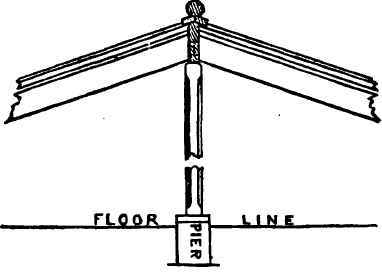
Fig. 137.
2. Our practice is, in every case, to plant the vines inside of the house, the foundation of which is built upon piers of brick (fig. 138), or upon posts, if the foundation: is to be of wood. The vines are thus allowed free access to the outside, and are better protected from sudden changes of temperature than if a portion of the cane is on the outside.
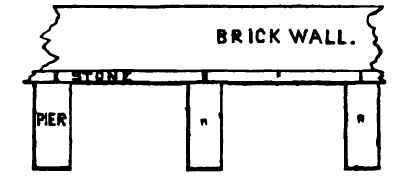
Fig. 138.
3. Iron for the roof of green-houses has not found much favor in this country, from the fact that our sudden changes of temperature create expansion and contraction of the metal to such an extent as to cause serious breakage of glass. Even in the milder climate of England this difficulty prevails. Of late years many devices have been put forth to obviate this difficulty, the best of which is the invention of Mr. Beard, for which he has secured a patent, which is illustrated in the London Florist and Pomologist, from which our cut is taken, one half of full size. (See fig. 139.) In this case the sash-bar is in two parts, the upper secured to the lower by means: of screws. A strip of asphalted felt on each side of the glass forms an elastic bed, separating it from contact with the iron. Large glass, twenty by thirty inches, is used; and when the angle of the house is greater than forty degrees, the glass is-' laid end to end. With a less angle the glass so laid we have found to drip badly at joints, from the moisture of the house, as well as to leak in violent, driving rainstorms. It is said by the inventor to be better in such cases to lap the glass. When the glass is lapped, the covering bars are made the same length as the glass.
If it is laid end to end, then two or three squares may be covered.
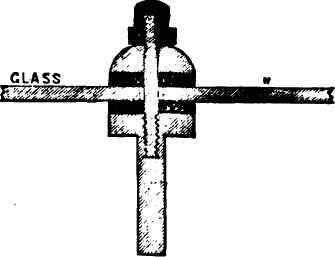
Fig. 139.
4. The flue system of heating is by far the most economical as regards the first outlay; and for small detached houses, a well-built flue, if carefully managed, is an efficient mode of heating; but for a larger class of houses the hot water has many and great advantages, among which may be mentioned less fuel, no dust, smoke, or gas in the house, no repairs for years, and the ability to equalize the heat throughout the house, as well as to heat two or more houses from one boiler.
Peolonia, Norfolk County, Va.
Messrs. G. E. & F. W. Woodward - Gents: As you requested, in answer to my last letter relative to my quarter-acre strawberry patch, I herein inclose you the result for this season.
My bed is now seven years old, and this season I shipped my berries myself to New York and Philadelphia. The fruit is finer and the vines were more productive than ever. Independent of what I have eaten, and we did not stint ourselves, I netted on the quarter acre $700. Some sold in your city, by my agent, at $1 50 per quart, per crate; and I sold some here at $2 per quart. The last of my berries sold in New York at fifty cents, when the best Jersey Seedlings were in opposition to them. I commenced picking on the 15th of May.
The demand for plants this season has induced me to let the vines run to suckers, or I should have had a chance to pick berries, as usual, until late in July. Northern visitors, and every trucker in this section, have looked in on these strawberries with an expression of the greatest astonishment; and in fact I have the Agriculturist, Jucunda, the Lorio, Prince's Welcome, Albany, and a number of others, all under the same treatment and condition, and they really fade into insignificance alongside of this Empress Eugenie, as to beauty, flavor, size, and adaptability for transportation.
Now, what do you think of seven-year-old strawberry beds ? I think I can keep this one in existence seven years longer, with the same results, if I had not allowed it to make runners.
If I were to tell you my plan of arranging the land to make so permanent a result, you would be astonished at its simplicity. But knowing how valuable an editor's time is, I do not desire to trespass upon your; patience, for fear it might no longer remain a virtue. Yours, most respectfully,
F. W. Lemosy.
Continue to:


My Books

