


Methods Of Medico-Mechanical Gymnastics. Part 3
Description
This section is from the book "Massage And Medical Gymnastics", by Emil A. G. Kleen. Also available from Amazon: Massage and medical gymnastics.
Methods Of Medico-Mechanical Gymnastics. Part 3
The other purpose of the lever is to fulfil the requirement just explained, i.e., that the resistance must be varied during the performance of the movement. This is made possible by the fact that the resistance of the weight to the raising of the lever (rotation round its horizontal axis) varies according to the inclination of the lever to the horizontal. If the lever hangs straight down, this resistance is nil; when the lever is turning upward this increases by degrees till it reaches its maximum, when the lever becomes horizontal; if the rotation is continued, it diminishes again, and again becomes nil when the lever points directly upward. If a lever with such a path of movement is applied to a resistance apparatus, the resistance from being nil at the beginning would slowly increase and be greatest in the middle of the exercise and then decrease, to become nil again at the end of the exercise. Such an arrangement is not to be found in connection with the Zander apparatus, as no gymnastic exercise requires resistance varying in this way. But the example serves to point out what possibility of variation the leverage arrangement offers; e.g., if I want resistance to be gradually decreased throughout the exercise, I let the lever lie horizontally at the beginning of the exercise, and from this position rise through a larger or smaller angle, according to the relation in which the resistance at the beginning should stand to the resistance at the end. If I want a resistance which increases somewhat at first and then diminishes, I begin with the lever pointing downward at an angle suitable to the conditions. And so on according to what is desired. One must remember that the total angle described by the lever during the performance of the movement does not correspond in extent with that described by the patient. By means of the shunting apparatus one can make any relationship between these two angles; in some apparatus the first is greater than the second, in others vice versa. The whole problem of construction is concentrated on these two points - the relation between the patients and the weight-lever's angle of movement and the angle of inclination at which the latter begins and ends the movement. The question with each apparatus is that these points should be most suitably arranged so as to obtain the best resistance, i.e., the resistance which seems most even and comfortable for the performance of the movement. Many prolonged experiments were required to obtain the definite results now shown in the apparatus.*

Fig. 148.
From the above description of resistance apparatus it follows that although the apparatus works by means of pressure in a definite direction, all movements consist of two phases - the first, positive or concentric, when the muscle shortens, overcoming the resistance of the apparatus; and the second, negative or eccentric, when the muscle lengthens, by degrees giving way to the pressure of the apparatus. As distinct from the manual method, where concentric movements in general are used much more than eccentric, these different forms of work are used methodically in the medico-mechanical apparatus to a precisely similar extent, i.e., continually alternating in every movement. If for any definite purpose it is required to use one form of work only, this may be done easily by an assistant grasping some of the movable parts of the apparatus and performing the opposite phase of movement instead of the patient.

Fig. 149.
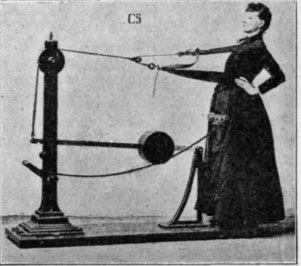
Fig. 150.
The forms of apparatus used by Zander for resistance exercises are the following: -
Al. Arm-lifting-outward.
A2. Arm-raising, Shoulder-lifting.
* I have gone somewhat deeply into these questions in order to make clear the difference between apparatus on the one hand specially constructed for medical gymnastics, and on the other hand a number of "gymnastic apparatus" of many kinds, more or less pretentious, which are to be obtained cheaply. Common to them is the fact that they more or less neglect the above requirements, which are rightly demanded of apparatus for medical gymnastics. They content themselves with obtaining a resistance which is nearly always based upon the use of elastic ropes, spiral springs, or such devices. All these arrangements have this fault, that the resistance throughout the movement perpetually increases, so that it is strongest at the end of the exercise, i.e., when the patient's power of work is least. That they can be used without discomfort by healthy persons to strengthen muscles and give exercise is undoubted. For real medical gymnastic purposes they should be discarded as not fulfilling the simplest requirements in this direction.
A3. Arm-downdrawing.
A4. Arm-stretching-upward.
A5. Arm-carrying-forward.
A6. Arm-carrying-backward (Arm-parting).
A8a. Arm-turning (rotation).
A9. Forearm-flexion.
A10. Forearm-extension.
All. Wrist-bending and -stretching.
A12. Finger-bending and -stretching.
Bl. Hip-flexion.
B2. Hip-stretching.
B3. Hip-updrawing.
B4. Hip-downpressing.
B5b. Crook-half-lying Leg-adduction.
B6. Leg-abduction.
B8. Leg-rotation.
B9. Knee-flexion.
BlO. Knee-extension.
B13. Foot-flexion, -extension, -inversion and -eversion.
Cl. Sitting Trunk-flexion.
C2. Sitting Back-raising.
C3. Long-sitting Trunk-flexion.
C4. Long-sitting Trunk-backward-falling.
C5. Lean-standing Back-raising.
C6. Trunk-side-flexion.
C7. Trunk-rotation.
C8. Pelvis-rotation.
C10. Neck-extension.
The accompanying illustrations will serve to indicate the nature of the apparatus: - A9 (Fig. 148), B9 (Fig. 149), C5 (Fig. 150) (see also Figs. 168 - 171).
Continue to:


My Books

