


Methods Of Medico-Mechanical Gymnastics. Part 4
Description
This section is from the book "Massage And Medical Gymnastics", by Emil A. G. Kleen. Also available from Amazon: Massage and medical gymnastics.
Methods Of Medico-Mechanical Gymnastics. Part 4
Pendulum Apparatus.
Pendulum movements are brought about by the patient himself performing the described movement, thus setting in motion the apparatus, of which the swinging part (balance-wheel or pendulum) continues the movement owing to its inertia and carries the patient's body with it in its motion. For the continuance of the movement only slight muscular exertion is required, a condition in which these movements differ from all other kinds of active movements. For this reason they are termed "momentarily active" instead of "continuously active" movements.
The movements are either circular (rolling), or in the form of a pendulum (flexion and extension). In both cases the original Zander apparatus is provided with a balance-wheel which continues the movement. Later apparatus (after Krukenberg's type) consists of a pendulum arrangement fixed to the above - mentioned resistance apparatus to allow of pendulum movements.
The apparatus constructed for this purpose alone are : -
A7a. Arm-rolling.
A7b. Hand-rolling.
A8b. Arm - alternate -turning.
B7. Cycling.
Bll. Foot-flexion and -extension.
B12. Foot-rolling.
Pendulum arrangements are constructed for the following apparatus: -
A9 and A10. Forearm-flexion and -extension. B9 and B10. Knee-flexion and -extension. B13. Foot-flexion, -extension, -inversion and -eversion. An illustration is given of B12 (Fig. 151).
Apparatus for Trunk Balancing Movements.
The patient places himself on an apparatus in a sitting position. The apparatus, driven by motor power, is set in motion, making the seat slope in different directions. The patient's pelvis takes part in the swaying movement, and in order to keep his position he is obliged to make a series of contractions in all the muscles of the trunk and pelvis, to balance the trunk on the pelvis. The muscle contractions are the active part of the exercise; the passive part are those movements which take place in the lumbar spine, and also a slight massage of the abdominal viscera.
The apparatus constructed for these exercises are three : -
Dl. Trunk-bending (forward, backward or laterally). D2. Stride-sitting Trunk-rolling.
D3. Ride-sitting Trunk-rolling. An illustration is given of D3 (Fig. 152).

Fig. 151.
2. Apparatus for Passive Movements.
Some of the apparatus mentioned in groups A, B, and C can be used for purely passive movements also. An assistant can set the apparatus in motion by using the weight lever or a specially-made handle attached to certain machines for the purpose; or when shortened ligaments and muscles have to be stretched the apparatus can be used to give constant pressure in a definite direction of movement by means of the loaded weight lever. If, for example, a bent knee has to be straightened, the patient is put into the apparatus for Knee-flexion (B9), and is told to slacken the flexors of the knee and to let the resistance weight press in the opposite direction, i.e., stretching the knee.

Fig. 152.

Fig. 153.
For a few special passive exercises there are specially-constructed apparatus, all of which except one (E4) are worked by motor power. E4 is worked by an assistant, or even by the patient himself with his free hand. The apparatus are : -
E2. Hand-alternate-flexion and -extension.
E3. Hand-abduction and -adduction.
E4. Hand and Finger-flexion and -extension.
E5. Leg-rolling.
E6. Chest-expansion.
E7. Trunk-rotation.
E8. Pelvis-raising.
Fig. 153 illustrates E6.
3. Apparatus for Massage Effects.
In close connection with movement proper in the Swedish system, the gymnast since Ling's day has used a series of procedures (hacking, vibration, kneading, etc.), which, though called by him passive movements, are not really movements in the technical sense of the term, but rather massage manipulations. In a gymnastic prescription they are often inserted here and there among the movements proper, as they are often quite as important as the latter.

Fig. 154.

Fig. 155.
The following apparatus have been constructed for such purposes, not actually to replace "manual" massage.
Fl. Vibratory Apparatus.
F2. Ride-shaking.
Gl. Trunk-hacking.
G3. Leg-hacking.
G4. Back and Arm-hacking.
G5. Head-hacking.
H1. Abdominal-kneading.
Jl. Arm-sawing (or rolling).
J2b. Finger-stroking.
J3. Leg-sawing (or rolling).
J4. Foot-stroking.
J5. Back-roll-stroking.
J6. Abdominal-circular-stroking.
We give the following illustrations : - Fl (Fig. 148), Gl (Fig. 155), Jl (Fig. 156), J6 (Fig. 157).
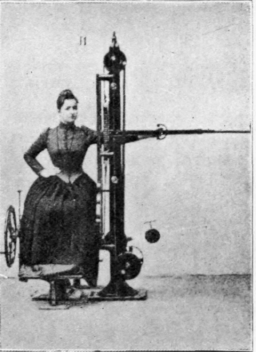
Fig. 156.

Fig. 157.
4. Orthopaedic Apparatus.
In the third division of this chapter an account is given of the orthopaedic apparatus, which is used solely for scoliosis treatment.
I have here given a short review of the medico-mechanical gymnastic apparatus. Its therapeutic use is founded on the same principles as all gymnastic treatment. The two subjects about to. be described, the Treatment of Heart Disease and Scoliosis, are probably the most important. The first may be treated briefly, since its principles and treatment are the same as those of the "manual" method which was described above; the second more in detail, since the mechanical method provides means of treatment to which nothing in the "manual" method corresponds.
Continue to:


My Books

