


Chapter XIX. Iron Drains - Continued
Description
This section is from the book "Plumbing Practice", by J. Wright Clarke. Also available from Amazon: Modern plumbing practice.
Chapter XIX. Iron Drains - Continued
Most of the soil pipes in first-class London houses are of lead. It is important that these lead pipes should be securely made good to the drains. This is sometimes done as shown in Figure 186, and it would scarcely be credited the numbers that are found to be made in this bungling way. Even when the socket of the drain is as it should be, it is often found that the joint is badly made, as shown in Figure 187, and a deposit of cement which has fallen through and set in a hard lump at A. An improved way is shown in section, Figure 188, where the lead pipe has a flange worked on its extremity, so as to fit tightly into the drain socket, thus insuring the bore of the pipes being perfectly straight. Sometimes putty or red-lead cement is used to bed the lead flange in the earthenware socket. This prevents the Portland cement, with which these joints are usually made, from running through into the drain, but it is not a good plan, as a part of the red-lead gets squeezed out, and projecting, as shown at B, causes an obstruction, and this evil is aggravated if the work has to stand some weeks before any discharges pass down to break it away before it sets so hard as to resist this action. The best way to make the connection is shown in section, Figure 189. In this case the soil pipe enters the drain pipe about an inch. A lead flange is soldered on the soil pipe to prevent its slipping down, as shown at C. A bed of common putty can be placed under this flange, and the part of the pipe telescoped into the drain will prevent this being squeezed out to form an obstruction, and the socket can then be filled in with Portland cement. Joints made in this way will withstand any hydraulic pressure not exceeding that to which the rest of the work may be subjected. This is a good way for connecting lead soil pipes with iron drains, but a lead joint is better than one made of Portland cement. Sometimes a lead pipe is joined to an iron pipe, as shown in Figure 190. Although this can be made perfectly tight, it is not so good as the next illustration, Figure 191. In Figure 190 the lead is flanged out and very much weakened, while in Figure 191 a flange is soldered on, and about an inch of lead telescoped into the iron pipe. The remarks on connecting lead and stoneware pipes also apply in this last case.
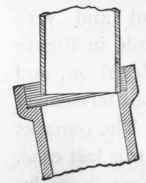
Figure 186.
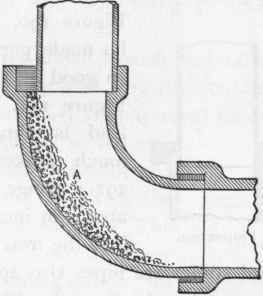
Figure 187.

Figure 188.
A great improvement has been made this last few years by soldering a harder metal, such as copper or brass, on to the lead pipe, so that an ordinary lead joint can be made to the iron.
Brass is not good for this, as the air in the drain causes a corrosive action. The same may be said of copper, but this is an open question. Copper pipes which have been fixed several years have been found to be in perfect condition, and although submitted to a severe test they showed no signs of any defects.
But where this metal has been used as part of a water-closet apparatus, and subjected to the action of urine on both sides, it has not been found to last long.

Figure 189.
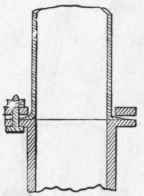
Figure 190.
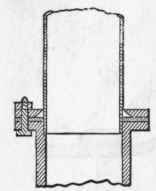
Figure 191.
The usual way of making the connection of lead soil pipe with iron drains is shown in section, Figure 192. The copper thimble is passed over the end of the lead pipe, which is then flanged over it at the end, and they are then soldered at D, as shown. The joint is then yarned and run with lead in the same manner as those on the iron pipe. By doing it in this way neither the copper thimble nor the lead joint are exposed to the action of either sewage or its gases. Sometimes the soldered joint is omitted, and instead of flanging the end of the lead pipe, it is entered into the iron in the same manner as shown in Figure 191, but as illustrated in Figure 192 is much better, as by no possibility can sewer-air pass out at D. There is less liability of a voltaic action being set up between the various metals used, as the lead only is exposed, the iron being protected by the coating applied to it.
In the late International Health Exhibition a specimen joint was shown for connecting lead with earthenware pipe. Figure 193 is a section. It was called an improved patent collar-joint. A is an earthenware collar, B is red-lead cement, C is a 1/4-inch wrought-iron nut and bolt, D is the flange of the lead pipe, E is Portland cement. The earthenware pipe, F, has a flange with corrugated surface, and is left unglazed for the cement to key to. There is no doubt that it is simple and easy of application, and could be made at a moderate cost, but it has several defects, which may be enumerated as follows: The lead flange is shown of the same thickness as the lead pipe, but in practice it will be found to get very much reduced in working or tafting it over. In the exhibited drawing the pipe was shown to be quite square at G, which is a source of weakness, and if the reader refers to what has been said further back, and then looks at Figure 193, he will see that there is nothing to prevent the red-lead cement squeezing out and projecting inside the pipes where they meet at H. Again, earthenware is too frail to stand the strain of being screwed together, even if the bolt-holes were made perfectly true so as to come opposite each other. When made the joint looks large and clumsy, and after all is not so strong and reliable as the one shown at Figure 189. Again, it can only be used in a horizontal position.

Figure 192.
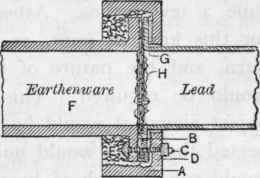
Figure 193.
While writing, the idea has suggested itself that a gland-joint would be very good for connecting a lead pipe to an iron drain, something as shown in section, Figure 194. By using this kind, any hot water passing down the vertical pipe causing it to expand, it would do so without hindrance, and in cooling would again shrink back to its original dimensions. Another reason could be given, - that if the building or wall, to which the pipe is fixed, were to settle downward, it would not affect the joint, or, if the ground in which the iron drain is laid was to sink a little, the joint would still be air and water-tight, provided the load pipe was telescoped into the iron pipe a few inches. Asbestos would be a good packing to use for this kind of joint, as it would not be so liable to perish as yarn, and the nature of this material is such that no lubricant would be required. This is an important point, as part of the object aimed at would be lost if the pipes were so secuiely connected that they would not freely slide, one inside the other, and would run the risk of breaking the weakest - the lead.
Soil pipes used to be generally fixed inside the house or building, but it is becoming more frequent nowadays with sanitary engineers to have them fixed on the external face of the wall, but there are numbers of cases where there is no available external wall-face, so that it is imperative that the soil pipes should be fixed inside. A great many people think that when the soil pipes and drains are fixed outside so much care need not be taken when making the joints, but no greater mistake could be made. Take the drains; if they leak the earth at first may act as a deodorizer, but a continual leaking will soon so saturate it with sewage that the house may be said to stand in a sewage-bog, and there is the further liability of this sewage soaking through the house-walls or passing beneath the footings, so as to render the earth beneath the basement floors in the same condition as that outside. A case occurred where the occupants of a house were very much troubled with smells. The whole of the drains were taken up and relaid, but before the people had been back more than a week or two they found that the smells were as bad as ever. The builder had to submit to a severe reprimand, and was threatened with an action at law. He pleaded that there was no defect in his work, and proved it to be sound by charging the drains with water and letting them stand several hours without showing any subsistence at the sight-holes. The idea that a cesspool might be buried somewhere next suggested itself, and the only way of finding this out was to excavate the whole of the basement. The result was that sewage was found to be oozing through the wall which separated the next house. On inquiring next door if they were troubled with smells, an indignant "No" was the answer, but the necessary pressure being brought to bear, the drains were examined and found to be completely choked up, and the whole of the earth beneath the basement floor was found to be so charged with sewage (in an abominable state of putrefaction) that it was passing through the party-wall into the next house. The writer has met with men who argued that in certain soils it is a good plan not to make the underside of a drain-joint so that any water in the soil would pass through the joint and run away down the drain, and who then gravely and deliberately proceed to put cement around the top and sides of the joints - for what reason the reader must find out for himself, as the writer cannot give any. An exception might be made when the drain passes away down a field to a cesspool or irrigation system, but in towns the rule should be laid down that all sewage-conduits should be perfectly water-tight.
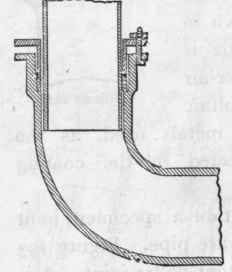
Figure 194.
Continue to:


My Books

