


Wash-Hand Basins. Part 3
Description
This section is from the book "Plumbing Practice", by J. Wright Clarke. Also available from Amazon: Modern plumbing practice.
Wash-Hand Basins. Part 3
When waste-valves are used for emptying the contents of a wash-hand basin, a grated connection should be made to fit the bottom, and should be fixed flush on the inside of the bowl. The grating should be a good size, and the water-way through the perforations should be slightly in excess of that of the waste pipe. That is, should 1 1/2-inch waste pipe be used, the number and size of holes in the grating should, in the aggregate, be equal to, or a little larger than, the pipe. When round basins are used, a vortex will form in the water as it runs away, but this does not take place to such an extent when oval basins are used. Instead of a grated connection, one similar to the section, Figure 291, is sometimes used. This does away with the grating, the holes in which are sometimes thought to be unsightly, but nothing else is gained. If the cap is raised so that there is a tree water-way around it, there is room for a small finger-ring to slip through.
"Tip-up" wash-hand basins are liked by some people, in spite of the outer receiver very often being offensive by reason of the soapy matter adhering to the inside. Great numbers of manufacturers make these basins, but the original inventor has patented an improvement by means of which the tipping basin can be lifted off the trunnions, and thus gives free access to the receiver for cleaning it. The receiver, also, has been improved by making a back outlet instead of the straight down. This gives more room beneath the wooden enclosure, and the water is not so liable to splash out of the receiver on to the dress of the user when the basin is tipped up. Figure 292 represents the tip-up basin with a back-outlet receiver. Pains should always be taken to make a tight joint between the slab and the rim of the receiver. I have found a piece of indiarubber tubing to make a good packing.
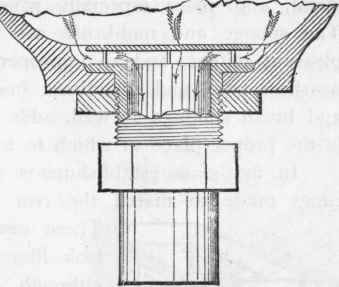
Figure 291.
Lavatories should not be fixed in bedrooms if it can be avoided. When of necessity they must be, great care should be taken in the selection of the basin and in every detail of waste pipe and trapping, so as to avoid any possibility of a smell escaping. There is very often a faint: odour near an ordinary wash-hand stand, and more especially when highly-scented soap is used. The sponge and nail-brush will retain soapy matter to an unpleasant extent, and an improperly fixed basin, with waste and overflow pipe, and sometimes from the waste pipes of the soap and brush sinkings as well, adds to the evil. The dressing-room is the proper place in which to fix the lavatory.
In first-class establishments the lavatory enclosure is sometimes made to match the rest of the furniture in the room.
These enclosures are generally made to look like a large piece of furniture, and although, perhaps, nice to look at, are very uncomfortable to use. The mistake is generally made of having the front out as far as the top, as shown by sketch, Figure 293. By cutting out a piece of the skirting or plinth, as shown by dotted lines, room is made for the toes, but the knees lodge against the front. A much better plan is to have a cornice beneath the nosing of the slab and the doors recessed a few inches, as shown by sketch, Figure 294. This gives room for the person to lean over the basin without making the back ache. The above evil is aggravated when the stand is too high, and the basin is placed too far from the front edge. The stand should not be more than 2 feet 6 inches high for persons of ordinary stature. If higher, water will be found to run off the user's elbows and drip on the floor. When the basin is too far from the front edge, the person has his whole weight thrown on the tips of his toes when washing, and runs the risk of tipping forward on to his face. It would be better if wash-hand basins could be fitted up without any enclosure, but there is often such a nest of pipes beneath that to all (excepting admirers of plumbers' work), they would appear unsightly. In some cases a small brass rail is fixed 1 or 2 inches away from the marble slab, to prevent the user's dress becoming wetted by contact with any water that may be near the front edge. This is shown in Figure 294, from A to B. Or, if the basin is used before dressing, a towel can be hung on this rail to keep the body from touching the cold marble.
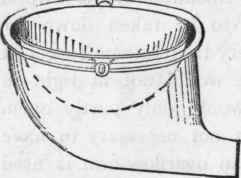
Figure 292.
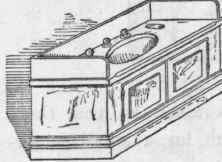
Figure 293.
Figure 295 is a neat enclosure for an oval basin with porcelain top. The cupboard door, A, being recessed, is a great advantage, and can be made much more cheaply than if it was rounded in the same manner as the front, at B. Some makers insert ornamental tiles in the panels of the doors, or have fancy designs painted on the woodwork.
Plumbers vary very much in their ideas as to the size of traps for wash-hand basins. Figure 296 is a view of one shown to the writer by a master plumber, who boasted that it was impossible to break the water-seal by syphonage.
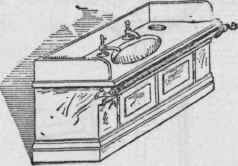
Figure 294.
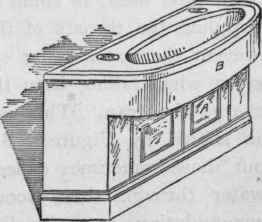
Figure 295.
Calculations based upon the measured dimensions show it held about two-and-a-half gallons. The basin was very small, only 12 inches diameter, and held just enough to stir up the contents of this small cesspool. A wooden stool had to be placed beneath this trap to keep the weight from pulling out the bottom of the basin. The inlet and outlet pipes were 1 inch in diameter. Traps should not be larger in diameter than the waste pipe and plug, but they should always have a good dip or water-seal. If a 1-inch or 1 1/2-inch round pipe trap is used, and made by the plumber, it should have a 4-inch to 6-inch water-seal, as shown by Figure 297. The reason such a deep seal is an advantage is because the trap being fixed above the floor is more likely to have the contents evaporate by exposure to the atmosphere. If made to the shape shown, and thick pipe used, it could be loaded with sand and bent without crippling the throats of the bends. The shape is also good to prevent the water being carried through the trap by the impetus given when falling from the basin so as not to leave enough to charge the trap. This is found to occur when traps are made as shown by Figure 298. All traps are liable to syphonage, but those sometimes called self-cleansing (that is, the passage of water through them scours the inside so as to prevent fur accumulating) are more liable to this than the box-shaped traps, hence the necessity of ventilation pipes.
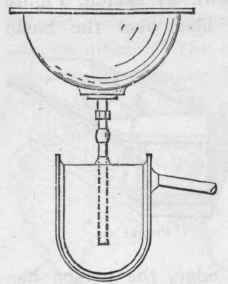
Figure 296.
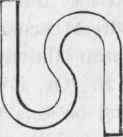
Figure 297.
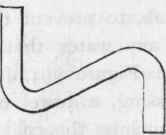
Figure 298.
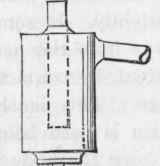
Figure 299.
Figure 299 represents a trap very often made by plumbers for fixing to wash-bowls. It is sometimes called a soap-trap, and there is a general impression that it will retain soapy matter from passing into and clogging the waste pipes. There is about as much sense in this argument as in that of the old lady living in a house in the north of London, who asked me to fix a grating in the trap of the water-closet to prevent the paper used from passing into the drains, as she was afraid a stoppage would occur.
Continue to:


My Books

