


VIII. Settees, Couches, And Sofas
Description
This section is from the book "Colonial Furniture In America", by Luke Vincent Lockwood. Also available from Amazon: Colonial Furniture In America.
VIII. Settees, Couches, And Sofas
THE words settee and sofa have often been used interchangeably, and there seems to have been no uniformity in their use, even among the cabinet-makers of the eighteenth century. For the purpose of this chapter we will call the pieces that do not have upholstered backs, more or less resembling chairs, settees; and those with upholstered backs, not suggestive of chair backs, sofas. It was the fashion throughout the late seventeenth and the entire eighteenth centuries to make settees to resemble two or more chair backs. They are commonly known as double chairs, triple chairs, etc., depending upon the number of chair backs they represent.
The settle seems to have been a direct evolution from the chest. W. H. Pollen, in his book on furniture, says: "As the tops of coffers served for seats, they began in the thirteenth century to be furnished with panelled backs and arms." At any rate, we find beautiful examples of carved settles in England, dating through the fifteenth and sixteenth centuries.
A glance at Figure 618 will clearly show how closely the settle resembles a chest. The lower part of this piece has all the characteristics of a chest, including the lifting top, and the three panels are carved in the same manner and design as are found in chests. The two end stiles are extended to support the arms, and the seat is panelled. The back is divided into three panels, as is the lower part, and the centre panel closely resembles that found below. The top of the back is finished in the fashion of the wainscot chairs, as are also the arms. Many familiar patterns are found in the carving on this settle, most of them of the early periods, as, for instance, the two centre panels and especially the two inside stiles on both top and bottom. The panelled seat suggests that the settle must have been used with a cushion. The piece seems to be made of American oak, and was found at Great Barrington, Massachusetts, where it had been used in a stable to hold salt for cattle. It dates in the latter half of the seventeenth century and is now in the Bulkeley Collection.

Figure 618. Carved Oak Settle, last half seventeenth century.

Figure 619. Pine Settle, first half eighteenth century.
Settles are mentioned in the inventories of this country from the very first. We find one mentioned in Boston, in 1643, and at Yorktown, in 1647, "1 long wainscol settle"; at Philadelphia, in 1706, "l settle 17s"; and again, in 1720, "1 long settle 14s"; and at Providence, in 1712, "1 settle 9s."
Such handsome settles as that shown in the last figure were extremely rare in this country, the settle commonly in use being similar to the one shown in Figure 619. It is made of pine, with high back, and the front extends nearly to the floor, thus forming an effective screen against the cold winter winds, for it was the custom to draw these settles up close to the large, open fire, usually in the kitchen, thus making a sort of little inner warm room. This settle is owned by the Misses Andrews, in whose family it has always been. These settles are sometimes furnished with a small shelf fastened in the centre of the back to hold a candle.
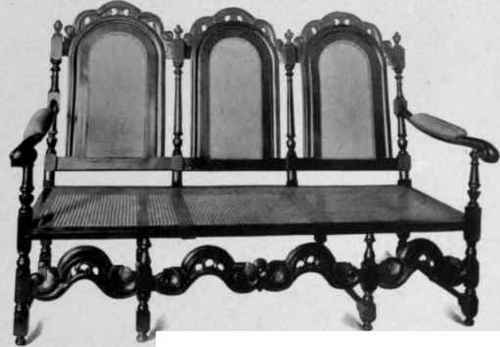
Figure 610. Cane Settle with three chair backs, about 1675.
Settles of this type were in use in this country for a long period, from the very earliest times down to about 1760, and were, many of them, more carefully made than Figure 619, being of oak and often panelled.
Figure 620 shows a triple chair of the cane period which belongs to the writer. It will be noticed that the two inside stiles of the back are set into the seat rail instead of carrying through to the floor, and that the inside rear legs are not placed under the stiles, the reason apparently being that if the stiles had carried through they would have weakened the seat rail. The trouble, however, with this form of construction is that the entire strain of the back falls upon the end stiles and the arms, which makes the piece rather fragile. The legs arc turned, with carved front stretchers, and in the middle the design is double. The piece was intended to be used with a cushion.
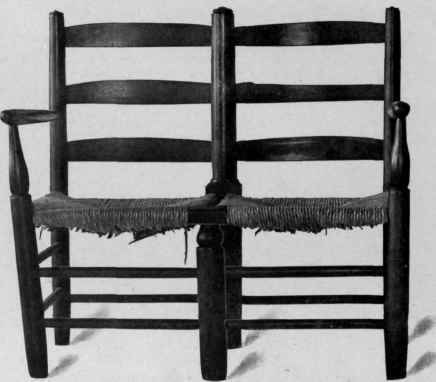
Figure 621. Wagon Chair, first half eighteenth century.
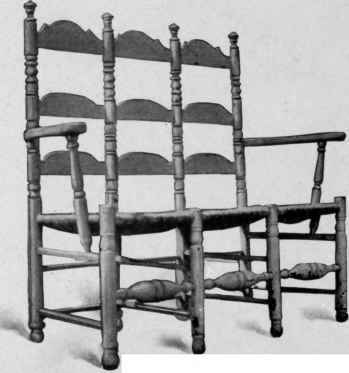
Figure 622. Turned Slat-Back Settle with three chair backs, 1725-50.
Figure 621 shows a small double chair of the slat-back variety, the property of Mr. Dwight Blaney. Such pieces are called wagon chairs, because they were intended to be placed in the farm wagons to furnish seats when the wagon was to be used as a carriage. Such pieces are fairly common throughout the country places and were probably used through a long period, the earlier ones having large turnings in the usual manner. The outer legs are often notched with a flat outer surface so that they will fit into the sides of the wagon.
Figure 622 is a very unusual example of a triple-back chair of the slat-back variety which belonged to the late Mrs. Frank H. Bosworth. It is the only one of the kind which has come under the writer's observation. The backs and set-back arms are similar to those shown in the rocking-chairs (Figure 425). The seat is of rush and the front stretchers are large and bulbous turned.
Continue to:


My Books

