


VIII. Settees, Couches, And Sofas. Continued
Description
This section is from the book "Colonial Furniture In America", by Luke Vincent Lockwood. Also available from Amazon: Colonial Furniture In America.
VIII. Settees, Couches, And Sofas. Continued
Figure 623 shows a double chair in the plain Dutch style, having all the characteristics of a chair of the same period. The lines are all softened into cyma curves, which gives the piece a very graceful appearance, although unrelieved with carving, except on the knees, upon each of which is carved a shell pattern. This double chair is in the Pendleton Collection, owned by the Rhode Island School of Design.
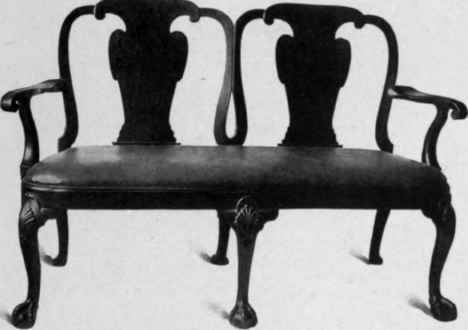
Figure 623. Settee with double chair back in Dutch style, first quarter eighteenth century.
Figure 624 shows another settee, or double chair, of the Dutch period, in which the outline is very similar to that shown in the preceding figure except that the surfaces of the splat are ornamented with carving. The centre of the top rail of the back is depressed instead of raised and is carved in a shell pattern with foliated streamers. On the edges of the splat are carved foliated scrolls, and at the centre is an oval piercing which forms the centre of a cartouche, on each side of which is a bird, with beaks coming together at the centre of the top, and above their heads are carved acanthus-leaf scrolls. Below are cords and two tassels. The arms are in the usual form found in this style, making a continuous curve with their supports instead of, as in the last figure, ending in a scroll extending beyond the supports. The front legs are cabriole, terminating in bird's claw and ball feet, and on the knees are carved shells with pendent flowers, and a C scroll finishes the outer edges of the knees. This piece is the property of the Metropolitan Museum of Art.
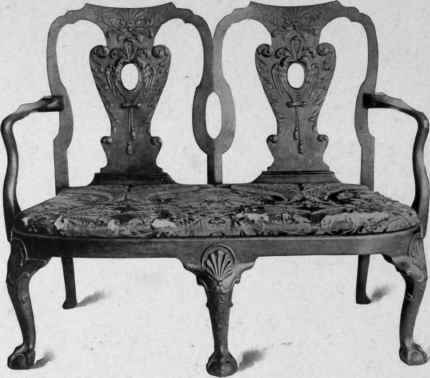
Figure 624. Settee with double chair back in Dutch style, about 1725.
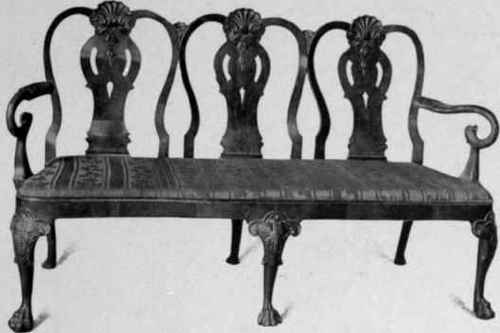
Figure 625. Settee with three chair backs, Dutch style, 1725-50.
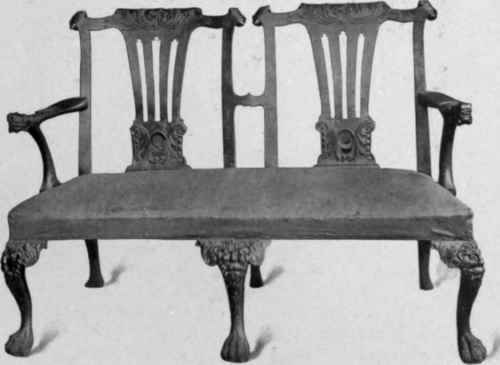
Figure 626. Settee with two chair backs, Chippendale style, 1750-60.
Figure 625 shows a settee with three backs, of the same general style, the property of Mr. John J. Gilbert, of Baltimore. At the centre of each back is carved a shell with pendent flowers extending down onto the splats, which are otherwise plain except for piercings. Between each back is a carved flower. The arms are scrolled, terminating in birds' heads, which was a design popular in the period. The legs are cabriole, terminating in animal's claw and ball feet, and on the knees are carved acanthus leaves with a vertical pearl beading through the centre. This piece, as is usual in the period, is made of walnut.
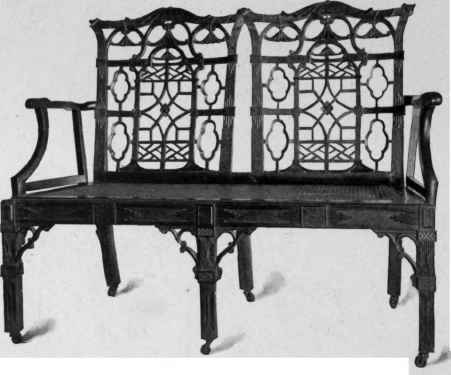
Figure 627. Settee with two chair backs, in Chinese taste, 1750-60.
Figure 626 is a very beautiful example of a double chair of the Chippendale period. The backs are separate except for a binding band of wood. The outer ends of the crestings are scrolled and the centre is carved in acanthus-leaf designs. The lower part of the splats are carved with foliated scrolls. The arms terminate in dragons' heads. The legs are cabriole, each terminating in an animal's claw grasping a ball, and on the knees are carved mascarons. This settee belongs to the American Antiquarian Society, of Worcester, Massachusetts.
Many settees having two or more backs arc found in Chippendale style, and yet there is not a single example of one in his book.
Figure 627 shows a settee with two backs, in Chippendale style, showing the Chinese taste, which is at the Ladd house, Portsmouth, and is part of the same set as is the chair shown in Figure 572. The two backs are identical in every way with the back of the arm-chair, but the fretwork under the arms is missing.
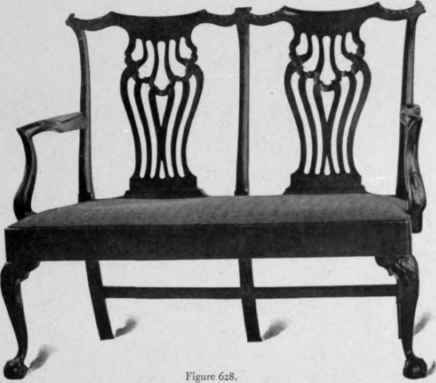
Settee with two chair backs, Chippendale style, third quarter eighteenth century.
Figure 628 shows another example of a Chippendale double chair belonging to Mr. H. W. Erving. A single stile separates the two splats, which are elaborately pierced in a rather late Chippendale design. There are but two front legs, which are cabriole, each terminating in the bird's claw and ball foot. All of the stiles of the back carry through to the floor, forming three legs strengthened by a stretcher.
Figure 629 shows another settee with two chair backs, in the Chippendale style, the property of Mr. Dwight M. Prouty, of Boston. This settee is small and very attractive. An unusual feature of the piece is that there is no stile separating the two splats, it being probably omitted in order to make the piece a little smaller. The splat is cut in a form suggestive of the Gothic. The arms are of the usual type and the legs are cabriole, terminating in Dutch feet. The only carving on the piece is on the knees in a crude acanthus-leaf design. This settee was probably made in this country.
Figure 630 is a particularly interesting example of a four-back settee which was made in the vicinity of Hartford, Connecticut, and belongs to Mr. H. W. Erving. The cabinet-maker had apparently seen a four-back settee, but, not having the model before him, built this from memory. He apparently forgot that each chair back should have its own cresting, and instead he has made a single, very much elongated, cresting to cover all. The splats are cut in charming designs, but the heavy cresting rather detracts from the symmetry of the piece. There are five straight legs front and back, each underbraced in the manner of the chairs of the period.
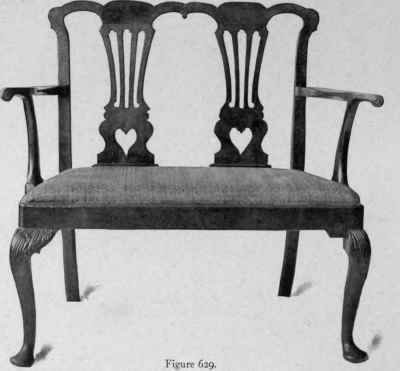
Settee with two chair backs, Chippendale style, third quarter eighteenth century.
Figure 631 shows a double chair, in the Chippendale style, quite different from the foregoing. The backs are filled in with lattice-work, at each crossing of which is carved a piece of wood which appears to bind the sections. Beneath the arms are simple lattices. The front rail is beautifully carved in a fine Gothic design, and a simple fret is carved on the surface of the front legs. There are but four legs underbraced as a chair. The settee belongs to Mr. H. W. Erving.
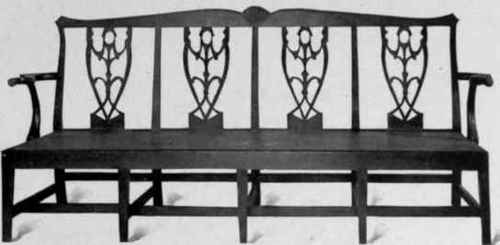
Figure 630. Settee with four chair backs, Chippendale style, 1770-80.
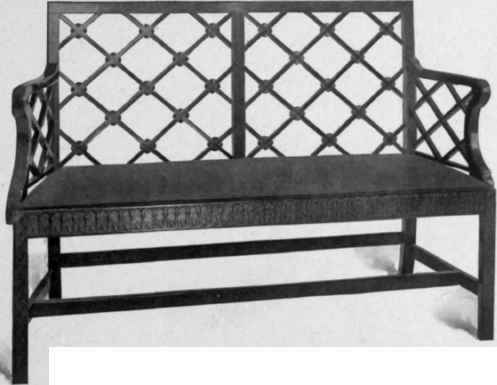
Figure 631. Settee in Chippendale style with two chair backs, 1760-80.
Figure 632 shows a very interesting triple-back settee in the design of a ladder-back chair. The stiles joining the inside back are pierced, giving the effect of separate stiles for each back. The cresting is complete only on the two ends. The legs are straight, with double ogee and bead mouldings, and there are pierced brackets where the legs join the seat rail. The arms have a slight acanthus-leaf carving. This settee is the property of Mr. A. C. Hencken, of Greenwich, Connecticut.
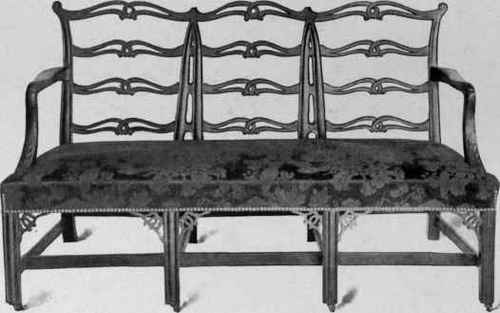
Figure 632. Settee with three ladder-back chair backs, about 1770.
Figure 633 shows a settee with two chair backs, in the transition style, between the Chippendale and the Hepplewhite, Shearer, and Sheraton schools. The upper rails of the chair backs are shield-shaped, and at the centre of each is carved an anthemion with pendent flowers extending down on the centre section of the splat, and on either side of this ornament on the top rail are bell flowers. The surfaces of the stiles are moulded. The splat is cut with four piercings which appear to be bound at the centre. The rails of the seat and the legs are plain and the piece is underbraced in the usual manner of this period. This settee is the property of Mr. H. W. Erving.
A settee with three backs, in Hepplewhite style, the property of Mr. William W. Smith, of Hartford, is shown in Figure 634. The backs are shield-shaped, and at the centre of the top of each are carved heads of wheat with pendent flowers.
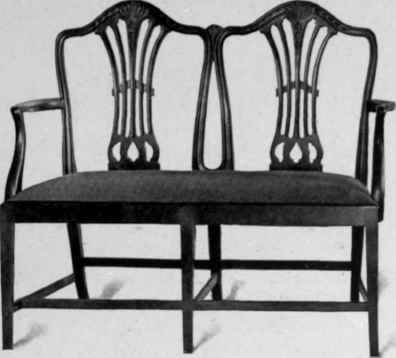
Figure 633. Settee with two chair hacks, transition style, 1775-85.
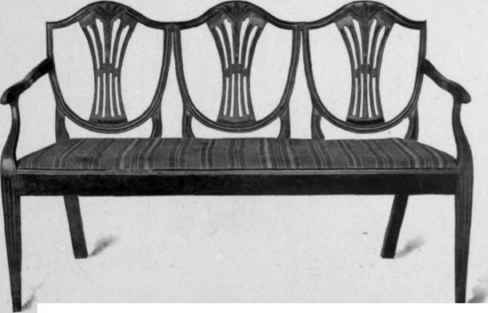
Figure 634. Settee with three chair hacks, Hepplewhite style, 1785-95.
The splats are in very much the same shape as shown in the preceding figure, with four piercings bound together at the centre. The front rail is plain and the legs are tapering and fluted.
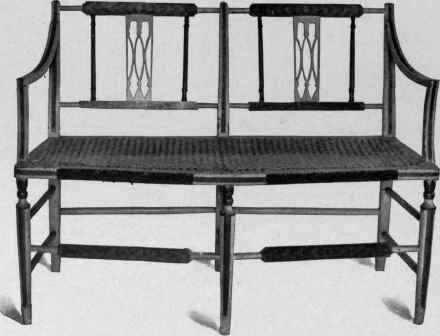
Figure 635. Settee with two chair backs, Sheraton style, about 1800.
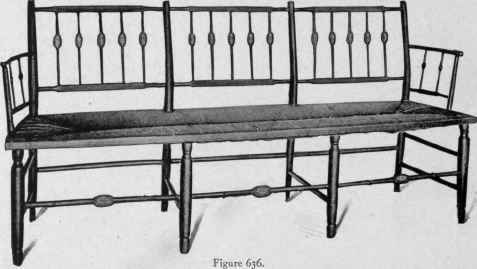
Settee with three chair backs, Sheraton style, 1800-20.
Figure 635 shows a double chair in Sheraton style which belongs to the set of which the chair is shown in Figure 604. It was originally decorated like the chair in red lacquer and gilt, but at a subsequent date the piece was painted white and stencilled. It is the property of Professor Barrett Wendell.
Figure 636 shows a triple chair in what is called American Sheraton design. It is plain black, and the stretchers, splats, and frame are enlivened with flowers in gilt, a few of which may be seen in the illustration. The same design of spindles appears under the arms as in the splat, and the front stretchers are cut in the same form.
Continue to:


My Books

