


The Period Of The Cabinet-Makers, 1750-1840. Part 10
Description
This section is from the book "Colonial Furniture In America", by Luke Vincent Lockwood. Also available from Amazon: Colonial Furniture In America.
The Period Of The Cabinet-Makers, 1750-1840. Part 10
Figures 605 and 606 show two simple forms of Sheraton chairs. The first has three spindles swelling and split at the centre with carved rosettes, and the other has three carved braces with a medallion at the crossings. The decoration on these chairs is painted.
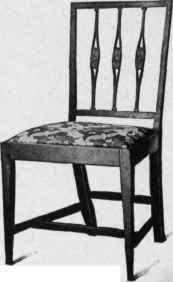
Figure 605. Painted Chair in Sheraton style, about 1800.
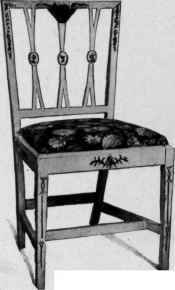
Figure 606. Painted Chair in Sheraton style, about 1800.

Red Lacquer Chair in Sheraton style, about 1800.

Figure 607. Upholstered Chair in Sheraton style, 1790-1800.
Figure 607 shows an upholstered chair in this style. The frame throughout is finished with a pearl beading and at each corner is a well-carved rosette. The supports to the arm are carved and spirally twisted. The legs are round and fluted with acanthus-leaf carving above. This chair is the property of the Metropolitan Museum of Art.
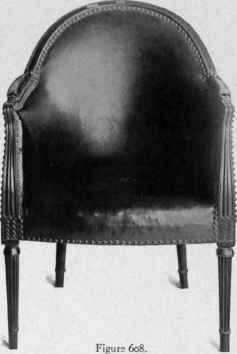
Another Sheraton upholstered chair is shown in Figure 608. The back is rounded, the arms forming part of the back. The supports for the arms are moulded and there is a slight leaf carving where they join; the legs, which are round, are reeded. This chair is the property of the Tiffany Studios.
Figure 609 shows a tall-backed upholstered chair of the period which resembles the easy-chair, except that it has low wooden arms instead of wings. The supports for the arms are raked in a curve and moulded. The legs are straight and plain. This chair is the property of Mr. Dwight Blaney.
A late form of Sheraton painted chair is shown in Figure 610 and is a design often found in this country. The rails of the back are painted, and between them are three groups of spindles consisting of four at the centre and three at either side. The front stretcher on the arm-chair is broadened at the centre and painted in a floral design.
Upholstered Chair in Sheraton style, 1790-1800.

Figure 609. Upholstered Chair in Sheraton style, 1790-1800.
The chair shown in Figure 611 is one of the later Sheraton designs in what is called the Empire style. The seat and the back appear to sweep forward in a curve to form the seat rail, and the back is curved backward in the Egyptian style. The legs are an extension of the supports of the arms and are slightly cabriole. This chair is the property of the Tiffany Studios.
A very ornate chair in the Sheraton Empire style is shown in Figure 612. The back is suggestive of the roundabout style. The supports for the arms are beautifully carved swans standing on cornucopias full of fruit, at which they are pecking, and these stand on a pedestal decorated in the anthemion pattern. The splat, which does not show, is carved to represent Roman arms, banners, and fasces. The front rail is carved in a design which alternates acanthus and anthemion designs, and above the legs is a small panel carved to represent armour and arms. The legs are cabriole, in the Egyptian pattern, ending in griffin's feet, and on the knees are carved the anthemion pattern. Of course, no such ornate chair was probably found in this country, but such designs are found in the third edition of Sheraton's book, and it is thought well, therefore, to show an example. The carving is of the highest order and of the cameo type. This chair is the property of the Metropolitan Museum of Art.
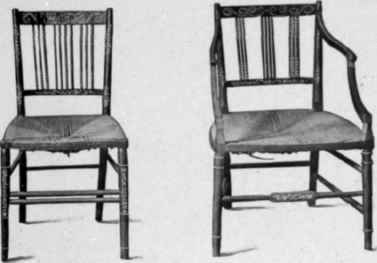
Figure 610. Painted Chairs in Sheraton style, about 1800.
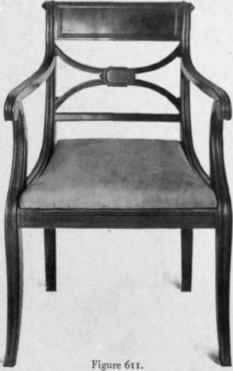
Chair in Sheraton style, 1800-10.
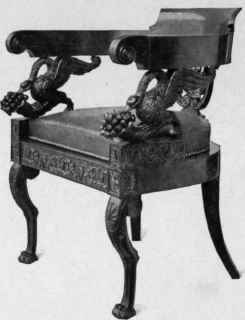
Figure 612. Carved Chair in Sheraton style, 1800-10.
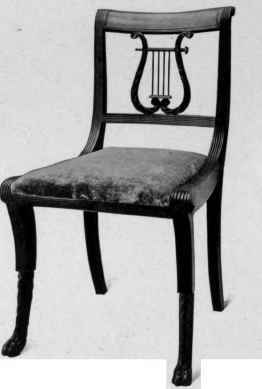
Figure 613. Chair in Phyfe style, 1810-20.
One of the best known of the New York cabinet-makers was Duncan Phyfe, whose shop was at 35 Partition (now Fulton) Street, New York. He made a specialty of the late Empire style, never carried it to excess, and showed a delicacy and refinement of the design which was highly commendable. His workmanship was of the best and his pieces are highly prized.
Figure 613 shows a side chair made by Phyfe. The back, it will be seen, is curved backward in the Empire fashion and the stiles seem to form a part of the seat rails. The surfaces are reeded in the manner he mostly employed. The legs are slightly curved and the lower half of each is carved with a lion's leg and daw. The swplat is .a lyre with acanthus-leaf carving on the scrolls, and there are four strings to the lyre. This chair is the property of Mr. R. T. Haines Halscy, of New York.
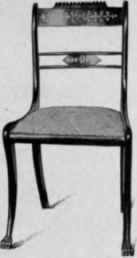
Figure 614. Chair in late Sheraton style, 1810-20.
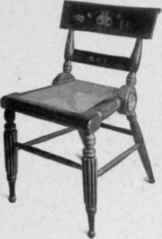
Figure 615. Painted Chair, 1810-25.
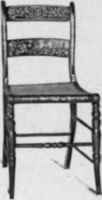
Figure 616. Empire Chair, 1825-30.
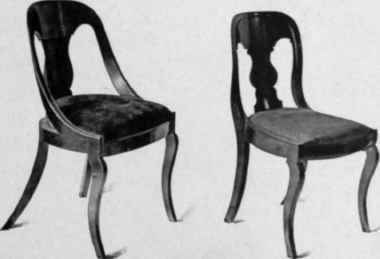
Figure 617. Empire Chairs, about 1840.
Another chair quite suggestive of phyfe, although much inferior to his work, is shown in Figure 614. The ornamentation is of inlaid brass, and lion's feet finish the legs.
Figure 615 shows a painted variety of the Empire chair such as is quite commonly found in the South. The back and rear legs are raked and are joined to resemble the folding bronze chairs found in Egypt. A brass rosette finishes the imitation hinge. The front legs are heavily fluted. This chair is painted with flowers and gold scrolls and the seat is of cane.
Figure 616 shows the late Empire style as it became modified in this country. The Sheraton influence is seen in the painted lyre on the back. The slat is also painted in fruit designs.
Figure 617 shows two styles of the parlour chairs of our grandmothers' day, which remained in style up to, and indeed later than, 1840. The one to the right has the back and legs made of the same piece, while the other shows a construction where the legs are made separate from the back. The former method of construction makes a stronger and more desirable chair. They clearly have the Empire pieces as their model, and it is amusing to see how the "antique dealers" are to-day advertising such pieces as colonial when they were new within the memory of some of the readers.
Continue to:


My Books

