


Easy-Chairs
Description
This section is from the book "Colonial Furniture In America", by Luke Vincent Lockwood. Also available from Amazon: Colonial Furniture In America.
Easy-Chairs
Not all of the chairs of the early eighteenth century were as straight and austere as those above sho wn. The records make frequent mention of easy-chairs. This form of chair had a high back and wings extending into the arms, low seat, and was heavily cushioned and upholstered. In the. inventories they were valued much higher than other chairs, probably because of the fabric with which they were covered, which at this period was always imported. Most of these easy-chairs are of the period now under discussion. It is, therefore, thought well to insert the illustrations of all of the types here, so that they may be studied together, rather than scatter them through the chapter in their chronological order. They appear in the inventories among the chamber furniture; in New York, 1708, "An easy chair lined with red, £2. 10s."; in Boston, 1712, "an easy chair £1"; in 1713, another for £4; at Philadelphia, in 1720, "an easie chair £7. 10s."
The earliest form of easy-chair belonged to the cane period. It was upholstered and the legs and underbracing were carved in the manner of the cane chairs. None of these pieces have been found in this country, and it is probable that the transition piece shown in Figure 507 is the earliest form here. There were two forms of the earlier type of this chair, one in which the front of the arms are finished in scrolls, as in this piece, and the other in which the front of the arms are straight (See Figure 508.) In these types the arms extend only to the wings, never through to the back, the latter being the distinctive feature of the Hepplewhite form. (See Figure 507, it will be seen, has the earliest form of arms with the scroll finish. The legs are turned and the piece not only has the side, back, and centre stretchers, but also one across the front, which indicates an early date, for the front turned stretcher is a survival of the carved stretcher of the former period. This piece is the property of Mr. Hollis French, of Boston.
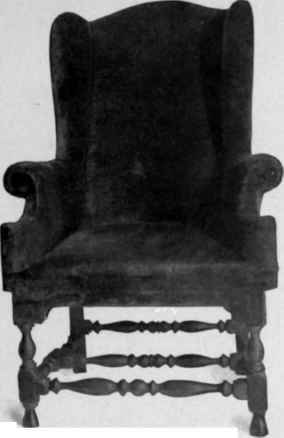
Figure 507. Turned Easy-Chair, 1700-10.
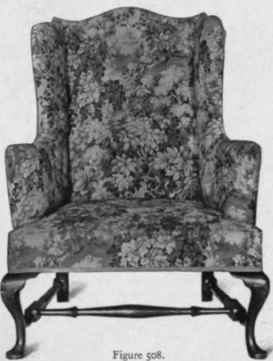
Easy-Chair, about 1725.
Figure 508 shows an easy-chair with the second type of arm. The seat is much wider, probably due to the change of fashion of dress. The legs are cabriole, terminating in Dutch feet, and side, back, and centre stretchers strengthen the piece. The rear legs between the stretchers are chamfered in the early manner. This chair is the property of the writer.
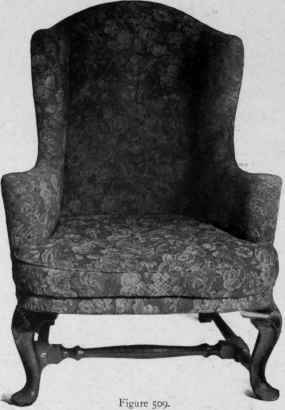
Figure 509 shows another chair with the second type of arm. It has a rounding seat with a cushion, and bandy legs terminating in Dutch feet; on each knee is carved a shell with a pendent flower, and the piece is underbraced in the manner shown in the preceding figure. This chair is the property of Mr. H. W. Erving, of Hartford.
Figure 510 shows an easy-chair, the property of the writer, which has the earlier form of arms; the legs are cabriole, terminating in grooved Dutch feet.
Easy-Chair, 1725-50.
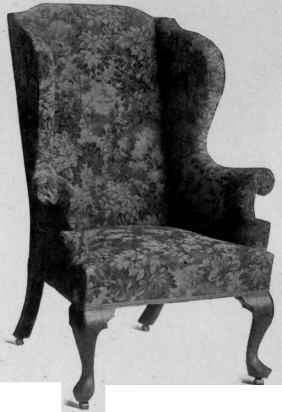
Figure 510. Easy-Chair, 1725-50.
Although this form of arm is early, yet rarely are the legs on these pieces strengthened by stretchers.
Figure 511 shows another easy-chair of this same type in the rough. The seat should be finished with a cushion. The legs are cabriole, terminating in bird's claw and ball feet, and the knees are plain.
Figure 512 shows an easy-chair with the early form of arms. The legs are cabriole, terminating in bird's claw and ball feet, and on the knees are well-carved shells with pendent flowers. This piece is the property of Mr. John H. Buck, of Hartford.
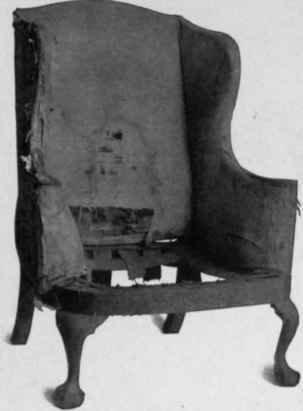
Figure 511. Easy-Chair, 1725-50.
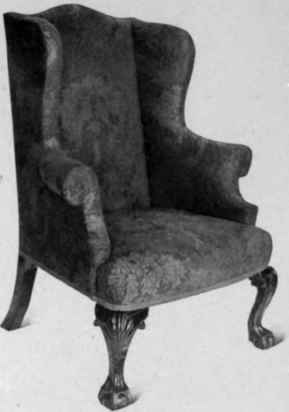
Figure 512. Easy-Chair, 1725-50.
Figure 513 shows a rather late variety of an easy-chair with the early form of arms, and it represents the perfection of the style. A characteristic of this type is that the seat is built on a curve with a separate cushion, and the legs are set nearer together and not on the corners as in those above shown. The legs are cabriole, terminating in bird's claw and ball feet, and on the knees are carved acanthus leaves and flowers extending well down the legs. This chair is the property of the writer.
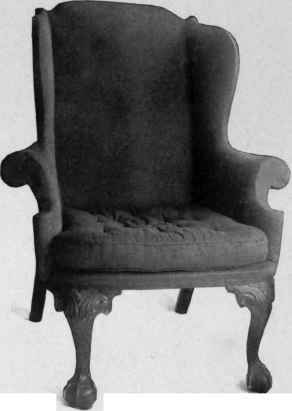
Figure 513. Easy-Chair, third quarter eighteenth century.

Easy-Chair, last quarter eighteenth century.
Figure 514 shows an easy-chair in Hepplewhite style. The distinguishing features are the large wings, which are higher than the back, and rest on the arms which carry through to the back. The legs are straight and underbraced, after the manner of the chairs of the later period. The seat, although straight, has a cushion. This chair is the property of the writer.
In Figure 515 we find a very unusual easy-chair in the late Empire style. The arms are scrolls and carved with rosettes and acanthus leaves, similar to the sofas of the period, and carry through to the back, while the wings rest on the outer edge. On the rail above the legs are carved rosettes, and the legs terminate in claw feet with heavy carved acanthus leaves on the knees. T his is the only easy-chair of so late a period that has come under the writer's observation. It is the property of Mr. C. R. Morson, of Brooklyn.
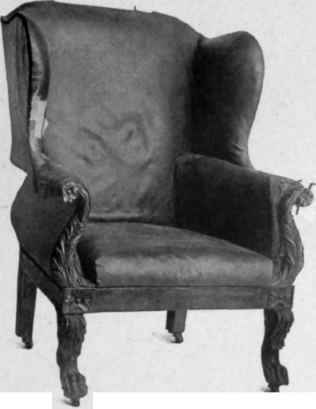
Figure 515. Easy-Chair, Empire period, first quarter nineteenth century.
Continue to:


My Books

