


Sofas
Description
This section is from the book "Colonial Furniture In America", by Luke Vincent Lockwood. Also available from Amazon: Colonial Furniture In America.
Sofas
We now come to the discussion of the sofa, which, according to our definition, differs from the settee in that it is upholstered and does not closely follow the design of a chair back. Such pieces are found in every style from the middle of the seventeenth century to and including the Empire style of 1820. In the Dutch period the sofa was often an enlarged arm-chair and was called a love seat, undoubtedly because it would fairly seat but two persons. In Chippendale's first edition of the "Director" he gives but two examples of sofas, and they are in Chinese style, but in his third edition there are found several.
Figure 653 shows an example of a settee, or sofa, of the turned period preceding the Restoration. The legs and stretchers are turned in the knob design. The seat and back are covered with Turkey work. The nature of this upholstery is discussed in Chapter VII. This piece is the property of the Essex Institute, at Salem.
Figure 654 shows a sofa, in the transition style, which belongs to Miss Jessie T. McClellan, of Woodstock, Connecticut. The end legs are straight and the two inside legs are slightly cabriole, terminating in crude Spanish feet. The legs are braced with turned stretchers, connecting the front and back legs, joined at the centre by stretchers running the length of the piece in the manner of the period.
Figure 655 is a sofa preserved at Independence Hall, Philadelphia, and at one time the property of George Washington. It will be interesting to compare this piece with the easy-chair shown in Figure 513. It will be seen that the arms and back are in the same design, but the feet of this piece have the animal's claw instead of the bird's claw. The rear legs are slightly cabriole. The knees are carved in an acanthus-leaf design and C scrolls. The sofa is now covered with hair-cloth, which is probably not the original covering. Sofas of similar design but with straight feet are frequently found and are of a little later date.

Figure 653. Turned Sofa upholstered in Turkey work, about 1660.
A very beautiful sofa in the Pendleton Collection, owned by the Rhode Island School of Design, is shown in Figure 656. The entire back is carved in a series of simple and ogee curves, and at the centre is a shell pattern with flowers and leaves above. At the centre of each side of the top and on the two ends the scrolls are finished with an acanthus-leaf carving. The arms twist outward and are finished in large scrolls with carved surfaces. There are five cabriole legs on the front, terminating in bird's claw and ball feet, and the skirt is so cut that between each two legs on the upper section is a simple serpentine curve and on the lower surface two ogee curves separated by a short serpentine curve. This sofa has many of the characteristics of an early date, but the shell carving at the centre of the top indicates that it belongs to the Chippendale period.

Sofa, about 1700.
Figure 657 shows a very interesting sofa, in Chippendale style, which was found in a farm-house on Long Island and now belongs to Mr. E. B. Willets, of Brooklyn. The cresting is covered with carving in the design of foliated scrolls and shells. The frame of the back is carved in waving lines, and at either end above the arms are small upholstered wings. The arms are well shaped and ornamented with acanthus-leaf carving. The four front legs are cabriole, terminating in bird's claw and ball feet, and on the knees are carved conventionalised shells.

Figure 655. Sofa, Chippendale style, 1760-80.

Figure 656. Sofa, Chippendale style, third quarter eighteenth century.

Sofa, Chippendale style, third quarter eighteenth century.
The skirt is of wood cut in a series of cyma curves with the surfaces carved in a shell design with streamers. The upholstering is shaped to the skirt. It seems quite probable from the nature of the carving and the construction that the piece is of American origin.

Figure 658. Upholstered Sofa, 1770-80.
Figure 658 shows an interesting example of an unusually long sofa. The back is shaped to suggest four chair backs but is entirely covered with upholstery. The skirt is cut in cyma curves. The five front legs are in cabriole form, each standing on a small ball, and are braced with turned stretchers connecting the front and back legs, joined at the centres by stretchers running the length of the piece. The sofa once belonged to John Hancock, and is now at Pilgrim Hall, Plymouth.
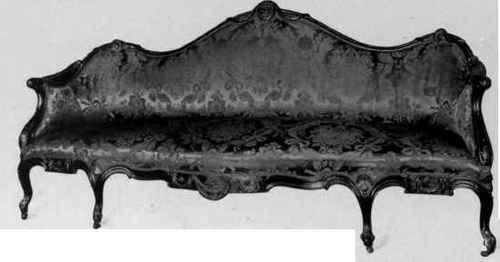
Figure 659. Sofa, Sheraton style, about 1785.
Figure 659 showi a sofa in Sheraton style, the property of Mr. Marsden J. Perry, of Providence. It is unusual to find a Sheraton piece with cabriole legs, but the form of this piece was apparently influenced by the Louis XVI school. The back is in the form of a serpentine curve, and at the centre is an oval in which is carved a sheaf of wheat with streamers of leaves, and at either end of the back are small rosettes in which are carved anthemions. The entire top rail is beautifully carved, except at the ends, which are upholstered. There are four cabriole legs in the front terminating in French scroll feet. At the centre is a basket of flowers with wreaths, festoons, ribbons, and medallions, and a similar design is between the two outer legs. Above each leg is carved an anthemion with pendent flowers.
Continue to:


My Books

