


Couches. Continued
Description
This section is from the book "Colonial Furniture In America", by Luke Vincent Lockwood. Also available from Amazon: Colonial Furniture In America.
Couches. Continued
Figure 644 shows a couch, in the pure Dutch style, with six cabriole legs terminating in club feet. The back stiles are cut in the characteristic cyma curves. The couch is underbraced with turned stretchers connecting the legs from side to side and connecting the centre of the cross-stretcher. The couch is the property of Mr. Dwight Blaney, of Boston.
Figure 645 shows another couch very similar to the preceding one, except that the back is in the Chippendale instead of Dutch form. The legs are cabriole, terminating in club feet raised on a shoe. The couch is underbraced in the manner described in the preceding figure, and the seat is of canvas fastened in the manner described in Figure 643. The skirt is cut in cyma curves. The stiles rake backward and are very heavy, to withstand the strain of the swinging back. The couch is the property of the writer.

Figure 644. Cabriole-Legged Couch, Dutch style, 1725-50.

Figure 645. Cabriole-Legged Couch, Chippendale style, about 1750.
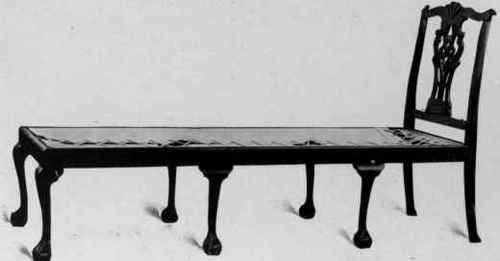
Figure 646. Ball-and-Claw-Foot Couch, Chippendale style, 1750-60.

Figure 647. Couch, Chippendale style, 1760-70.
Figure 646 shows .1 form of couch, in the Chippendale style, which belongs to Mr. H. W. Erving. The legs are cabriole, terminating in bird's claw and ball feet, but without any underbracing. The back is stationary and cannot be swung back. The canvas seat is fastened in the manner already described.
Figure 647 shows another couch with a back, in the Chippendale style. The splat is cut in Gothic form, and one of the most popular in the period. About the lower edge of the skirt is a carved godrooned moulding, and the piece stands on six straight legs, with a stretcher between each pair of legs and two X stretchers. This method of underbracing is uncommon. This settee is in the Bolles Collection, owned by the Metropolitan Museum of Art.

Figure 648. "Duchesse," Chippendale style, about 1760.
Another form of couch known as a "duchesse" is occasionally found in England. These are composed of two bergeres and a stool which when placed together form a couch. The writer has never seen an American one.
Figure 648 shows an exceptionally fine specimen of a "duchesse," which is the property of Mr. Marsden J. Perry, of Providence. The upper end is a high-back bergere with four beautifully shaped cabriole legs with carved knees and bird's claw and ball feet. The stool is in the same design, and at the lower end is a low-back bergere. The pieces lock together with metal clamps.
There do not seem to have been any couches made after the Chippendale period which followed the design of chairs, probably because the chairs of the Hepplewhite and Sheraton designs were not strong enough to withstand the strain. Upholstered couches, however, came into fashion in England, but very few are found in this country until the Empire period.
Couch, Chippendale period, 1770-80.
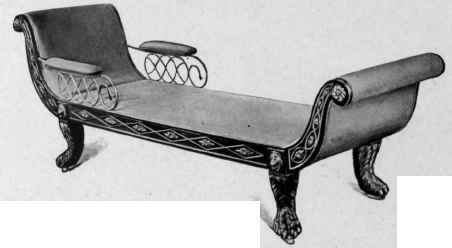
Figure 650. Chaise-Longue, 1790-1800.
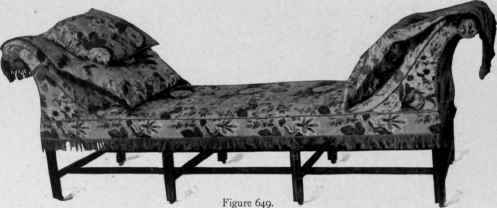
An example of a couch prior to the Empire period is shown in Figure 649 and is the property of Professor Barrett Wendell. The two ends roll and are completely upholstered. The eight legs are straight, with double ogee mouldings on the surfaces, and are strengthened by underbracing across and two underbraces, one on each side, a little recessed, extending the length of the piece.
Figure 650 shows a couch, in the Empire style, which originally belonged to Mr. Joseph Bonaparte and came from his house at Bordentown, New Jersey. It is in the writer's possession. It is made of well-selected mahogany, and the carved bean' Of lions' feet are unusually well executed. The arms are of brass and brazed. The sides are enriched with diamond-shaped panels marked off by a raised bead of ebony which is fitted into a channel. At the centre of each panel, graduating in size as the panel becomes smaller at the rolling ends, is a rosette of ebony. A large rosette of ebony finishes the four ends, and four ebony lions' heads finish where the legs join the frame. The seat is of cane covered with a thin layer of hair.

Figure 651. Window-Seat, Chippendale style, third quarter eighteenth century.

Figure 652. Window-Seat, Chippendale style, third quarter eighteenth century.
Throughout the eighteenth century it was common to have small seats to fit into the window recesses, and a number of them have been found in this country, although they are not nearly so common here as they are in England. A very handsome one, in the Chippendale style, is shown in Figure 651, the property of Mr. Marsden J. Perry, of Providence. The ends are scrolled, each scroll being finished with a rosette, and on the front surface are carved acanthus-leaf scrolls. The legs are cabriole, terminating in French scroll feet, and on the knees are carved acanthus leaves. The rear side is straight and the front is serpentine. A lattice design quite similar to that shown in the splat of the chair in Figure 567 finishes the two ends.
Another window-seat, the property of the Tiffany Studios, is shown in Figure 652. The ends are scrolled, terminating in rosettes, and the sides are moulded with a pearl beading through the centre. On the lower edge of the rail is a god-rooned moulding and above each leg is carved a rosette. The legs are straight with the surfaces fluted. The seat and two ends are upholstered.
Continue to:


My Books

