


The Period Of The Cabinet-Makers, 1750-1840. Part 6
Description
This section is from the book "Colonial Furniture In America", by Luke Vincent Lockwood. Also available from Amazon: Colonial Furniture In America.
The Period Of The Cabinet-Makers, 1750-1840. Part 6
Just as, a half-century before, the Dutch, then the controllers of the Eastern trade, had borrowed the ball and claw foot from the Chinese, so now Chippendale borrowed extensively from other Chinese designs for English use. The cabinet-makers of his day seem to have doubted the practicality of many of Chippendale's designs, especially those in the Gothic and Chinese styles, for in his preface Chippendale, referring to these designs as "fit for eating parlours," says: "Upon the whole I have given no design but what may be executed with advantage by the hands of a skilful workman, though some of the profession have been diligent enough to represent them (especially those after the Gothick and Chinese manner) as so many specious drawings, impossible to be worked off by any mechanick whatsoever. I will not scruple to attribute this to malice, ignorance and inability; and I am confident I can convince all noblemen, gentlemen, or others, who will honour me with their commands, that every design in the book can be improved, both as to beauty and enrichment in the execution of it, by their most obedient servant Thomas Chippendale." Quite a number of chairs in the Gothic and Chinese styles found their way to this country, especially about the seaports of New England, and they also seem to have been made here, for John Briner, a cabinet-maker at New York in 1762, advertises to make "Gothic and Chinese Chairs."
Figure 571 shows an example of a Chinese bamboo and rattan chair which was brought from China about one hundred years ago. It was apparently such chairs as this that were copied by the cabinet-makers of the middle of the eighteenth century.
A very beautiful arm-chair in Chippendale style, showing the Chinese taste, is shown in Figure 572 and is at the Ladd house, Portsmouth, New Hampshire, where it has been from colonial times. The back of this chair is extremely elaborate and is different from any of the designs contained in Chippendale's book. The combination of C scrolls and the slight Gothic effect in the lattice design is strong indication, however, that the chair was made by Chippendale. The cresting rather suggests the third figure in Plate XXVII of Chippendale's book. The design is so ornate that it defies description. The general scheme, however, is a pagoda top, on the cresting below a series of three pagoda tops hanging pendent between C scrolls, and below the centre one another pagoda top in a half circle. The central section is supported by two columns with a suggestion of a capital, within which are well-known Chinese scroll designs. On either side of this centre are four openings within which are lattices in quatrefoil form. To enhance the Chinese effect the seat is caned. The space under the arms is filled with a Chinese fret design. The legs are straight and C-scroll brackets are at the corners formed by the joining of the legs to the rails. On the flat surfaces of the rails, stiles, and legs are clusters of reedings. This chair is one of a set with a settee (Figure 627) which are undoubtedly of English origin, and they illustrate the fact that furniture of the highest quality was being imported to the colonies from England.

Figure 571. Chinese Chair, about 1800.

Figure 572. Chair in Chippendale style, Chinese taste, third quarter eighteenth century.

Chair in Chippendale style, Chinese taste, third quarter eighteenth century.
Figure 573 shows a Chinese Chippendale chair in which the entire back is composed of a fret design. At the centre of the top rail is the same suggestion of a pagoda as is found in the preceding figure, and on the legs are fret designs. The arms are curved much like those of the Dutch period. This chair is the property of Mr. Marsden J. Perry, of Providence.
Figure 574 shows a very interesting Chippendale chair combining French, English, and Chinese motifs. The pattern is known as the rope and bell and is one of the most beautiful of the period. The cresting is suggestive of a pagoda and is edged with rococo, from which hang little bells on ropes which give the name to the design. The splat is broken into irregular curves and piercings to carry out the Eastern flavour, and a bell on a long rope is carved on the surface.
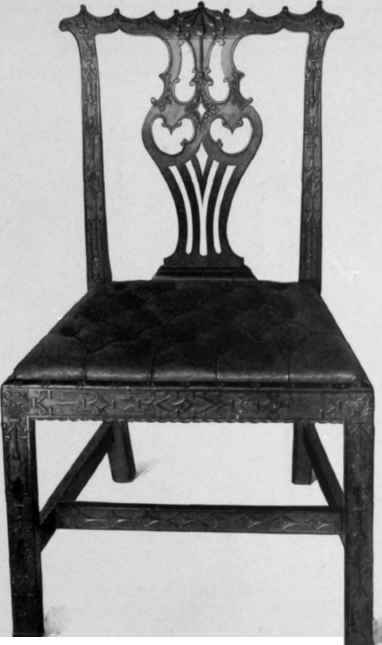
Figure 574. Chair in Chippendale style. Chinese taste, about 1760.
The surfaces of the stiles, rails, and legs are carved in a wonderful Chinese fret design interspersed with ropes and bells and leaves. This chair is the property of Mr. Richard A. Canfield.
In many respects the pieces which carry the Chinese motif into English form are more interesting than those which too closely copy the Chinese.
Figure 575 shows still a different design of splat, the scroll being in the Flemish form instead of the simple. On the surface of the scroll is carved an acanthusleaf design, with carved drapery connecting each side, above which is a tassel suspended by a cord which extends to the top. The cresting is well carved in an acanthus-leaf design and at the centre is a slight suggestion of the Chinese. The stiles are fluted and the arms appear to make a continuous whole with the supports in the form common in the Dutch period. The legs are cabriole and terminate in bird's claw and ball feet, with an acanthus-leaf carving on the knee, and on the skirt is a rope carving. This chair is the property of the Tiffany Studios.
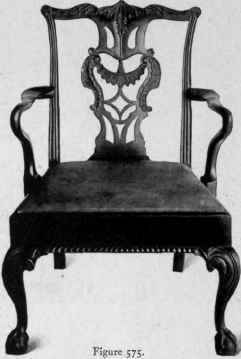
Chair in Chippendale style, third quarter eighteenth century.
Continue to:


My Books

