


The Period Of The Cabinet-Makers, 1750-1840. Part 5
Description
This section is from the book "Colonial Furniture In America", by Luke Vincent Lockwood. Also available from Amazon: Colonial Furniture In America.
The Period Of The Cabinet-Makers, 1750-1840. Part 5
Figure 560 shows an arm-chair in which there is a suggestion of the Gothic style caused by the interweaving of ribbon-like pieces. The cresting is carved in rococo and leaf design, and pendent flowers finish the surfaces where the two loops of the ribbon touch. The stiles are fluted, as are also the arm supports and the straight legs. On the outer edge of the legs is carved a reel and bead moulding. This chair is the property of the Tiffany Studios.
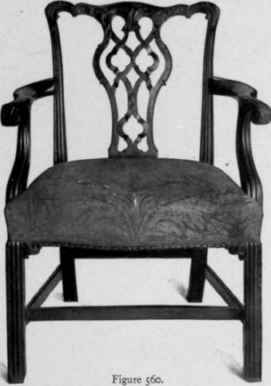
Chair in Chippendale style, Gothic taste, third quarter eighteenth century.

Chair in Chippendale style, Gothic taste, third quarter eighteenth century.
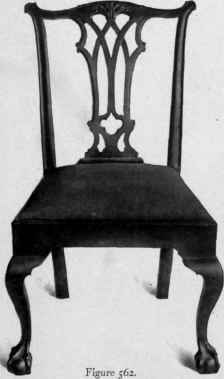
Chair in Chippendale style, Gothic taste, third quarter eighteenth century.
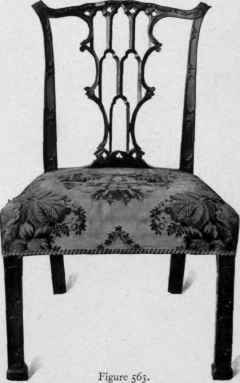
Chair in Chippendale style, Gothic taste, 1760-70.
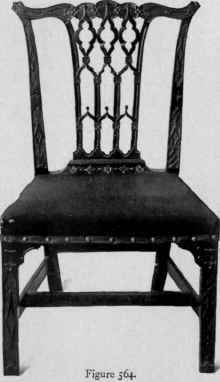
Chair in Chippendale style, Gothic taste, 1760-70.
Figure 561 shows .a chair very similar to one shown in Plate X of Chippendale's book. The splat has a suggestion of the Gothic, and the chair, though plain, is well proportioned and finished. The legs are straight and not under-braced, and at the corners are fret brackets. This chair is the property of Miss Augusta Manning, of Hartford.
Figure 562 shows a chair having the splat composed of three concave curves in the Gothic fashion. This design seems to have been one of the most popular, and is to-day, for there are many reproductions. The legs are cabriole with bird's claw and ball feet. This chair is the property of the Tiffany Studios.
Figure 563 shows a chair, the property of the Tiffany Studios, which has a very interesting form of Gothic back. The outer edges of the splat are composed of three C scrolls. Within these scrolls are Gothic arches in a series of three, two, and one, the top arches cutting into the cresting and being pierced on either side and between in quatrefoil piercings. The upper surface of the cresting is cut in Gothic designs and there is a slight carving at either end. The fronts of the stiles and of the legs are cut in Gothic designs, and at the base of the splat are two quatrefoil piercings with a trefoil between.
A very elaborate Chippendale Gothic chair is shown in Figure 564. The splat is composed of archings above which is a species of quatrefoil piercings extending into the top rail. On the stile, rails, and legs are Gothic designs in flat carving. This chair is the property of the Metropolitan Museum of Art.
Figure 565 shows another chair in the Gothic taste, the property of Mr. Richard A. Canfield. This chair has no splat, but the entire back is filled in with Gothic interlacing arches and on the cresting between are pierced Gothic designs. The entwined arches are carved so as partially to extend over the stiles. The underbracing is pierced in quatrefoil and lozenge form. The legs are straight and are carved in strap design. The design of this chair is quite similar to some of those shown in Chippendale's book.
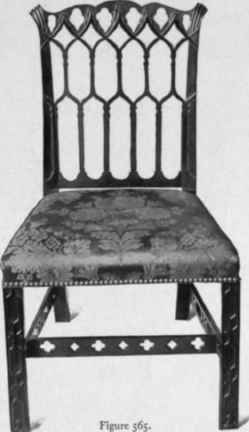
Chair in Chippendale style, Gothic-taste, 1760-70.
A totally different kind of a Gothic chair is shown in Figure 566. The back represents columns and Gothic arches, and the effect is carried to the legs which are in the form of cluster columns. The arms are plain and quarter-round. This chair is the property of Mr. John J. Gilbert, of Baltimore.
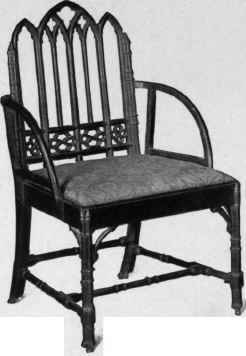
Figure 566. Chair in Gothic taste, 1760-70.
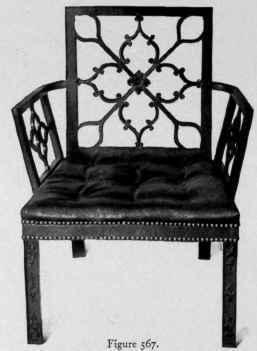
Chair in Manwaring style, Gothic taste, 1760-70.
Figure 567 shows an interesting chair in the Gothic taste, the property of Mr. Richard A. Canfield. The Gothic effect is obtained by series of C scrolls so placed as to make a cruciform figure through the centre. These scrolls are strengthened by diagonal bands which cross at the centre and are finished with a rosette. Beneath the arms are cut ornaments in cruciform. The legs are straight and on the surface are carved rosettes and scrolls. This chair is very similar to some of Manwaring's designs and is supposed to have been made by him.
Figure 568 shows another form of Chippendale Gothic splat, the outline of which is composed of a concave, a convex, and a long concave curve. The splat is pierced to resemble a Gothic window and the surfaces are carved with a slight acanthus-leaf pattern which is also on the top rail. The legs are straight and plain with fret brackets at the corners. This chair is the property of the writer.
Another attractive Chippendale Gothic chair with splat in the same curve, but differently treated, is shown in Figure 569. The ends of the top turn down instead of up; the legs are plain and straight and underbraced. This chair is the property of Mr. George T. Kendal, of Grand Rapids, Michigan.
Another form of splat consisting of three concave curves is shown in Figure 570. This form of splat, as has been seen, is almost always found in the Gothic design, and this chair appears to be an exception to the rule, for inside the outer scrolls are oval and round openings ornamented with carving. The surfaces of the stiles, rails, arm supports, and legs are carved in a simple design which increases very much the beauty of the piece.
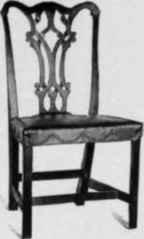
Figure 569. Chair in Chippendale style, Gothic taste, 1770-80.
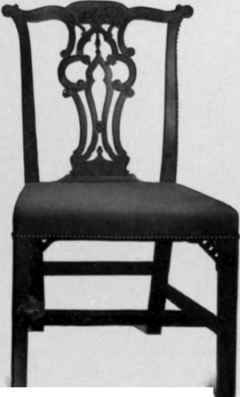
Figure 568. Chair in Chippendale style, Gothic taste, 1760-70.
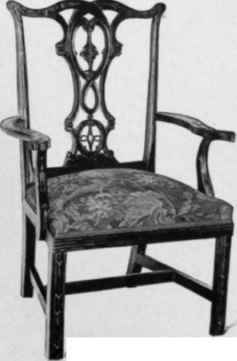
Figure 570. Chair in Chippendale style, 1760-70.
Continue to:


My Books

