


Roundabout Chairs
Description
This section is from the book "Colonial Furniture In America", by Luke Vincent Lockwood. Also available from Amazon: Colonial Furniture In America.
Roundabout Chairs
A style of chair very popular in the first half of the eighteenth century is the roundabout chair. Its popularity was probably due to its comfort, obtained from the curved back. It is constructed with one leg in front, and the other three legs carry through the seat to support the arms and back which are built on a curve. They are found in three styles, the transition, the Dutch, and the Chippendale.
Figure 516 shows a form of chair known as a wheel chair, owing to the fact that the underbracing has the appearance of spokes of a wheel. It is probably the forerunner of the roundabout chair. The back is circular in form and is supported by the extension of the four back legs. The outer ends terminate in finials. The back is in three sections, each mortised and tenoned into the upper section of the legs and each oval-shaped opening, which was originally caned both front and back as was also the seat. There are two legs in front and a round moulded stretcher connects all of the six legs, which are turned and terminate in plain feet. Wheel chairs are very uncommon. They are probably of Eastern origin, for the one in the frontispiece, which is the property of the writer, has bamboo pegs and the cane is very fine, after the Eastern fashion. The writer has seen several in England which have the carved cresting between the legs in the manner of the caned chairs. This chair is the property of Mr. William W. Smith, of Hartford.

Wheel Chair About 1700
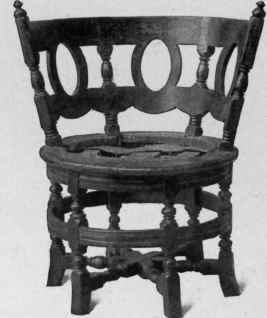
Figure 516. Cane-Back Wheel Chair, about 1700,.
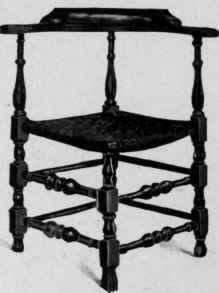
Figure 517. Roundabout Chair, 1720-30.
Figure 517 shows a roundabout chair in the transition style. The legs and the stretchers on the front are nicely turned, while at the back the stretchers are plain. The front leg terminates in a Spanish foot and the others are plain turned. Chairs of this early style are also found with two splats, either plain or slightly pierced. The seat is sometimes finished with rush and sometimes with a slip seat. This chair is the property of the Misses Andrews.
Figure 518 shows another roundabout chair in the transition style built in the usual manner. The simple Dutch slats in the back fasten to a lower rail instead of extending to the seat rail. The legs have double underbracing, as in the preceding figure, and the front leg terminates in a short Dutch foot similar to those appearing on the chair in Figure 491. This chair is the property of Mrs. Charles P. Cooley, of Hartford.
Figure 519 shows a roundabout chair with extension top, in the early Dutch style, quite closely resembling the chair shown in Figure 495. The legs are cabriole, terminating in Dutch feet, and the arms are rounded on the edge instead of having the usual flat surface. This chair is the property of Mr. Albert H. Pitkin, of Hartford.
Figure 520 shows a very good roundabout chair, the property of Mr. Francis H. Bigelow, of Cambridge. It is in the graceful Dutch style. The legs, supports for the arms, the seat, and the splat are all in cyma curves. The arms end in a scroll and the legs terminate in Dutch grooved feet.
A well-proportioned roundabout chair is shown in Figure 521, the property of Mr. Nathaniel Herreshoff, of Bristol. The supports to the arms are curved, as in the preceding figure, and the slat is cut in a double C-scroll design. At the front of the arms is a slight hollowing. The rail on either side of the front leg is cut in cyma curves, and the piece stands on four cabriole legs terminating in bird's claw and ball feet. Several chairs identical with this have been found in Rhode Island.

Figure 519. Roundabout Chair with extension top, second quarter eighteenth century.
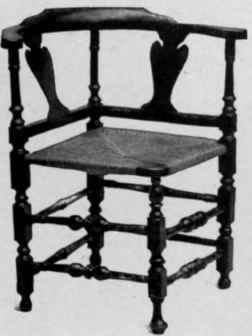
Figure 518. Roundabout Chair, 1720-30.

Figure 520. Roundabout Chair, second quarter eighteenth century.
Figure 522 shows another chair quite similar to that shown in the preceding figure. The legs and supports for the arms and the splat are composed of cyma curves, but the seat rail is straight. A deep skirt extends below the seat rail. The arms are in the usual flat form and the legs terminate in bird's claw and ball feet, and on the front knee is carved a shell. This chair is the property of Mr. H. W. Erving.

Figure 521. Roundabout Chair, third quarter eighteenth century.

Figure 522. Roundabout Chair, third quarter eighteenth century.
Figure 523 shows another roundabout chair, the property of Mr. H. W. Erving. The front leg is cabriole, terminating in a Dutch foot; the other legs are straight, terminating in the same feet. The legs are underbraced with a turned X bracing. The splat is pierced in a scroll design the same as that shown on the Chippendale chair (Figure 543). The seat rail is curved.
Figure 524 shows a very handsome roundabout chair with extension top. There are four cabriole legs, terminating in bird's claw and ball feet, and on the knee of the front leg is carved a shell. The legs are underbraced with turned X bracing. The supports for the arms are turned and the splats are cut in a Chippendale design. The extension of the back is also in the Chippendale style. This chair was the property of the late Mr. Walter Hosmer.

Figure 523. Roundabout Chair, third quarter eighteenth century.

Figure 514. Roundabout Chair with extension top, third quarter eighteenth century.
Figure 525 shows an interesting armchair which at first glance seems to be a roundabout, but it has two legs in front. The back and arms are, of course, in the roundabout form and cover three sides instead of two. The splat is cut in a Chippendale design. This chair is the property of Mr. Dwight M. Prouty, of Boston.
Continue to:


My Books

