


Windsor Chairs
Description
This section is from the book "Colonial Furniture In America", by Luke Vincent Lockwood. Also available from Amazon: Colonial Furniture In America.
Windsor Chairs
Probably no variety of chair was so popular in this country during the last half of the eighteenth century as the Windsor chair. The origin of the chair is not known. Tradition says it received its name by having been found by one of the Georges in a peasant's hut near Windsor. It was very popular in England all through the eighteenth century and appears to have been made in this country first in Philadelphia. There can be little doubt that the standard was set by that city, for advertisements are found in the Boston papers stating that a local chair-maker has Windsor chairs for sale "as good as those made in Philadelphia," and at New York, in 1763, are advertised "Philadelphia made Windsor chairs." That the trade was a large one is evidenced by the fact that the early directories and advertisements show that the work was specialised, and the expression "Windsor Chairmaker" is common.
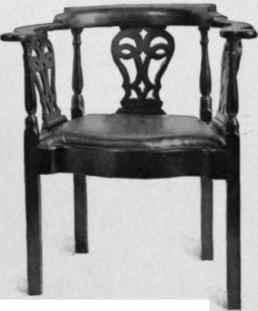
Figure 525. Roundabout Chair, third quarter eighteenth century.
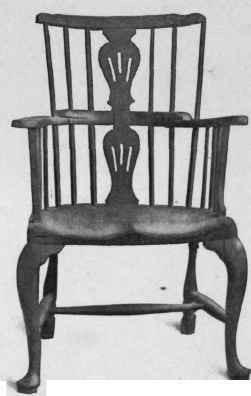
Figure 526. Windsor Chair, third quarter eighteenth century.
Fortunately we are able to determine which were the earlier types of the chair, because advertisements often give illustrations. In the earliest form the arms extended round the back, as in roundabout chairs, and there was an extension top either made of a bent piece of wood with either end fastened into the arms and supported by spindles, or with a curved piece of wood so supported. (See Figures 526 and 527.)
In the next form of construction the arms and back are formed of a piece of bent wood supported by spindles. (See Figure 532.)
The third form is the late form with the rectangular lines following the outlines of the Sheraton school (Figure 535).
By far the largest number of Windsor chairs found are in the earliest type, not only became that form was the strongest and easiest to make, but also because that style continued to be made in large numbers well into the nineteenth century. These chairs are usually found painted, and the popular colour seems to have been green, because many of the advertisements mention "Green Windsor chairs." The great popularity of these chairs was undoubtedly due to the fact that they were cheap and light and much more comfortable than the ordinary chairs with which they were contemporaneous. They were, in fact, the everyday chair of the period.
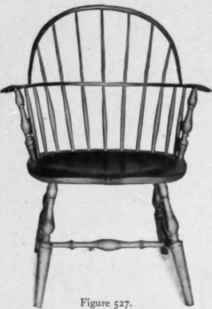
Windsor Chair, third quarter eighteenth century.
The English variety differed in some particulars from the colonial. In the first place, many of them had a splat as well as spindles, a feature never seen on American Windsors, and the turning on the legs was not so elaborate on the English as on those found here.
Figure 526 shows an English Windsor chair. It has a comb top and a pierced splat in each section. The arms extend from the back in the usual way and the legs are cabriole, terminating in Dutch feet and underbraccd.
Figure 527 is an early form of Windsor chair which is the property of Mr. Albert H. Pitkin, of Hartford. The legs are turned in vase turning and raked. The legs on Windsor chairs usually pass through the seat and fasten with a foxtailed wedge. The bulb-turned underbracing connecting the back and front legs and the stretcher through the centre give further rigidity. The spindles directly under the arms are turned, while the others are plain, slightly swelling. The long spindles which support the back extend through the back and fasten into the seat.

Figure 528. Windsor Chairs, third quarter eighteenth century.
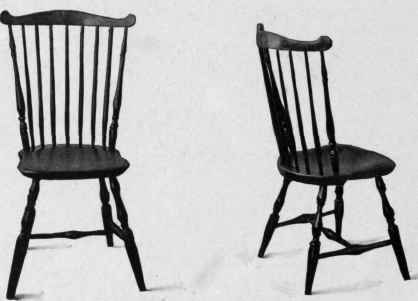
Figure 530. Fan-Back Windsor Chairs, last quarter eighteenth century.
All of these features are common to all Windsor chairs. The ends of the arms on this piece are carved to represent an open hand; they are also found carved to represent a closed hand. These carved types are rare.
Three good types of Windsor chairs are shown in Figure 528. The first one, on the left, is in the early type with a very high back. The legs and supports for the arms are turned in the usual way. The centre chair has what is known as the comb back because of its resemblance to the old-fashioned back comb. It consists of a curved bow-shaped piece usually, as in this case, with scroll ends and supported by spindles passing through the back into the seat. The third chair is in the same type of comb back but a little more elaborate. The centre of the back is a little raised, like the roundabout chairs, and the arms are carved in a scroll. These chairs are in the Bolles Collection.

Figure 529. Windsor Chair, third quarter eighteenth century.
Figure 529 shows another comb-back Windsor chair in the Bolles Collection. The turning of the legs and stretchers is finer than in the preceding figures, as are also the supports for the arms. The comb top is taller and bow-shaped and finished with well-carved scrolls.

Figure 531. Windsor Slipper-Chair, Dutch feet, last quarter eighteenth century.
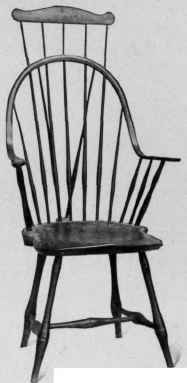
Figure 533. Windsor Chair, last quarter eighteenth century.

Figure 532. Windsor Chairs, last quarter eighteenth century.
Figure 530 shows a pair of what are called fan-back Windsors. It will be seen that they are really the side chair of the comb-back type and, as is the case with the side chairs of the Windsor type, are less strong than the arm-chairs. These chairs are the property of the Honourable John R. Buck, of Hartford.
Figure 531 shows an interesting slipper-chair of the fan-back type, the property of the writer. The seat is but fourteen inches high, while the back is of the regular height. The turnings are unusually large and the front legs terminate in Dutch feet, a most unusual feature for American Windsors.
Figure 532 shows the next type of Windsor chairs, in which the arms, instead of passing through the back in a horizontal line, are bent to form a high back quite similar in appearance to the extension back in Figure 527. This form of the chair is very graceful. It is quite common, but is structurally much weaker than the other type, as the chair invariably breaks at the point where the arms so sharply bend to form the top. The side chair, it will be seen, has the same general appearance, but the curved strip is fastened into the seat. The back of the arm-chair is supported by two spindles fastened into the top and extending to a projection of the seat.
Another chair of the same type with a comb-back extension top is shown in Figure 533 and is in the Bolles Collection. The comb top is supported by five spindles which pass through the top and fasten into the seat. The back is supported by two spindles, as in the last figure.
The rarest form of the Windsor chair is that known as the writing-chair, of which a very beautiful example is shown in Figure 534. The back is of the same type as that shown in the preceding figure and has a large comb top supported by seven spindles. The right arm is enlarged into a table and is supported by spindles set into the extension of the seat. Under the seat is a drawer on side runners, and a similar drawer is under the table. In front, under the table, is a candle slide which, when closed, locks the drawer. This piece is in the writer's possession and at one time belonged to the first Congregational minister of Chesterfield, Massachusetts, and was not new in 1790. Such a piece may have been referred to in a Boston inventory of 1760, "A writing chair, 3s. 8d." One can hardly realise what a comfortable and convenient piece this is, both for reading and writing.
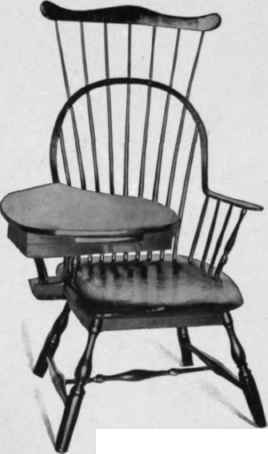
Figure 534. Windsor Writing-Chair, last quarter eighteenth century.
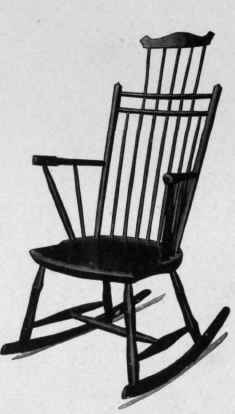
Figure 535. Windsor Chair, about 1800.
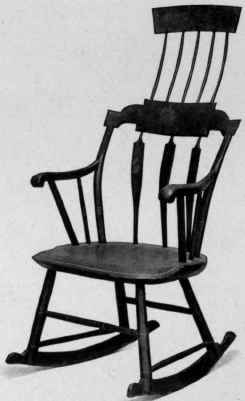
Figure 536. Windsor Chair, first quarter nineteenth century.
A later type of Windsor chair is shown in Figure 535. All the lines are rectangular except the comb top, which is in the usual bow shape, and the turnings are very simple. The rockers on the chair are original.
Figure 536 shows the latest type of Windsor chair. The back and spindle slats are painted, as is also the comb top, which is supported by five spindles which extend only to the main back instead of to the seat. This piece is in the Bolles Collection.
Continue to:


My Books

