


The Period Of The Cabinet-Makers, 1750-1840. Part 9
Description
This section is from the book "Colonial Furniture In America", by Luke Vincent Lockwood. Also available from Amazon: Colonial Furniture In America.
The Period Of The Cabinet-Makers, 1750-1840. Part 9
Figure 593 shows a chair in Hepplewhite style, the property of Mr. Richard A. Canfield. The back is shield-shaped and the cresting is carved at the centre with flowers. There are three central supports, the centre one being pierced and carved in a guilloche pattern within the centre circle of which is a carved rosette. On the outer ones is a slight leaf carving with pearl drops. The legs are square, in the Marlborough form.
Figure 594 shows a Hepplewhite chair with an oval back which gives even a more delicate effect than the shield shape. There are four curved strips forming the splat, and festoons of carved flowers are attached to the under surface of the frame of the back. The arms and supports are curved and the straight legs have moulded surfaces. This chair belongs to the Tiffany Studios.
Figure 595 shows a Hepplewhite chair with a heart-shaped back. The drapery, leaves, and flowers are well carved and the design is one of the best found. The legs are tapering and reeded, with spade feet. This chair was the property of the late Reverend Samuel J. Andrews, D.D.
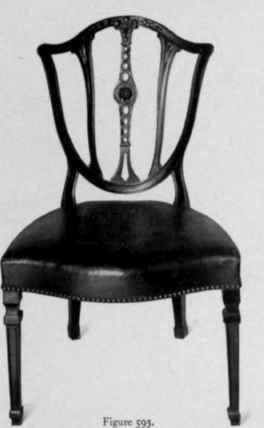
Chair in Hepplewhite style, about 1790.

Chair in Hepplewhite style, 1785-95.
The influence of Thomas Sheraton, the last of the great furniture designers, was very great in this country. His designs were often literally copied, and practically all of the furniture here of the period showed his motifs. The chief characteristics of his style in chairs were the rectangular lines, sometimes with a rectangular panel at the centre of the top rail upon which was cameo carving.
Figure 596 shows a pair of arm-chairs which are exactly like Plate XXXIII in Sheraton's "The Cabinet-Maker and Upholsterer's Drawing-Book." A set like these and those shown in the following figure were imported from London by the Nichols family, of Salem, Massachusetts. The backs of these chairs are composed of three arcades. On the surface of the two inner pilasters are carved pendent flowers. The front legs are rounded.
Figure 597 shows a pair of side chairs also belonging to the Nichols family. Between the frame of the back is a lattice design and at the centre of the back is a rectangular panel in which is carved a basket of flowers. The legs are straight and plain.
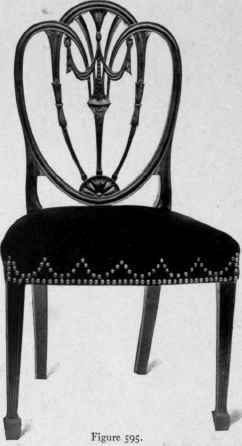
Chair in Hepplewhite style, 1785-95.
Figure 598 shows a chair in Sheraton style the top rail of which is perfectly straight, and the stiles are raked toward the centre. Within the frame is carved drapery caught at the centre and at the two ends, falling down the inside of the stiles, and in the centre is a bow knot and drapery with a cord and two tassels. This is one of a set of six chairs in the writer's possession.
Figure 599 shows another form of Sheraton chair which is substantially like Plate XXXVI, No. 1, in Sheraton's book. In effect the back is rectangular with another rectangular frame imposed and extending above the main frame.
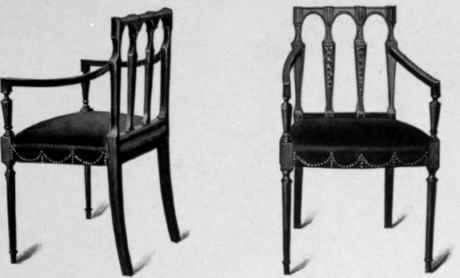
Figure 596. Chairs in Sheraton style, 1785-90.

Figure 597. Chairs in Sheraton style, 1785-90.
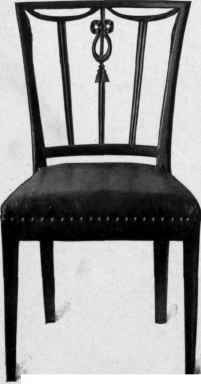
Figure 598. Chair in Sheraton style, 1785-95.

Figure 599. Chair in Sheraton style, 1790-1800.
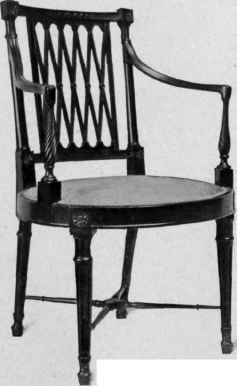
Figure 600. Chair in Sheraton style, 1785-95.
The splat is urn-shaped, with drapery, and above are three feathers. The legs are tapering with spade feet. This chair is the property of the writer.
Figure 600 shows a Sheraton chair with a round seat. The back is rectangular with rosettes in the corners and a lattice back with rosettes at the crossings. The supports of the arms are spirally twisted and the legs are round and fluted with X underbracing. This chair is the property of the Tiffany Studios.
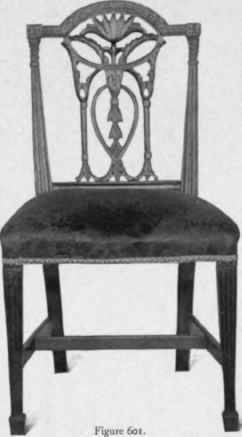
Figure 601 shows a chair in Sheraton style, the property of Mr. William W. Smith, of Hartford. The cresting is arched at the centre and the entire surface is carved, and at the corners are carved blocks with a rosette in the centre. The stiles have an acanthus-leaf carving at the top resembling capitals, the lower part representing a fluted shaft. Under the arched top and forming a part of the splat is a beautifully carved flower-and-leaf design with pendent flowers, and on either side are columns having the base and top carved in the same leaf design. The legs are in Marlborough form with fluted surfaces.
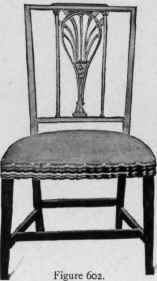
A form of Sheraton chair quite often found is shown in Figure 602. In the centre of the back is a well-shaped splat below which are carved pendent flowers. The legs are straight and underbraced.
Figure 603 shows another form of chair in the Sheraton style with a curved seat, in the form known as a conversation chair. The legs are so shaped that a man can sit straddle-legged, resting his arms on the back, and thus keep his coat tails from being creased. Quite a number of designs of these chairs are found in Sheraton's book.
Figure 604 shows a chair in red lacquer and gilt, which is one of a set of side arm chairs and two settees, the property of Professor Barrett Wendell. This set had been painted like the settee of the set shown in Figure 635, but when the paint was removed the design as shown on this chair was disclosed. On the top rail is painted a bow and arrow and a quiver and in the upper section of the splat acanthus leaves in a design found on some of the carved chairs of the Sheraton period. On the flat surface of the front stretcher are painted laurel leaves and a bow knot.
Chair in Sheraton style, 1785-95.
Chair in Sheraton style, 1785-95.
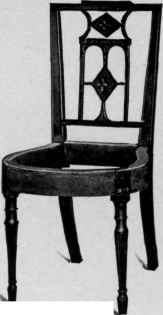
Figure 603. Chair in Sheraton style, 1785-95.
Continue to:


My Books

