


The Dutch Home. Part 4
Description
This section is from the book "Dutch And Flemish Furniture", by Esther Singleton. Also available from Amazon: Dutch and Flemish Furniture.
The Dutch Home. Part 4
Wherever the Dutch went, they lived not only in comfort, but in all the elegance and even splendour that their means would allow. In the New or the Old World, the merchant princes surrounded themselves with sumptuous furniture of mahogany, ebony, marquetry, ivory, lacquer, teak and sandal-wood, as well as porcelain, embroideries, rugs, screens and all kinds of stamped metal and bric-d-brac.
In 1685, the Count de Forbin says that the General of the East India Company at Batavia has a court quite royal in numbers and brilliance. "On my arrival (at the palace), the usual guard," he writes, "which is very numerous, stood at arms, and, between two ranks of men, I was introduced into a gallery adorned with the most beautiful Japanese porcelains."
Evelyn and other travellers are enthusiastic in their admiration of the riches and luxury they witnessed in Holland, although, as we have seen, England was not unfamiliar with Oriental art products. The Stuarts were art connoisseurs of the first rank, and James II, to whom Macaulay denies mental and aesthetic appreciation, was an intelligent collector. The most brilliant figure in the Court of Louis XIV, the Marquis de Dan-geau, notes in his Diary (January 8, 1689), on the arrival of the fugitive Stuart: "The King of England found the apartments (of the Dauphin) admirable, and talked like a connoisseur of all the pictures, porcelains, crystals and other things that he saw there."
One of the travellers who describes the Eastern goods seen in the shops and houses of Amsterdam and other Dutch cities, Charles Patin, writes in 1690:
"I had a sight of all their curiosities and those of all sorts, and among other divers paintings that we know, and others which are unknown to us; as also Indian and Chinese pieces of an inestimable value. In these last a curious eye may discover all the secret particulars of the history, the manner of living, customs and religion of those countries, and there are represented certain martyrs, who sacrifice their blood to the transport of their zeal, if it may be allowed to make so bad an application of that sacred name, which belongs only to the heroes of the true religion."
Wills and inventories are invaluable aids to the student of Dutch furniture; but even more illuminating are the interiors painted by the Great and Little Masters - Jan Steen, Metsu, Cocques, Teniers, Rembrandt, Ter-burg, Don Weenix, Hoogstraten, Koedyck and a host of others. These are valuable as showing not only individual pieces of furniture, but also the general arrangement of rooms.
Plate XXVI, representing The Sick Woman, by Jan Steen, in the Rijks Museum, shows a very simple room with bare floor and bare walls. At the back of the room is an upholstered bed with long straight curtains, and tester ornamented with fringe and surmounted with "pommes." On the wall hang a lute and a Frisian clock. The back of the chair is carved with lions' heads above the arms. The table is covered with a handsome "carpet."
A similar bed stands in the right hand corner of the room, represented in Plate XXXVII, also the picture of a Sick Lady, by S. van Hoogstraten. The arrangement of this room is extremely interesting, as a short flight of seven steps leads into a narrow passage and room above. A round window hung with a curtain lights the passage-way above, which contains a number of fine paintings and a low-backed chair with spirally turned legs, the back and seat covered with velvet put on with large-headed nails. A door leads into the room beyond, but all that we can see of this is a marble mantelpiece with a handsome painting above it, and heavy andirons. A large square armchair with spirally turned legs stands on the left of the bed. The invalid is seated on a common stiff chair of no decorative interest.
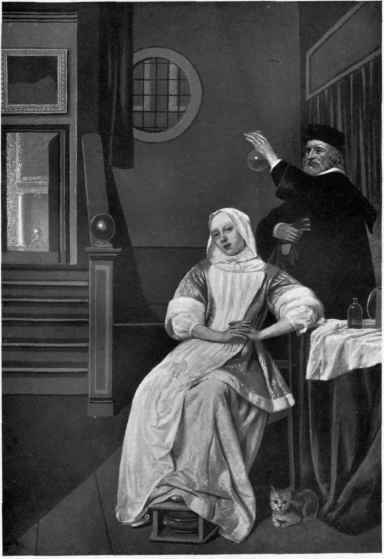
Plate XXXVII. - The Sick Lady, by Hoogstraten. RIJKS MUSEUM, AMSTERDAM.
The obvious upper room was always a favourite feature of the houses in the Low Countries. An interior balcony is shown in Plate XXXVIII. This interior, painted by J. Koedyck about 1650, now in Brussels, is very interesting. The ceiling is unusually high, and consists of heavy beams; the windows are flush with the outside wall with deep interior recesses, and beneath them is a long wooden bench rudely carved. The old woman seated in a plain, two-backed, rush-bottomed chair seems to be dusting the legs of a spinet. Another two-backed chair stands in front of the bed, which from the positions of its pillows looks as if it might consist of an upper and lower berth, as was and still is often the case in the simpler homes in the Netherlands. Straight curtains hang from the cornice, a warming-pan is seen on the right, while above the cornice of the bed a child looks out of the shutters in the upper gallery. The chimney-piece is without the usual funnel-shaped top, and is also lacking in flat architectural ornamentation or a large painting. A candlestick and a few plates are the sole ornaments.
It is carved with caryatids, however, and furnished with a chimney-cloth. Near the only caryatid visible stands what seems to be a metal "blower "; but there is probably no fire in the hearth, for the cat has found what she considers the most comfortable spot in the room on the foot-warmer. The most interesting piece of furniture in the room is the high-backed settle in the space between the fireplace and the window. This is panelled, and a little decoration occurs below the arms. Of course, the seat lifts up, and the box is used as a receptacle for articles.
Continue to:


My Books

