


Queen Anne And Early Georgian. 1702-1750. Part 3
Description
This section is from the book "The Practical Book Of Period Furniture", by Harold Donaldson Eberlein And Abbot McClure. Also available from Amazon: The Practical Book Of Period Furniture.
Queen Anne And Early Georgian. 1702-1750. Part 3
Chairs
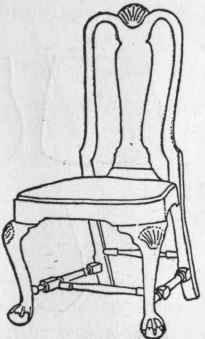
The typical Queen Anne chair is a distinct and strongly characteristic piece of furniture not to be confounded with anything else. It is also a singularly beautiful and graceful creation and exceedingly comfortable. It has cabriole legs and a fiddle-splatted, hooped and "spooned" back (Key V, 7 and 10; Fig. 4). The uprights of the back, a few inches above the seat, break at a sharp angle and curve in towards the splat only to swell out again in a graceful, sweeping curve at the top, which goes over in a bow without break of line to the other upright (Fig. 4). Variations there were, of course, but the general type was unmistakable. The earlier chairs had stretchers (Fig. 4, B) to underbrace them, but these were dispensed with in most cases not long after the beginning of the period. Instead of a stretcher between the front legs there was a recessed stretcher (Fig. 4, B) connecting the two side stretchers, shaped, turned or moulded and either flat or rising. After the early disappearance of the stretcher it did not appear again, except in the cheaper turned furniture of farmhouse type, until Chippendale styles revived it.
Early Queen Anne cabriole legs sometimes had hoof feet (Fig. 4, I, Chap. Ill), solid or cloven, and occasionally Spanish scroll feet (Fig. 4, G, Chap. Ill), the latter form occurring especially in early. New England chairs of the period, with straight turned legs. The usual form of foot, however, was the "Dutch" or club foot in one of its varieties (Fig. 1); pointed, slipper or round-cloven hoof feet appeared again later when claw and ball and paw feet came into vogue. The web foot (Fig. 8, A) occurs at this time. The common motif of carved decoration for the cabriole knee was the cockle shell, except in the cases noted in the introduction to this chapter. Back legs were either quadrangular or rounded.

A
B
Fig. 4. A, Early Queen Anne Arm Chair; B, Early Queen Anne Side Chair with Stretchers.

Fig. 5. Typical Shapes of Queen Anne Chair-seats.
Seats varied in shape (Fig. 5) but were usually rounded or had at least rounded corners in front, and sometimes compound curves were introduced, giving the front of the seat a serpentine outline and projecting the rounded corners like the bastions of a fortress. Seat rails or frames were ordinarily straight, except for the carved shell ornament often found in the middle of the front.
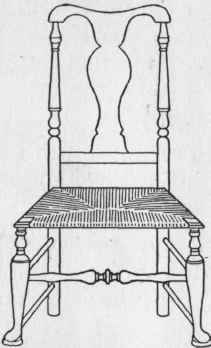
Backs also varied in shape but held to the main characteristics of outline till the influence of Chippendale and his contemporaries began to be strongly felt. Some of the early hooped backs, though "spooned" in profile, had uprights rising straight from seat to cresting without angular or concave break like the side of a fiddle. Then, again, there are instances of two such sharp curving breaks (Fig. 6) in each upright instead of the customary one. We sometimes find double-rail hooped backs (Key V, 5) where the splat terminates in a hooped cresting and above this, quite separate from it, is another hooped top rail connecting with the upright. In the New England and New York rush-bottomed chairs with straight turned legs, Spanish feet and turned stretchers, the pronouncedly Dutch form of back, with the uprights of unbroken line (Fig. 8, B),was usually found. The banister-back, being a vigorous and virile type, persisted for a time.
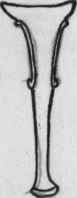
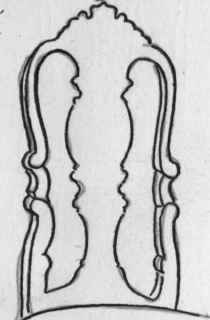
Fig. 6. Back and Leg of Chair typical of Late William and Mary and Early Queen Anne Epoch.
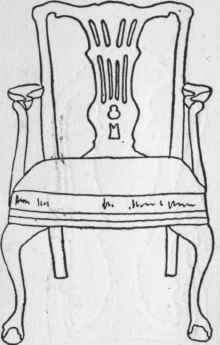
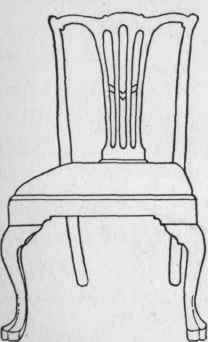
At different dates the splats displayed variations in form, but an approximation to the fiddle shape was always traceable. Nearly all of the early splats were plain, often covered with veneer of burr walnut. Later, in the decorated period (see Introduction to Chapter) ornamentation was added, at first on the edges and, last of all, came the pierced splat (Fig. 7, A) in the process of development.
A
B
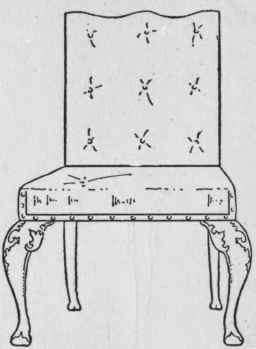
Fig. 7. A, Pierced Splat-back Arm Chair of Early Georgian Type; B, Square-back Upholstered Chair of Queen Anne-Early Georgian Period.
Many of the earliest hoop-back chairs retain a high carved or moulded cresting above the splat, a survival of the high and elaborate cresting of William and Mary days (Fig. 6). But this cresting soon disappeared and we find in its stead only a simple cockle shell (Key V, 10), or else a hollowed space suggesting a head rest (Fig.4,A).
Wing chairs had a comfortable flare (Key V, 4), easy, flowing lines and cabriole legs, for the most part without stretchers. Some of the upholstered arm chairs with wooden arms had backs that followed the curving contour of side chairs. Arms were shaped and flared (Fig. 4, A) outward, the supports being broadly chamfered and curved and attached to the sides of the seat frame. In the rush bottomed arm chairs with straight turned legs, the arm support was an extension of the front leg.
A
B
C
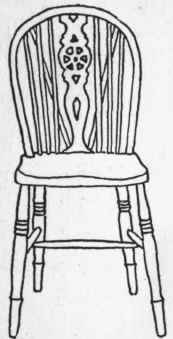
Fig. 8. A, Pierced Splat-back Chair; B, American Rush-bottomed Colonial Chair of Period with Dutch Feeling; C, Windsor Chair of Early Form.
By Courtesy of Mrs. H. Genet Taylor, Camden, N. J.; Col. William J. Youngs, Garden City, L. I.; and James M. Townsend, Jr., Esq., Mill Neck, L. I.
Another type of chair had a broad square, or approximately square, upholstered seat and a square upholstered back (Fig. 7, B). The seat rail is covered by the upholstery which comes close down to the tops of the cabriole legs.
It must not be forgotten that the Windsor chair (Fig. 8, C) came into being during this period and has retained undiminished popularity ever since. The earliest forms had either straight plain legs spreading outward or else simple cabriole legs with club feet. Oftentimes a central rudely-pierced splat was introduced into the back between the spindles (Fig. 8, C). Fan backs and hoop backs, as we know them, in Windsor chairs mark a later development (Chap XIV, Fig. 5).
The early Georgian or Hogarthian chair (Plate XI, p. 126) is worthy of special notice on account of its slightly different contour and proportions. In all the Hogarthian pieces the curve of the cabriole is much less flowing and all the proportions are seemingly heavier, although a great deal of this feeling is produced by the approximately straightened (Fig. 9) leg and the heavy shoulder of the cabriole. The so-called Hogarthian pieces constitute an interesting episode of design in the Early Georgian period.
The variations from the typical Queen Anne shape that came into evidence in the latter part of the Early Georgian period really foreshadow Chippendale modes and will be dealt with in that chapter. The decorated types of Queen Anne and Early Georgian chairs were substantially the same as the earlier type in contour and the successive phases of ornamentation - eagles' heads, lions, satyr-masques and cabochon-and-leaf - are treated in the introduction to this chapter and in the Section on Types of Decoration.
Continue to:


My Books

