


Bird House
Description
This section is from the book "Shop Projects Based On Community Problems", by Myron G. Burton. Also available from Amazon: Shop Projects Based on Community Problems.
Bird House
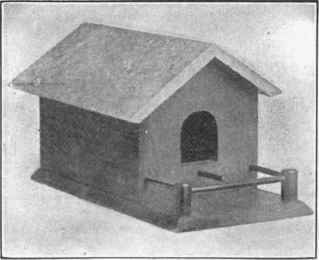
Materials
Basswood (Chap. III., Par. 31) or any soft wood.
lpc. 3/4"x8"xl4 1/2" S2S
Bottom. 2 pcs. 5/8"x5 1/2"xl0 1/2" S 2 S
Sides. 2 pcs. 5/8"x6"x8" S 2 S
Ends. 1 pc. 3/4"x3 1/4" dowel rod. 1 pc. 1/4"x15" dowel rod. 2 1/2 dozen l 1/2" brads. 1 pc. galv. iron 12"xl4". Roof. 1/2 doz. 3/4" No. 6 R. H. screws.
Introductory Statement
Most people enjoy the presence of song birds, but many people do not realize what a great benefit they are to the production of farm and fruit crops. The Government and various societies are spending considerable time in an effort to educate the public to a proper appreciation of bird life. The days of the thoughtless killing of song birds have gone by and now no boy can claim to be a manly fellow if he insists upon being destructive to bird life.
This bird house will provide a safe place for the shelter of desirable birds and their nests. When completed it should be mounted upon a pole or on some building where it will attract the birds.
References:
U. S. Bulletin No. 609, Bird Houses.
Song Birds and Water Fowls, Parkhurst. Chas. Scribner's Sons, Pub. Bird Portraits, Ernest Thompson Seton. Ginn & Co. What I Have Done With Birds, Gene Stratton Porter. Bobbs-Merrill Co. A Watcher in the Woods, Dallas Sharp. Century Pub. Co. U. S. Agricultural Bulletin No. 133, Birds as Weed Destroyers. U. S. Agricultural Bulletin No. 630, Some Common Birds in Their Relation to Agriculture. Our Native Birds, Lange. Macmillan Co., publishers. Bird Life, Frank Chapman. Appleton Pub. Co., New York. The Bird, Its Form and Function, C. W. Beebe. Holt Co., New York. U. S. Bulletin No. 493, The Relation of Sparrows to Agriculture. Bird Neighbors, Blanchan. Book Supply Co., Chicago. Handbook of Birds, Frank Chapman. Book Supply Co., Chicago.
Bird House

Suggestions For Original Design
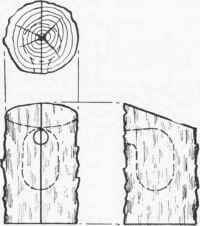
NO. 1
Limb of Tree Split and Hollowed
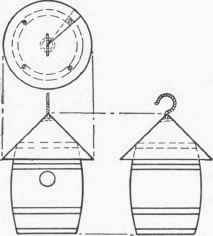
No.2
Small Paint Keg with GalvanizedRoof
Bird House Specifications
The Bottom
As this material is furnished S 2 S it will not be necessary for you to resurface it. Plane a working edge (Chapter II., Paragraph 4) and a working end (Chapter II., Paragraph 5). Lay out and cut the material the size shown in the drawing. Lay out the chamfer (Chapter II., Paragraph 8) and plane to the gauge line.
The Sides
It will not be necessary for you to resurface this material. Prepare a working edge (Chapter II., Paragraph 4) and a working end (Chapter II., Paragraph 5). Lay out and cut the material the size indicated in the drawing. Note: If you prefer, you need not bevel the top edge of the board to receive the roof until after it is assembled. Prepare the two sides exactly the same length, and make sure they are perfectly square.
Continue to:


My Books

