


The Metalworking Shop
Description
This section is from the book "Handcraft In Wood And Metal", by John Hooper, Alfred J. Shirley. Also available from Amazon: Handcraft In Wood And Metal.
The Metalworking Shop
When setting out a metalworking shop for the purpose of giving instruction, the main idea should not be how much work can be turned out in a given time, or how much labour-saving machinery can we put into a given space, but rather, how can the maximum of instruction be given with the minimum of tools and appliances. By giving instruction without the aid of expensive equipment the resourcefulness of the student is developed as well as his adaptiveness. Moreover, a student, just because he is a student, is more likely to damage expensive tools. Often a student can repair a simple tool that he may have broken, and this in itself is a good training. With the shop planned and equipped with the plant and tools illustrated in Fig. 23, it is possible to do all the work indicated on these pages. All the tools and appliances shown have been proved to be the best and the most necessary for the teaching of metalwork on broad lines. But of course many can be done without, or many more can be added as occasion demands. The plan of a shop on page 219 is offered as a suggestion, and could if necessary be modified to suit conditions; but it is based on one in actual use, and is very convenient. An additional advantage would be a storeroom for the safe keeping of metals, etc., and a room suitable for the pickling, washing, and dipping of metals, with a small room for lacquering. The necessary working drawings to be used in connexion with the work could be done in the shop itself, as the patterns, tools, etc., necessary for reference are all handy.

Fig. 23.-Suggested plan for a metalworking workshop.
With reference to the ventilating, lighting, and heating:-
Plenty of windows with casements and fanlights above, so that artificial light is not used more than is necessary, are suggested. In bad weather the fanlights can be opened when the casements cannot. For artificial lighting the use of individual lights to each vice and lathe, consisting of a single counterweight pendant, with switch lamp holder and lamp, are best. These are economical, as only the light actually wanted need be used.
For heating the shop in winter low - pressure steam seems very satisfactory and comfortable. In Fig. 24 will be seen the section of a bench with a rack for files above. The bench should be 2 ft. 9 in. high and 2 ft. 8 in. broad; the front board should be of beech 1 ft. 3 in. wide and not less than 2 in. thick. The bottom of the file rack should be 1 ft. 3 in. from the bench. Leg vices are very suitable for general use, as they are more solid to work on than parallel vices. Various sizes should be obtained, say from 3 1/2 to 4 1/2 in. jaw width. The jaws vary by 1/4 in. The large vices should be fixed in close proximity to the forges. The rack for smith's tools illustrated on page 221 is most convenient if fixed to the wall by the side of the forges, as then the tools are close by and handy for working. In Fig. 26 is shown a strong wood stand for holding a cast-iron block which is used for chopping out work with hammer and chisel, as illustrated on page 62. The block measures 12 x 12 x 21/2 in. A fillet of wood is screwed down all the way round to prevent the iron block jumping off. Six of these blocks should be provided, two for the stands and four for bench use. The shop is designed for use without power; if power was installed the arrangement of the lathes, grindstone, and drilling machines would have to be modified. It is also arranged for eighteen boys and one instructor, but with the aid of another instructor and a little arrangement of the work ten more boys could be accommodated by using the six lathes and two forges, two boys to each forge, so making accommodation for twenty-eight.
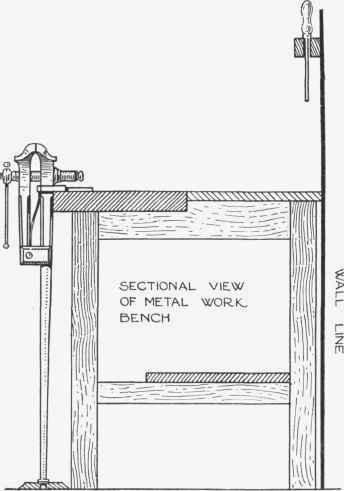
Fig. 24.
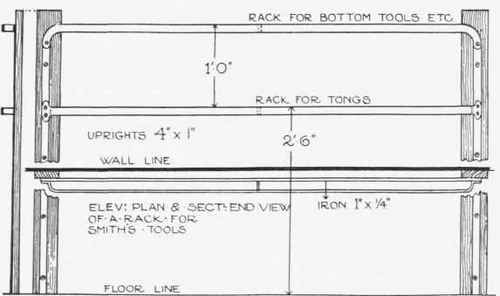
Fig. 25.-Rack for smith's tools.
If the shop was required for the use of advanced students, some additional machinery would be required, such as a planing machine, screw-cutting lathes, etc., and then power would be a necessity, and for the convenience of working it would be best to have all the machines in a separate shop.
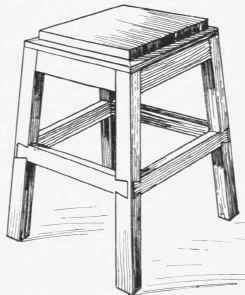
Fig. 26.-A chopping block on wood stand.
Continue to:


My Books

