


Sharpening Cutting Tools With Artificial Grinders. Part 5
Description
This section is from the book "Turning And Mechanical Manipulation", by Charles Holtzapffel. Also available from Amazon: Turning and Mechanical Manipulation.
Sharpening Cutting Tools With Artificial Grinders. Part 5
Fig. 1054.

Concave tools, whose edges when seen in plan form part of a circular line, such as the bead, astragal, and quarter hollow tools, figs. 395 to 398, page 519, Vol. II., are most conveniently and accurately ground upon conical grinders fed with flour emery, or other abrasive powders, after the manner of laps; these grinders are in the form of long cones of small diameter, so that some part of their circumference may agree with the curve of the tool, which may be then ground with great accuracy to the circular form.
Bead tools, exceeding about half an inch wide, are commonly ground upon a soft iron cone, fig. 1055, about seven inches long, one inch and a half diameter at the larger end, and half an inch at the smaller. The cone is mostly furnished with a square tang at a to fit the square hole chuck of the turning lathe in which it is mounted, the smaller end of the cone being pierced in the center with a conical hole for the reception of the center point of the popit head. For tools less than about half an inch wide, shorter cones are used, and which are fixed in a plain chuck, as shown at fig. 1056, so as to be supported at the one end only, as the lesser end of the cone is too small to admit of the support of the popit head, and which is also less required with the shorter cone.
Figs. 1055.

1056.

The cone having been turned true, and its surface slightly roughened by drawfiling, it is then charged with flour emery and oil, and the tool is applied to that part of the cone which fits the curve: and with the face of the tool towards the small end of the cone, in order that the lower side of the tool may be ground to a larger diameter, to give the proper angle of penetration to the chamfer of the tool at all parts of the curve. Large tools, which only require a moderate degree of accuracy, are finished upon a corresponding cone of lead, or hard wood, fed in like manner with flour emery and oil, the emery becomes embedded in the wood, and consequently gives a higher polish to the chamfer of the tool, the rectilinear corners of which are sharpened upon a flat oilstone, and, lastly, the face of the tool is rubbed on the oilstone to remove the wire edge. Quarter hollow tools are treated in exactly the same manner as bead tools and astragals.
Bead tools, bead drills, and revolving cutters, less than about one quarter of an inch wide, that are used in the various apparatus for ornamental turning, although ground in the same manner, require to have more accurate and highly-polished surfaces, as was explained in reference to the angular tools at page 1164; and for these delicate tools the more suitable arrangement is shown in fig. 1057, the instrument for setting bead tools and drills, which consists of a miniature lathe head, mounted on a wooden table-tee, having an iron stem that fits the socket of the common lathe rest. The instrument is driven by a pulley about eight inches diameter, screwed on the mandrel of the turning lathe, the band from which proceeds to the small pulley fixed in the little mandrel of the instrument, which thus admits of being driven at a considerable velocity, to compensate for the small diameter of the grinders, figs. 1058 - 9, which are made as a scries of six brass and six iron truncated cones, each a little more than one inch long, and gradually diminishing in size from the largest, which measures about five-eighths of an inch diameter, to the smallest, which terminates in a point, so that the series serves for all sizes of tools below five-eighths of an inch wide. The cylindrical stems of the grinders are fitted to a plain hole in the mandrel of the instrument; and to ensure their rotation, they are provided with a semicylindrical projection at the end, which slides into a corresponding notch in the mandrel in the same manner as in the drill stocks, figs. 489 and 450, Vol. II. Indeed, fig. 1057 is used also as a drilling lathe; and for this purpose it is generally provided with an assortment of piercing drills for small holes.
Fig. 1057.

Figs. 1058.

1059.
1060.

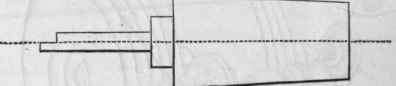
The obtuse cone, fig. 1060 is used for bead drills that are sharpened from both sides, in order to keep the edge central, and give the required degree of penetration.
In using the instrument, the tools to be sharpened are first ground upon the brass cones, charged with a little fine emery powder and oil, and they are afterwards polished on the soft iron cones, supplied with crocus and oil. To give steadiness during the application of the tools, the hand is rested on the wooden table-tee to which the instrument is fixed. The cones are roughened to retain the powders, and the tools should always be applied with the face towards the smaller ends of the cones.
Figs. 1061 to 1076, represent of about twice their usual size, some of the varieties of drills used for ornamenting turned works. The concave sweeps of figs. 1061 to 1071, are sharpened with the instrument for setting bead tools and drills, and the manner in which the tools are applied to the cones will be sufficiently obvious from an inspection of the figures. Figs. 1061 - 2 is the bead drill sharpened from both sides, but all the rest are sharpened from the one side only; and it is quite essential that the cutting edge should be exactly in a line with the center of the drilling instrument, as, should the edge be in the least degree out of the center of rotation, the drill would leave a small portion of the material projecting in the center, and which would spoil the appearance of the work: these drills therefore require in all cases to be fitted to the particular instrument in which they are to be used. The flat surface of the drill is made exactly diametrical, and unlike the screw tools and moulding tools used by hand, these drills do not admit of being sharpened by rubbing the flat face on the oilstone, as such a course would remove the edge from the line of center; the ornamental drills should therefore in all cases be sharpened upon the end only. It will also be seen that with the exception of the three first, they are made to embrace only about the one-fourth of the circle, as when the drills are sharpened with one bevil they can only cut on the one side of the center, and if the drills were made to embrace the half circle, the chamfer of the edge on the second side would be in the wrong direction for cutting, and consequently it could only rub against the work, and impede the action of the drill.
Continue to:


My Books

