


Dover
Description
This section is from "The American Cyclopaedia", by George Ripley And Charles A. Dana. Also available from Amazon: The New American Cyclopædia. 16 volumes complete..
Dover
Dover (Fr. Douvres; anc. Dubris), a seaport (one of the cinque ports) of England, on the S. E. coast of the county of Kent, on the straits of Dover, in lat. 51° 7' N, Ion. 1° 19' E., 62 m. S. E. of London (with which it is connected by the London, Chatham, and Dover, and the Southeastern railways), and 21 m. N. W. from the coast of France, to which it is the nearest English seaport; pop. in 1871, 28,270. The town is on a small bay, in a low interval formed between the lofty cliffs along the shore by the valley of a little stream call the Dour. The older portion is irregularly and rather poorly built, principally on one street, which runs parallel with the valley. The newer part faces the water; this includes many well built houses and several large hotels. There are about 20 places of worship, a theatre, museum, reading rooms, etc. The harbor consists of three basins, and though formerly possessing few advantages, it has during the past 20 years been so improved by the government, at immense cost, that it now forms a good anchorage for vessels of ordinary size. The entrance is sheltered by the admiralty pier, 1,700 ft. long, built of stone.
The trade of the town is inconsiderable; ship building and rope manufacture are carried on, and there are some smaller industries; but its prosperity chiefly arises from the constant passage of travellers and freight to and from the continent, and the visits of those who come in summer for the bathing and sea air. Lines of steamers connect Dover with Calais, Ostend, and Boulogne. The submarine telegraph between England and the continent crosses the channel from Dover to Calais; it was completed in October, 1851. The castle of Dover, one of the most remarkable edifices in England, stands on the summit of a chalk cliff about 1 1/2 m. N. E. of the town. Its walls enclose 35 acres. It is supposed to have been founded by the Romans, but some portions are Norman and Saxon, while others belong to still later epochs. It contains a spacious keep, used as a magazine, and barracks for 2,000 men. Within the precincts of the castle stands an octagonal watch tower, interesting not only as the earliest specimen of Roman architecture, but also as one of the most ancient pieces of regular masonwork in Great Britain. - In the neighborhood of Dover Caesar made his first attempt to land on the British coast, but he was induced to change his point of debarkation by the abruptness of the shore and other difficulties.
Under the Saxon kings it became a position of great importance in the defence of Kent. In the reign of Edward the Confessor it was made one of the cinque ports, and was looked upon as the key of the kingdom. After the establishment of the Norman rule it suffered from the vengeance of William the Conqueror, to whom it had made strong opposition. In 1213 King John performed at Dover the ceremony of submission to the pope, giving up his authority to the papal nuncio. In 1295 the French made a descent upon the place, and committed great depredations.
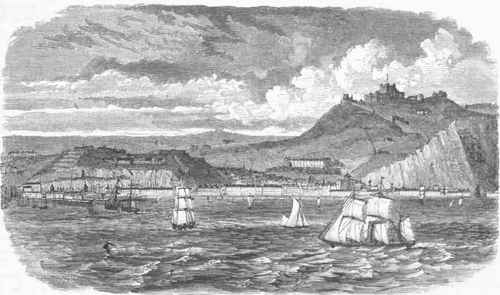
Dover, England.
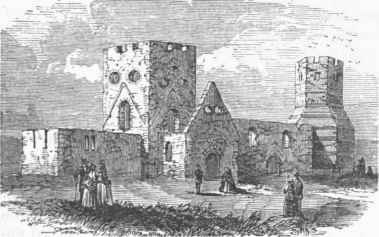
Ancient Church and Pharos.
Dover #1
Dover, a city and the capital of Strafford co., New Hampshire, situated on both sides of the Cocheco river, about 2 m. from its confluence with the Piscataqua, and 12 m. from the ocean, 35 m. E. of Concord, and about 60 m. N. of Boston; pop. in 1870, 9,294. Small craft ascend at high tide to the falls of the Cocheco within the city limits, and improvements in the channel are in progress which will enable large vessels to reach the city. It is connected with Boston and Portland by the Boston and Maine railroad, and with Lake Winnepiseogee by the Dover and Winnepiseogee railroad. A railroad to Portsmouth is in process of construction. The city is regularly laid out, and contains many elegant residences. The city hall is a commodious and substantial brick edifice. The high school building is one of the finest in the state. The Cocheco furnishes great motive power, the principal fall being 32 1/2 ft. The supply of water is maintained through the dry season by draining Bow pond in the town of Strafford, about 15 m. W. N. W., which has been converted into an immense reservoir. Black river, in the S. part of the city, also furnishes water power.
It has four large mills for the manufacture of print cloths, and extensive print works, which produce 31,-000,000 yards annually, valued at $3,410,000. The value of cotton goods manufactured annually is $1,125,000; of woollen goods, $380,000; of boots and shoes (1,200,000 pairs), $1,800,000; of carriages, $75,000; of lumber, $28,000. There are also tanneries, brass and iron foun-deries, machine shops, manufactories of hats and caps, of sandpaper, of glue, and of oil cloth. In 1870 the capital invested in manufactures was $2,031,000; males employed, 1,384; females, 972; value of products, $7,-130,000. There are three national banks, with an aggregate capital of $320,000. The value of property is about $6,000,000. The city is divided into four wards. There is a high school, and 3 grammar and 31 primary schools, employing 36 teachers, and having an average attendance of 1,270 pupils. The city library contains 4,500 volumes. There are three weekly newspapers, and eight churches. - Dover was settled in 1623, and is the oldest town in the state. It was attacked by Indians on the night of June 27, 1689, when 23 of the inhabitants were killed and 29 carried into captivity.
A city charter was granted in 1855.
Continue to:


My Books

