
![previous page: 9. Cytisus [Tourn.] L. Sp. Pl. 739. 1753](../../../images/nav/page_prev.gif)

![next page: 10. Medicàgo [Tourn.] L. Sp. Pl. 778. 1753. Continued](../../../images/nav/page_next.gif)
10. Medicàgo [Tourn.] L. Sp. Pl. 778. 1753
Description
This section is from the book "An Illustrated Flora Of The Northern United States, Canada And The British Possessions Vol2", by Nathaniel Lord Britton, Addison Brown. Also available from Amazon: An Illustrated Flora of the Northern United States, Canada and the British Possessions. 3 Volume Set..
10. Medicàgo [Tourn.] L. Sp. Pl. 778. 1753
Herbs (a single shrubby species in southern Europe), with small 3-foliolate leaves, and small yellow or violet flowers in axillary heads or racemes. Leaflets commonly dentate, pin-nately veined, the veins terminating in the teeth. Calyx-teeth short, nearly equal; standard obovate or oblong; wings oblong; keel obtuse. Stamens diadelphous, the 1 opposite the standard separate from the other 9; anthers all alike. Ovary sessile or nearly so, 1-several-ovuled; style subulate. Pod curved or spirally twisted, reticulated or spiny, indehiscent, 1-few-seeded. [Greek, Medike, from Medea, whence the Medic, or Lucerne, was derived.]
About 50 species, natives of Europe, Asia and Africa. Type species: Medicago sativa L.
Perennial; flowers violet, conspicuous. | 1. | M. sativa. |
Annual; flowers bright yellow, small. | ||
Pod 1-seeded, curved, not spiny. | 2. | M. lupulina. |
Pod several-seeded, spiny on the edges, spirally twisted. | ||
Pod loosely coiled, not furrowed on the edge. | 3. | M. hispida. |
Pod densely coiled, its edge furrowed. | 4. | M. arabica. |
1. Medicago Sativa L. Purple Medic. Alfalfa. Lucerne. Burgundy, Chilian Or Brazilian Clover. Snail Clover
Fig. 2468
Medicago sativa L. Sp. Pl. 778. 1753.
Perennial, much branched, decumbent or ascending, 1°-1 1/2° high, the young shoots and leaves with some scattered hairs, glabrous when mature. Leaves petioled; leaflets oblanceolate or obovate, 2"-12" long, dentate, especially toward the apex, obtuse, truncate or emargi-nate and often mucronate, narrowed or cuneate at the base; stipules entire; peduncles ¥-2' long, bearing a dense short raceme of violet or blue flowers; petals about 3" long; pod pubescent, twisted into 2 or 3 spires.
In fields and waste places, New England and Ontario to Minnesota, south to Virginia and Kansas. Much cultivated for fodder in the southern and western States. Introduced from Europe. Great or Spanish trefoil. Holy-hay. Sainfoin. Summer.

Medicago falcàta L., similar to this, but with yellow flowers and nearly flat, scarcely coiled pods, is occasionally found in waste places. Native of Europe.
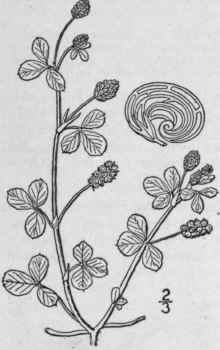
2. Medicago Lupulina L. Black Or Hop Medic. Blackseed. Hop Clover. Nonesuch
Fig. 2469
Medicago lupulina L. Sp. Pl. 779. 1753.
Annual, pubescent, branched at the base, the branches decumbent and spreading, often 1°-2° long; leaves petioled; leaflets obovate, oval or nearly orbicular, variable in size, sometimes 6"S" long, denticulate or crenulate, obtuse, mucronate or emarginate, narrowed or rounded at the base; stipules ovate or lanceolate, dentate; peduncles 1'-3' long; head oblong or cylindric, dense, 2"-10" long; flowers bright yellow, about 1" long; pods nearly glabrous, black when ripe, curved into a partial spire, strongly veined, 1-seeded.
In fields and waste places, common throughout our area, except the extreme north, and widely distributed as a weed in all temperate regions. Native of Europe and Asia. Black or melilot-trefoil. Black-grass. Black-nonesuch, natural grass, horned clover, shamrock, sainfoin. March-Dec.
Continue to:


My Books

