


37. Hydrocótyle L. Sp. Pl. 234. 1753. Continued
Description
This section is from the book "An Illustrated Flora Of The Northern United States, Canada And The British Possessions Vol2", by Nathaniel Lord Britton, Addison Brown. Also available from Amazon: An Illustrated Flora of the Northern United States, Canada and the British Possessions. 3 Volume Set..
37. Hydrocótyle L. Sp. Pl. 234. 1753. Continued
2. Hydrocotyle Cànbyi C. & R. Canbys Marsh-Pennywort
Fig. 3155
Hydrocotyle umbellata var. ambigua A. Gray, Man.
Ed. 5, 190. 1867. Not H. ambigua Pursh, 1814.
H. Canbyi Coult. & Rose, Bot. Gaz. 12: 103. 1887.
Stem creeping, sometimes 12' long, the subterranean branches tuberiferous. Petioles short, or elongated; leaves peltate, orbicular or nearly so, 1/2'-1 1/2' wide, with 7-11 shallow broad mostly crenulate lobes; peduncles elongated; inflorescence mostly proliferous, rarely simply umbellate; verticils 3-10-flowered; pedicels 1"-2" long, or some of them rarely 4" long; fruit about 1" long and 2" broad, slightly notched at both ends when mature, much flattened, the intermediate ribs corky-thickened, the dorsal one very obtuse.
In moist ground, New Jersey to Maryland. The record of this species from Florida in our first edition should apply to H. australis. June-Sept.
3. Hydrocotyle Verticillàta Thunb. Whorled Marsh-Pennywort
Fig. 3156
H. verticillata Thunb. Diss. 2: 415. pl. 3. 1798. Hydrocotyle interrupta Muhl. Cat. 30. 1813.
Similar to the two preceding species. Inflorescence always proliferous, 1'-2' long; verticils 2-6-flowered; pedicels very short, usually less than i" long; fruit about 1" long, 1 1/2"-2" broad, rounded or truncate at each end, not notched; intermediate ribs of the carpels filiform, not corky-thickened, the dorsal one acute.
In moist soil, Massachusetts to Florida, mainly near the coast, west to Texas. Arkansas and southern California, and in the West Indies, Central and South America. June-Sept.
Hydrocotyle austràlis Coult. & Rose has fruiting pedicels 1"-2" long, but is otherwise similar to this species. It ranges from southeastern Virginia to Florida. Cuba.
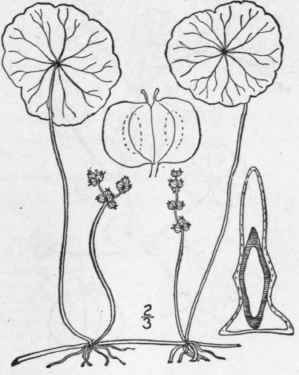
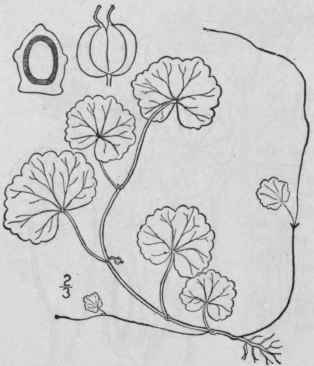
4. Hydrocotyle Americàna L. American Marsh-Pennywort. Penny-Post. Fig- 3157
Hydrocotyle americana L. Sp. Pl. 234. 1753.
Stems filiform, creeping, often bearing small tubers; petioles rather short, seldom over 2' long; leaves membranous, reniform, not peltate, deeply cordate, 1'-2' wide, with 9-13 shallow crenulate lobes; umbels sessile or very nearly so at the nodes, 1-5-flowered; pedicels less than 1" long; fruit slightly more than i" broad and nearly as high, the ribs all filiform.
In wet places, Nova Scotia to Ontario and Minnesota, south to southern New York, Pennsylvania, and in the mountains to North Carolina. Ascends to 3000 ft. in Virginia. June-Sept.
5. Hydrocotyle Ranunculoides L. F. Floating Marsh-Pennywort
Fig. 3158
Hydrocotyle ranunculoides L. f. Suppl. 177. 1781. Hydrocotyle natans T. & G. Fl. N. A. 1: 599. 1840.
Stem usually floating, sometimes creeping on shores, rather stout, abundantly rooting from the nodes, branched, 6'-24' long. Petioles elongated, weak; leaves reniform, 1'-2' wide, not peltate, 3-7-cleft, deeply cordate at the base, the lobes crenate; peduncles 1'-3' long, much shorter than the petioles, recurved in mature fruit; umbels simple, 5-10-flow-ered; fruit nearly orbicular, about 1 1/2" broad, the ribs obscure and filiform.
In ponds and swamps, eastern Pennsylvania to Florida, near the coast, west to Texas, Arkansas, and on the Pacific Coast from Oregon to Lower California. Also in Cuba, Central and South America, Abyssinia and Italy. June-Sept.


6. Hydrocotyle Rotundifòlia Roxb. Asiatic Pennywort
Fig. 3159
H. rotundifolia Roxb. Hort. Beng. 21. 1814.
Tufted and creeping, the stems very slender. Leaves reniform-orbicular with a narrow or broad sinus, glabrous on both tides or hispidu-lous beneath, 5"-10" broad, their petioles slender or filiform; peduncles as long as the petioles, or shorter; capitate umbels several-flowered; fruit slightly notched at the base and apex; its ribs filiform.
Escaped into lawns from cultivation in greenhouses, Pennsylvania, Kentucky and District of Columbia. Native of tropical Asia. Summer.
Continue to:


My Books

