


2. Queens of the World. No. 1. Queen Mary of England
Description
This section is from "Every Woman's Encyclopaedia". Also available from Amazon: Every Woman's Encyclopaedia.
2. Queens of the World. No. 1. Queen Mary of England
It was during her girlhood days at White Lodge that Princess May became intimately acquainted with King George and his elder brother, the Duke of Clarence. The latter was three years, and King George only two years, her senior, and many were the frolics and games they had together in the nursery, and it was with genuine regret that she left her playmates behind when the Duke and Duchess of Teck decided to close White Lodge and spend some time abroad.
At that time Princess May was sixteen years of age. Her birth month, of course, was May, and not April, as previously stated. For two years the family lived at Florence, where the Princess studied Italian, and had the opportunity of cultivating those artistic faculties which she inherited from her father. Sketching in water-colours was her favourite pastime during her stay at Florence, and many of the charming landscapes surrounding that city found a place in her sketch-book. She also devoted considerable time to historical reading under Madame Bricka, who was appointed her governess.
In 1885, when she was eighteen years of age, Princess May returned with the rest of the family to England, and again found herself in her old home at White Lodge. It was shortly after her return to this country that she was confirmed by the Bishop of St. Albans, and the following year saw the Princess at her first Drawing Room, which was held by Queen Victoria on March 23rd, 1886. From that time she frequently appeared at public functions with her mother, and quickly won the affections of the people by her beauty, graciousness, and charm.
It was shortly after her parents had celebrated their silver wedding in 1891 that Princess May's engagement to the eldest son of the Prince and Princess of Wales, the Duke of Clarence and Avondale, was announced. It came as no surprise to the nation, for the intimate friendship which had existed between the children of the Duchess of Teck and those of the Prince and Princess of Wales was well known. And then came the tragic sequel, for while the actual arrangements for the wedding were in progress, the ill-fated Prince "Eddy" succumbed to an attack of influenza on January 14th, 1892, after five days' illness.
His loss was a terrible blow to the Princess and after the funeral she went to pay a long visit with her mother to Georgiana Lady Wolverton in the South of France. She did not return for over twelve months, and then once again she took her place in the Royal circle, and renewed her friendship with Prince George and Princesses Victoria and Maud of Wales.
It was an open secret that both the Duke of Clarence and Prince George were in love with Princess May, and as one who knew the family intimately says, "the obligations of Royalty and deference to public sentiment had to be obeyed in the first place; but there was no question of the mutual attachment which resulted in the announcement to the world, on May 3rd, 1893, of the betrothal of Princess May to Prince George, or, rather, the Duke of York.
A popular Wedding
The story goes that the proposal actually took place during a walk in Richmond Park from White Lodge to Sheen House - the residence of the Duke and Duchess of Fife, where Prince George was then staying'. Queen Victoria officially stated that she ' gladly gave her consent to the union," and gave the wedding ceremony - which took place in the Chapel Royal, St. James's, on July 6th, 1893 - all the distinction in her power by attending in State.
Not since the marriage of King Edward to the "Sea King's daughter" from Denmark had the nation been so keenly interested. Presents poured in from all quarters, and intense enthusiasm was aroused by the happy thought on the part of Princess May to have an all-british wedding. Every item in the trousseau was of British manufacture. The bridal dress was of satin woven in Spitalfields; tweeds in the trousseau all came from Scotland; the flannel represented Wales, and the lace came from Ireland. All the bridesmaids were princesses of the English House - the Princess Victoria, the Princess Maud (now Queen of Norway), Princesses Victoria Melita, Alexandra, and Beatrice of Edinburgh; Princess Victoria of Schleswig-holstein, Princess Margaret of Connaught (now Crown Princess of Sweden), Princess Patricia of Connaught, Princess Alice of Battenberg (now Princess Andreas of Greece), and Princess Ena of Battenberg (now Queen of Spain).
The Archbishop of Canterbury, Dr. Benson, performed the ceremony, and was assisted by the Bishop of London and the Bishop of Rochester. Among those who attended were the present Tsar, the late King and Queen of Denmark, and Prince and Princess Henry of Prussia. After a wedding breakfast at Buckingham Palace, the Royal couple went to spend their honeymoon at York Cottage Sandringham.
The Princess had been married not quite a year when she presented the nation with a successor to the throne, Prince Edward being born at White Lodge on June 23rd, 1894; afterwards Prince Albert was born on December 14th, 1895; Princess Victoria Mary, April 25th, 1897; Prince Henry, March 31st, 1900; Prince George, December 20th, 1902; and Prince John, July 12th, 1905.
King George and his consort have always been careful to train their children in the same simple, unaffected manner which characterised their own childhood days. As Prince of Wales, the King had many claims upon his attention, and he was never so pleased as when, being free from his multifarious engagements, he was able to spend a quiet evening at home, surrounded by his wife and family. On these occasions father, mother, and children entered together into the joys of the home as if thrones and principalities had no existence for them. If it had been possible for his subjects to peep through the walls of Marlborough House but a day or two before the beginning of the fatal illness of King Ed-w a r d, they would have seen the Prince of Wales - now our present Sovereign - en-gaged in a game of squash racquets with one of his sons.
the Queen as a mother
And just as Princess May was the constant companion of her mother, so her own daughter, Princess Mary, shares much of her mother's society. Queen Mary is the perfect model of an English wife and mother. She is intensely domestic, and never demonstrative. Her children she has brought up admirably, always trying to be their companion, and to enter into all their interests; whilst she has taken care they shall be more simple-minded and natural than the bulk of children one meets. Both she and King
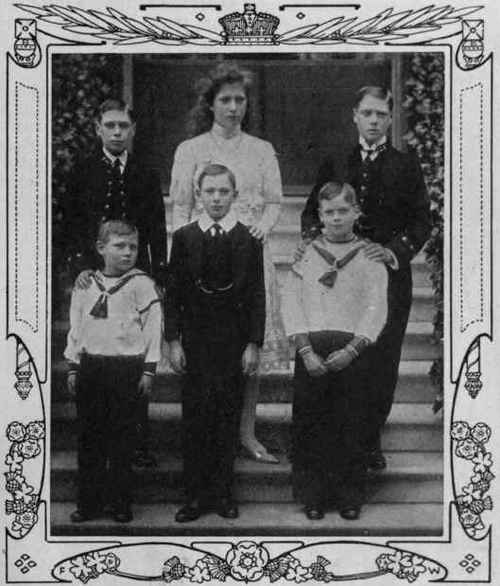
Queen Warp's Children
The names reading from the top of the picture and from left to right, are: Prince Albert, born December I4th, 1895; Princess Victoria, April 25th, 1897; the Prince of Wales, June 23rd, 1894; Prince John, July 12th, 1905; Prince Henry, March 31st, 1900;
Prince George, December 20th, 1902.
George are never so happy as in the bosom of their family, and this taste for domesticity cannot fail to have an effect upon the tile of the whole country. "Children are the favourite toys of their parents," Queen Mary once said to her little daughter, in answer to the question, "Mummy, what do you do with out toys?"
Few women have seen more of the world than Queen Mary, for she has visited Australia, New Zealand, South Africa, Canada, and India.
It was on March 16th, 1902, that the Queen and her husband set out from Portsmouth on board the Ophir for their historic tour of the Colonies - a voyage which not only made their Majesties great popular and Imperial figures, but also helped in a great measure to knit the Empire together. Then, in 1905, they set out for a protracted tour of India, returning again on May 6th, 1906. after an absence of seven months; but their stay was a brief one. for a few days later saw them on their way to represent King Edward and Queen Alexandra in Madrid at the m a r r i age of King Alfonso with his English bride. Back in England, their stay was again a short one, for on June 22nd they were present in Norway at the coronation of King Haakon and Queen Maud.
Since these foreign visits and tours, Queen Mary has devoted herself mainly to her children,and to the many charitable organisations in which she takes so practical an interest.
the Queen and Charities
Her activity in connection with the Happy Evenings Association and the Invalid Children's Aid Society, to mention but two of the bodies supported by her Majesty which have for their object the brightening of young lives, shows how much Queen Mary has the interests of the children of Great Britain at heart.
Continue to:


My Books

