


Ancient Houses And Their Chatelaines - Hatfield House And Apsley House. Continued
Description
This section is from "Every Woman's Encyclopaedia". Also available from Amazon: Every Woman's Encyclopaedia.
Ancient Houses And Their Chatelaines - Hatfield House And Apsley House. Continued
It was the son of this Lord Burleigh who made many improvements at Hatfield, entirely rebuilding a great part of it, and laying out the gardens in the stately plans of the day. His great out-of-door work, however, was the vinery, which still exists. For this 20,000 vines were brought from France, at a cost of £50. It is entered through an avenue of yew trees, cut so as to give an appearance of walls and towers with loopholes and battlements.
Samuel Pepys tells us in his diary of 1661 that he walked all down the vineyard, "which is now a very beautiful place again, and then through all the gardens such as I never saw in all my life, nor so grand flowers, nor so great gooseberries, as large as nutmegs."
The interior of Hatfield is full of interest.
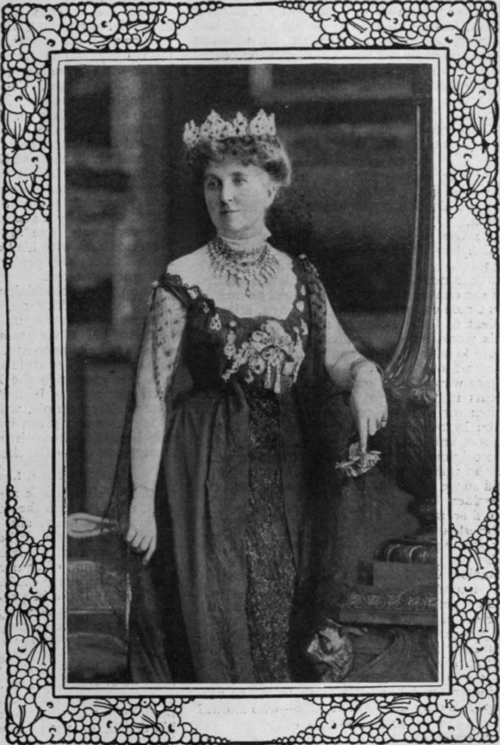
Her Grace the Duchess of Wellington, mistress of Apsley House. Apsley House is rich in relics of the Iron Duke, and still retains the shutters which were put up to preserve the hero from the fury of the mob in the riots of Queen Victoria's reign H. Walter Barnett
The great hall, which is 50 feet by 30 feet, is oak panelled and hung with fine old tapestry. A curious fixed settle runs all round the wall, ending in a beautiful massive oak screen carved with the various coats of arms of those connected with the family.
At the upper end rises the majestic Grand Staircase. This comprises flights with five landings, and above the massive balusters grin the carved heads of genii. The staircase has a curious hatch-gate of carved oak, which in Elizabethan days was placed there to prevent the dogs wandering into the staterooms which open out at the top of the staircase.
The most important of these state-rooms is the Great Chamber, or King James I.'s Room, which has a magnificent ceiling of gold and colours, and is furnished with gilt furniture upholstered in red plush. Above the centre of the white marble chimney-piece frowns a life-sized statue of this monarch in dark stone, in all his kingly state of robe and sceptre.
This room also contains a portrait by Reynolds of George III. and Queen Charlotte.
A Double-faced Portrait
A long gallery runs the whole length of the southern front of the house, and here is more elaborately carved oak and beautiful china.
In the library hangs a curious picture, which has two heads apparently painted on one body. The story goes that a portrait of the famous Duke of Monmouth was painted on the canvas, and there remained as long as his Grace was prosperous, but when, after his defeat at Sedgemoor, he made his exit from this world on Tower Green, it was thought more loyal, or perhaps safer, not to have the portrait of a traitor in the house, so the figure was painted out. The empty surface seems in the course of time to have been taken for a blank canvas, and was used as a background for the figure of the fourth Earl of Salisbury. Then the faint outlines of the original being discovered the lineaments of the unhappy duke were partly restored, and so we see one man looking over another's shoulder.
Other pictures in this room are of great interest, especially that of Queen Elizabeth, by Zucchero. There are no fewer than five original portraits of that queen in the mansion, which contains also many portraits by famous masters, including the well-known picture of Charles I. by Vandyck.
Here is preserved, too, the wooden cradle in which the baby Elizabeth passed her youthful hours of slumber. The wood is perceptibly gnawed and dented. Perhaps, in one of her early Tudor tempers, the Princess fixed her little teeth in it - or perhaps it is only the work of mice - who knows? Historic Treasures
A great number of historic manuscripts are preserved in the library. One sees there the forty-two articles of Edward VI. with his autograph, two letters from Wolsey, and his instructions to the ambassador sent to the Pope by Henry VIII., both autographed. There is also a quaint pedigree of Queen Elizabeth, richly emblazoned, tracing her ancestry back to Adam. One can imagine her Highness taking great delight in this work of art. There are two of the much debated "casket" letters of Mary, Queen of Scots.
The silk stockings given to the good Queen Bess by Sir Thomas Gresham are treasures of Hatfield, and so is a purse belonging to James I.
There are few war trophies at Hatfield, if one excepts two banners presented by the Duke of Wellington to the then Marquis of Salisbury, part of the "spoil of Paris in 1814."
The great Duke has also another little memorial at Hatfield, where, under one of the windows in the stable, is a stone with the inscription, "The last charger of Arthur, Duke of Wellington (descended from his Waterloo charger, Copenhagen), was presented by the second Duke to Mary, Marchioness of Salisbury, June 18, 1852, and was buried near this spot, Feb. 24, 1862."
Doubtless, the great Duke admired the peaceful atmosphere of Hatfield, and one can imagine him visiting this place of many memories, and comparing it perhaps with his own beautiful place, Strathfieldsaye, presented to him by a grateful country.
Nevertheless, one always associates this Waterloo hero with his London home, Apsley House, where are preserved so many relics of historic interest.
The present chatelaine of this stern mansion, Lady Wellington, has done much to soften and beautify the interior, and it has been to her a congenial task, for she is artistic to her finger-tips. Even in dress she has a simplicity of style all her own.
A few years ago the Duchess invented a particular style of bonnet, which she usually wears. Very simple, with just a suggestion of Marie Stuart given by the peak in front, this becoming head-dress fastens with soft strings tied under the chin.
No. I, London
Lady Wellington is a gifted conversationalist, and although she does not entertain on a very large scale, she is very popular in society and loves to gather round her a select coterie, mostly of people interested in art.
Her children, of course, are all grown up, and there is every evidence that the spirit of the Iron Duke has been handed down at least in one instance, as some little while back her son, Lord George Wellesley, bravely risked his own life to save a girl from drowning.
Apsley House, or No. 1, London, as it has been nicknamed, is not an ancient building, and dates only from Georgian times, being built by the Lord Chancellor Bathurst. On his death, in 1794, it was bought by the Marquis of Wellesley, and given by the nation to the Duke of Wellington in 1820.
He. it was who had the present portico erected, and later added the shutters, which give a touch of human pathos to the house.
These shutters were put up by the Duke during the riots in London, when the mob turned upon their favourite and stormed his house. When peace was restored the Duke refused to remove the shutters, and kept them as a reminder of the fleeting glories of the world.
The most important room at Apsley House is the historic Waterloo Chamber, where for many years the Iron Duke was wont to give banquets to those who fought with him at Waterloo.
The tables on these occasions were always decorated with great bunches of artificial flowers. Six of these are still preserved, quaint Victorian arrangements of dahlias, camellias, larkspur, jessamin, and auriculas, stiffly massed together, which doubtless accorded well with the dress of the time.
Here, too, are some famous pictures, especially the collection of Joseph Bonaparte, which fell into the victor's hands after the great battle.
The Duke would sometimes permit experts to view his treasures, and these gentlemen would often assign the paintings to other artists than those whose names appeared on them, thus raising endless discussions.
At last this became so annoying to the Duke that he had all the labels removed, saying, "Now they can say they were painted by whom they like!"
A Curious Picture
There are two Wouvermans at Apsley House for which a great modern financier has offered £40,000, and a priceless little Cor-reggio of "Christ on the Mount of Olives."
There is a remarkable peculiarity about this latter picture. As seen by the spectators the painting contains only the Divine Figure and the Angel in high golden light, the whole of the right side of the canvas being in darkness.
When, however, it was photographed some time ago the plate revealed clearly the figures of the Disciples in the gloom, and they are also plainly seen in the print, though not the minutest examination of the painting in all lights allows them to be seen with the naked eye.
Till recently the study in which the great Duke was wont to transact all affairs of state, and the tiny adjoining room which he elected to use as his bedroom, remained exactly as they were at the time of his death. The present Duke and Duchess, however, regarded this sentiment as morbid, and they had the room set in order, though preserving all of salient interest, and his plain, high desk and office stool still remain.
The Drawing-Room At Apsley House
The beautiful Piccadilly drawing-room is, of course, a trifle more modernised than the rest of the house, and contains many art treasures. The most prominent picture is the "Chelsea Pensioners Reading the News of Waterloo"; there is, too, a lovely Murillo, and some fine Dutch and Flemish pictures.
Among other treasures the Duchess possesses a splendid service of Sevres made for Napoleon I, in which every single piece is different, the set being practically priceless.
In the cellars at Apsley House is kept the wonderful service of plate presented by Portugal to the Iron Duke.
The Duke's insignia of the Order of the Garter is carefully treasured, and this, by special permission of Queen Victoria, the family were allowed to retain.
At one time Apsley House was open to the public, but now, except with a special permit, it is impossible for a stranger to go over the house.
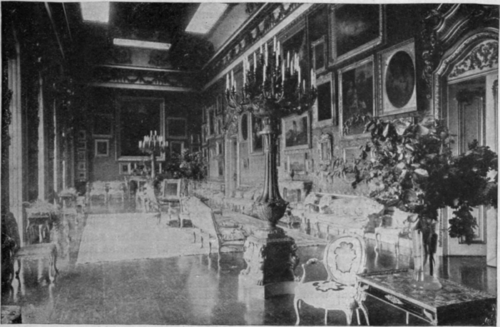
The famous Waterloo Chamber, Apsley House. Here was held the annual dinner given by the Iron Duke to those who fought with him at Waterloo H. N. King D 25 I X
Continue to:


My Books

