


Plan For A Rose-House And Conservatory
Description
This section is from "The Horticulturist, And Journal Of Rural Art And Rural Taste", by P. Barry, A. J. Downing, J. Jay Smith, Peter B. Mead, F. W. Woodward, Henry T. Williams. Also available from Amazon: Horticulturist and Journal of Rural Art and Rural Taste.
Plan For A Rose-House And Conservatory
The rapid progress which has been made in Horticulture within the last 15 or 20 years, has very naturally given rise to a variety of forms for glass structures. These forms, and their perfect adaptation to the various purposes for which they are required, have attracted the attention of the best Horticulturists of the country; for we find from time to time various articles (some of them very elaborate) make their appearance in the different periodicals devoted to Horticulture.
I notice in the March number of the Horticulturist, a very excellent one on the construction of cheap graperies, from the pen of Wm. Saunders, of Germantown, Pa., which may be considered as all the more valuable, as he is a thorough practitioner, and understands well what he writes about. I also notice a plan in the June number, of an Orchideous house, by M. Coleman, of Westchester, N. Y. Now, in my zeal for Horticulture, I also desire to contribute my mite, in the shape of a plan for a Rose-House and Conservatory, which, if you consider at all worthy of a place in your journal, you can publish in any shape you like. The design, as you will observe, is intended to serve a twofold purpose, viz: the largest, or south division, is to be used as a winter garden; the other, as a covered way to other buildings, and will be so constructed that each division may be used separately, or form a whole, as circumstances may dictate. Perhaps it may not be considered inappropriate, before entering more minutely into the details of this plan, to give a slight description of the place for which it is intended.
Hommock Manor, the coutry-seat of B. M. Whitlock, Esq., is situated in West Farms Township, on the East river, or Sound, about 3 miles from Harlem. The estate contains several hundred acres; but that part on which the dwelling is situated, is, as its name implies, a complete Hommock of about 20 acres - which at high tides is nearly surrounded by water - and is approached from the main part of the estate by a causeway. The whole of the ground contained in the Hommock is devoted to ornamental or pleasure ground, which is always kept in fine order. The immense pile of stabling in this place is well worthy of remark, as it is somewhat unique. The stables will accommodate about 40 horses, and the carriage house about half that number of carriages. From the centre of the pile, rises a bell tower of three stories, the lower one of which is fitted up as a lecture and a school room. Those above are used as observatories; while below are the stables and carriage-houses, jutting out in numerous projections, with pointed gables and elaborate drapery. These, from their peculiarity, form quite an interesting feature. The whole throughout is fitted up with numerous gas burners.
The gas for lighting this, and the dwelling house, and other buildings, is supplied from a highly architectural and ornamental gas-house, in which the gasometer is placed, which is filled from the retorts in a building adjoining.
A beautiful circular, or rather curved drive skirts the base of the Hommock, on the north of which is situated the bathing-rooms, boat-house, etc.; while statuary, and seats of various kinds embellish the grounds. But the principle feature, and the one to which I desire to draw particular attention, is the immense number of large forest trees, which were removed from a great distance to their present site. Four years ago, the Hommock was nearly destitute of trees of any description; whereas now, there is a luxuriant growth of timber. To obtain this result, Mr. Whitlock, with an enter-prize and liberality that does him credit, and which might well be imitated by some other would-be improvers who have the means, but not the enter-prize or liberality to carry out their designs, commenced operations by removing to his grounds, from a distance of two or three miles, forest trees of large size - many of them upwards of 60 ft. in height, and 15 to 18 inches and upwards in diameter, where they are now flourishing, many of them, in all the luxuriance of their pristine splendor.
They are for the most part Elms and Maples; which in one or two instances present as nice a mor-ceau of forest scenery as any one could desire.
A small portion of the ground is devoted to the raising of small fruits and flowers. On this portion are situated the glass-houses: one of which is a curvilinear double-pitch, cold grapery, 20 ft. wide, and upwards of 10 ft. in length; another is a rose-house 16 ft. wide by 60 ft.' in length; also a forcing-house, for vegetables, 80 ft. long, erected from the designs and under the superintendence of the writer. On one side of this ground, and nearer to the dwelling, is situated the group of buildings to which it is intended the house in the plan here shown shall form the connecting link between them and the dwelling. This group consists of the gardener's cottage, forcing grapery, plant-house, ten-pin alley and billiard-room, which are so constructed as to communicate with each other; but as they are placed at a distance of nearly 150 ft. from the dwelling, it was necessary to have a communication of some sort, so that the family or visitors might traverse the intervening space at all seasons, without exposure to the weather. (Necessity, it has been said, is the mother of invention, hence the plan adopted).

B. M. WHITLOCK's ROSE-HOUSE AND CONSERVATORY.
DRAWN BY WILLIAM WERSTER, GARDEN ARTIST.
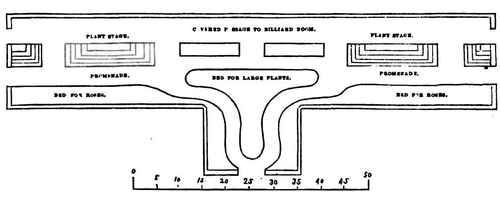
GROUND PLAN.
The structure, when finished, will be 103 ft. in length, by 21 ft. in width, viz: the covered way, or corridor, 7 ft. wide and 10 ft. high at the highest point of the roof; the winter garden will be 14 ft wide and 14 ft. high at the highest point of its roof. From this it will be seen that there will be a space of 4 ft. high, and running the whole length of the building above the covered way. Here is where the ventilators will be placed, as the roof will be a fixture without openings. The projection in the centre is 14x20 ft. The stages shown on the ground-plan are designed for specimen plants in pots. In the rose-bed, which runs along the front of the house, are to be planted pillar roses, which will be trained up the pillars and under the roof; and the rest of the bed planted with standard and dwarf roses. The beds marked " climbing plants" are for passifloras and other plants of a similar nature, to be trained on wires to the roof, where they will hang in festoons. The part marked "large plants," in the centre, is for camelias, magnollias, etc, where they will be planted in the soil. The openings in the ground plan are to be filled with glass doors; which will form either a means of communication or separation, as the exigences of the case may require.
The whole will be heated by means of a flue and hot-water pipes concealed beneath the walks.
One great object in publishing this plan, is to show how advantageously old materials may be worked into a house of this kind; for all the circular-headed windows, with a corresponding number of square ones, belonged to the old Brick Church in Beekman Street, which was pulled down to make room for stores; so that the plan had to be got up to meet the material, and not, as is usually the case, the materials to suit the plan. The design is to make this a summer garden, as well as a winter garden. By covering the roof during the hot weather with canvas and removing the front sashes and opening the rear ones, a thorough circulation of air can be obtained during the hottest weather, which will eminently fit it for plants in pots.
Continue to:


My Books

