


Sideboards. Part 3
Description
This section is from the book "Colonial Furniture In America", by Luke Vincent Lockwood. Also available from Amazon: Colonial Furniture In America.
Sideboards. Part 3
Figure 207 shows a very beautiful sideboard with eight legs; the outer ends are concave, then a short, straight section, and the centre is serpentine. On the left end is a drawer and on the right a cupboard. In the short, straight section are bottle drawers, and a recessed cupboard is below the centre drawer. The piece is quite elaborately inlaid. In addition to the oval lines on the drawers and doors, on the stiles are inlaid shells and oval panels of satin-wood, and on the legs are pendent flowers. This piece is the property of Mr. R. T. Smith, of Hartford.
Figure 208 shows a corner sideboard in the Bulkeley Collection. The front is curved, and the piece stands on four legs in front and a single leg at the back, in the corner. About the drawers and doors are bands of inlay.

Hepplewhite Corner Sideboard, 1790-1800.
Sideboards of which those above shown are types remained in favour for a considerable period. They probably were known and used here at about the same date as in England, and if we deduct ten years from the date of the published design, on a reasonable supposition that they may have been already executed before the designs were published, 1778 would be as early a date as we should obtain for the introduction of this style. That they were made as late as 1804 is certain, for the writer has seen a bill for a sideboard very similar to Figure 206 dated in that year.
These sideboards average about six feet in length and twenty-four inches in width, though they were made in many shapes and sizes, sometimes in miniature, and occasionally one is seen which is made to fit the corner of a room, the top being triangular.
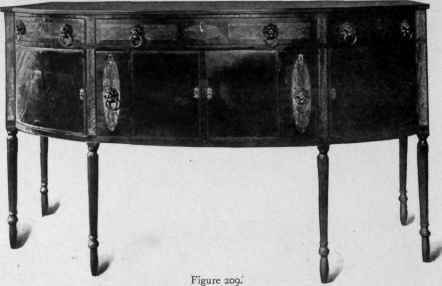
Sheraton Sideboard, 1790-1800.
In 1791 Thomas Sheraton, of London, published a book containing a number of designs for sideboards. He professes great dislike for Hepplewhite's work, but nevertheless his designs show the influence of that maker. He made great use of the slender fluted leg in place of the square tapering one, and used inlay both in wood and metal. Some of his extravagant pieces are elaborately painted and trimmed with brass.
The majority of sideboards in this country which are modelled after his designs are comparatively plain, most of them having no inlay.
Figure 209 shows a Sheraton sideboard which very closely resembles the Hepplewhite ones above described. The front is curved, and on the front of the drawers are bevelled panels of satin-wood. Oval panels of the same wood are on the bottle drawers. At either end and at the centre are cupboards. The handles are lions' heads holding rings. The legs, six in number, are turned and reeded in the manner popular in Sheraton's work. The piece is the property of Mr. Samuel Pray, of Boston.
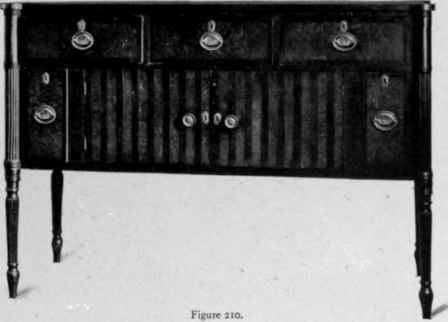
Sheraton Sideboard, 1795-1810.
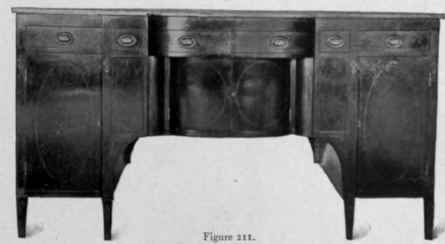
Sheraton Sideboard, 1790-1800.
Figure 210 shows a Sheraton sideboard, the property of Mr. Dwight Blaney, of Boston. There are three drawers across the top, below which are bottle drawers at cither end of the cupboard. The drawer fronts are of bird's-eye maple with mahogany border, and the cupboard doors are inlaid with strips of the woods alternating, and on either side of the doors is a fine network. The turned legs, which are reeded, extend to the top, which is cut to cover them.
Figure 211 shows a large sideboard, the property of Mr. Marsden J. Perry, of Providence. At either end are large cupboards extending close to the floor. The centre section is raised higher from the floor and the drawers have a swelled front, while the cupboard below is recessed. A bottle drawer is at either end of the centre. An oval band of inlay is about the drawers and door, and about the stiles are inlay panels and fleur-de-lis. The piece stands on stub feet. The top is a large slab of marble.
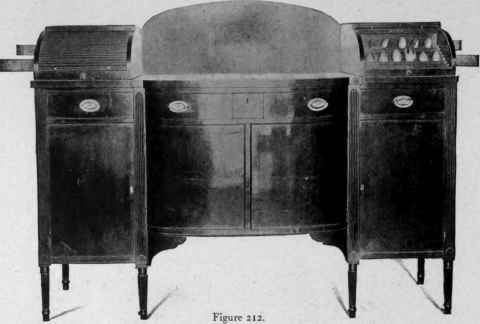
Sheraton Sideboard, about 1800.
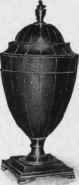
Figure 213. Knife and Spoon Box, 1790-1800.
A sideboard which belongs to Mr. Meggat is shown in Figure 212. The knife-boxes are attached to the top and furnished with sliding scroll covers. Two small drawers pull out from the ends of these, as shown in the illustration. Many sideboards similar to this in general style are found which have, instead of the attached knife-boxes, the end sections raised about four inches above the centre, probably designed to hold knife-boxes in urn shape, one of which is shown in Figure 213.
The top of these urn-shaped boxes is not on a hinge, but is supported by a rod of wood running through the centre, which, when the top is raised sufficiently, releases a spring, thus holding the top in that position. This box belongs to Mr. Meggat. The fashion of making the knife-boxes in urn shape is not original with Sheraton, as it had been extensively used by other English cabinet-makers before this time. They are very fine specimens of cabinet work, the fitting of the graduated sections requiring a skilful workman.
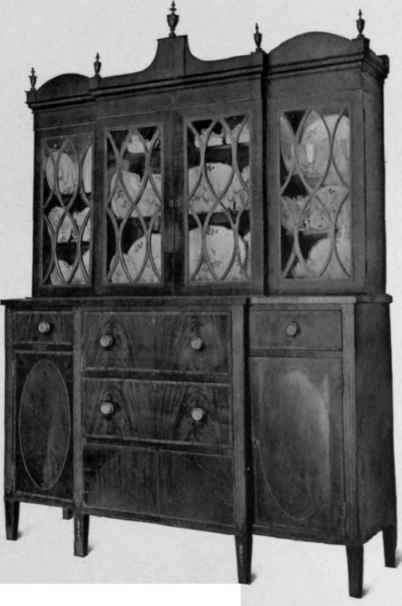
Figure 214. Sheraton Sideboard with china closet, about 1800.
Figure 214 shows a Sheraton sideboard with a china closet above, the property of Mr. Francis H. Bigelow, of Cambridge, Massachusetts. The cornice is composed of a fillet, a cyma recta, a broad and narrow fillet, a cove, an astragal, and a fillet, and on the top are five urns. The glass in the doors is shaped in curves. In tin- Clipboard part are two long cupboards, and at the centre is a desk drawer and a cupboard hidden by a tambour slide. The feet arc of the stub type with pendent flowera inlaid. On the stiles are inlaid parallel lines and an inlay edge is on the doors and drawers. On the cupboard drawers are also bevelled panels. The handles are brass rosettes.
Continue to:


My Books

