


Sideboards. Part 2
Description
This section is from the book "Colonial Furniture In America", by Luke Vincent Lockwood. Also available from Amazon: Colonial Furniture In America.
Sideboards. Part 2
Figure 201 shows a sideboard table, the property of Professor Barrett Wendell. It stands high from the ground on straight legs whose surfaces are cut in double ogee mouldings. The lower edge is finished with a moulding and the corners with brackets.

Sideboard Table, 1760-70.
Figure 202 shows a sideboard table of a little later date. It has a long swell on the front and at the back is a serpentine shelf. In the centre of the skirt and the back are carved, in cameo carving, urns and festoons, and at the ends, on the back, and above the legs are carved rosettes. A thumb-nail moulding finishes the edges. The piece stands on Marlborough legs which are fluted. This piece is the property of the Tiffany Studios.
The first style of sideboard which is commonly found in this country is the slender-legged inlaid mahogany one commonly credited to Chippendale. It is, however, not in any sense Chippendale either in design or workmanship. The statement is repeatedly met with, and usually supported by traditions as to date of importation or purchase, that sideboards of this kind date before 1750. This, of course, is impossible, as there is no trace of any furniture made with a straight, tapering leg, and decorated with inlay, as these sideboards invariably were, as early as 1750. The fact is that this fashion originated with an English designer named Thomas Shearer, a member of the London Society of Cabinet-makers, whose book of prices was published in 1788. The designs therein shown for serpentine inlaid sideboards arc signed by Shearer. In Hepplewhite's own book of designs, published a little later, he adopts this same fashion in his sideboards, and as his reputation seems to have much outlasted Shearer's, they generally bear his name.

Sideboard Table, 1780-90.
The book of prices gives this interesting list of woods which were principally employed by these makers for marquetry and inlay: "satin wood, either solid or veneered, manilla, safisco, havannah, king, tulip, rose, purple, snake, alexandria, panella, yew and maple," the principal wood being, of course, always mahogany. Great numbers of sideboards made after these designs are still to be seen in this country, which were undoubtedly made here, judging from the fact that the veneering is on pine, and the insides of the drawers and back are of the same wood. The outlines of the fronts and sides are varied in many ways, as is also the arrangement of drawers and cupboards. The inlay also is sometimes but an outline of holly and satin-wood around the top, drawer fronts, and legs, and sometimes quite elaborate marquetry designs in many-coloured woods arc used. The handles are almost invariably the brass ones with oval plates.
A Shearer or Hepplewhite sideboard of very graceful design, belonging to Mrs. L. A. Lockwood, is shown in Figure 203. The front is serpentine in shape, an extra curve being added below its two centre drawers; the drawer fronts and top are veneered in very finely grained mahogany on whitewood. This is usually the case, a sideboard of this kind being seldom met with where the drawer fronts are solid. The fan inlay in the corners of drawers and cupboard doors, as well as the wreath design on the legs, is characteristic. At least one drawer is usually arranged in sections to hold bottles.
Figure 204, the effect of which is very much marred by the cheap modern handles, is also a fine example of Hepplewhite sideboard, belonging to Mr. Ethridge, of Salem, Massachusetts. Each drawer has a panel in light mahogany bordered with fine lines of inlay in white holly and ebony; the edge of the drawer outside of the panel is in dark mahogany. The small oval panels set into the stiles above the legs are in satin-wood. The narrow drawers each side of the centre cupboards are in this piece the bottle drawers. The knife or spoon boxes shown on the top of this sideboard were very generally made to accompany them, and are usually fine pieces of cabinet work beautifully inlaid; the inside is arranged with a wooden section set on a slant pierced in proper shapes for the holding of knives and spoons, and often each little hole is surrounded with a fine band of inlay. The handles and escutcheons are sometimes silver.
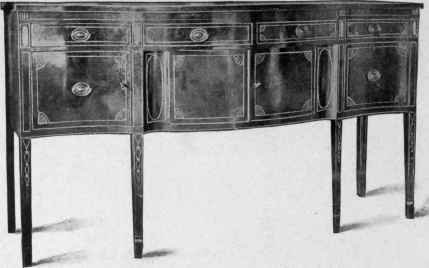
Figure 203. Hepplewhite Sideboard, 1790-1800.
Figure 205 shows a sideboard with but four legs, although it is six feet two inches long. The ends are curved and the centre is straight and recessed. There is an inlay border about the drawers and doors. At the two ends are cupboards and at the centre is a drawer with a cupboard below. This piece is the property of Mr. Frederic T. Bontecou, of Orange, New Jersey.

Figure 204. Hcpplewhite Sideboard, 1790-1800.
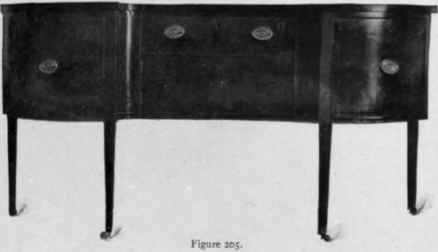
Hepplewhite Sideboard, 1790-1800.
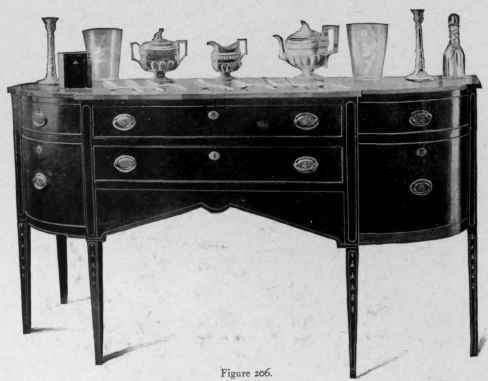
Hepplewhite Sideboard, 1799.
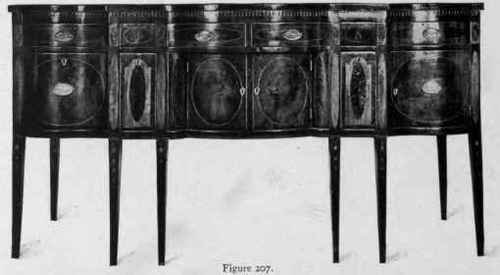
Hepplewhite Sideboard, 1790-1800.
Figure 206 shows a sideboard with six legs, the property of the Misses Andrews. It was purchased in 1799. The corners are curved and the straight centre projects. A narrow border of inlay is about the drawers, and at the ends are bottle drawers, and two long drawers are at the centre. The oval handles have stamped upon them a basket with a pineapple.
Continue to:


My Books

