


The Period Of The Cabinet-Makers, 1750-1840. Part 2
Description
This section is from the book "Colonial Furniture In America", by Luke Vincent Lockwood. Also available from Amazon: Colonial Furniture In America.
The Period Of The Cabinet-Makers, 1750-1840. Part 2
Not by any means were all the Chippendale chairs of the ornate type so commonly associated with his name. Such chairs were expensive, and many of his designs, even in England, were very simple, but in both countries are to be found magnificent examples of his best work. The chief fault in most of Chippendale's chairs is that the arms and seat rails are not sufficiently good for the back. The rails seem to have been his chief foible. In the Dutch period the rails were usually curved so that the lack of ornamentation was not noticeable, beauty of line compensating for their plainness. On the Chippendale chairs, however, the rail was generally straight and, except in the finest specimens, did not sufficiently harmonise with the other portions of the chair, which were often carved. This seems rather strange, because French chairs of the period with which he appears to have been familiar excelled in this particular.
It must be borne in mind that Chippendale was not the only designer of chairs during the third quarter of the eighteenth century. There were also Ince and Mayhew, Robert Manwaring, and others of less importance; consequently it is not strictly accurate to call all chairs having the bow-shaped back by Chippendale's name, but they should rather be called of his period. It is highly improbable that the few designs of chair backs shown by these cabinet-makers were the only ones used by them. These designs were undoubtedly the newest, but judging from the large number of chairs extant which are not in any published book of designs it seems probable that the cabinet-makers did not confine themselves to these new designs.
The chairs in Chippendale designs whose splats are in the general outline of the fiddle are probably earlier and represent the effort of the local cabinetmakers to keep pace with the times.
Before taking up the principal designs of the period we will illustrate a few-chairs showing the transition from the earlier pieces.
Figure 538 shows a chair with a Chippendale bow-shaped cresting and a pierced splat in a design shown by Manwaring. The legs, however, are turned and braced and terminate in Spanish feet. The splat does not extend to the seat, but is set into a rail after the fashion seen on some of the earlier chairs. This combination of the early transition and the Chippendale is not at all uncommon in America. This chair is in the Bolles Collection.
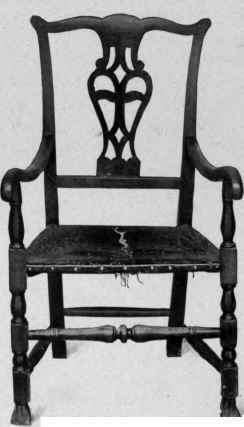
Figure 538. Chair in Chippendale style, Spanish feet, third quarter eighteenth century.
Figure 539 shows another transition chair with bow-shaped cresting, splat setting into a lower rail, and turned legs and stretchers. The legs terminate in short Dutch feet. This chair is very low and is in the form known as a slipper chair. It is the property of Mr. Dwight Blaney, of Boston.
Figure 540 shows a chair with a bow-shaped cresting and a solid splat, which is the simplest form of the chair of the period. The legs are cabriole, terminating in angular Dutch feet of the New Jersey type.
Figure 541 shows a form of chair quite commonly found. The back is high, the cresting well shaped, and a carved shell is at the centre. The splat is slightly pierced and the legs are cabriole, terminating in bird's claw and ball feet, and on each knee and centre of skirt is carved a shell. This chair is the property of Mr. William Meggat, of Wethersfield, Connecticut.

Chair in Chippendale style, Dutch feet, third quarter eighteenth century.
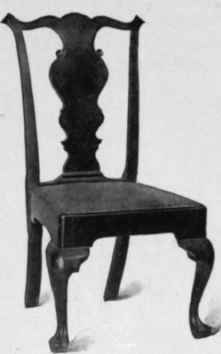
Figure 540. Chair in Chippendale style, third quarter eighteenth century.

Chair in Chippendale style, third quarter eighteenth century.

Chair in Chippendale style, third quarter eighteenth century.
Figure 542 is quite similar to the foregoing, except that the splat is pierced in scroll designs. A shell is carved at the centre of the cresting and on each knee, and the cabriole legs terminate in bird's claw and ball feet. This chair is the property of the Honourable John R. Buck, of Hartford.

Chair in Chippendale style, third quarter eighteenth century.

Chair in Chippendale style, third quarter eighteenth century.
Another of the earlier designs is shown in Figure 543, the property of Mr. F. O. Pierce, of Brooklyn. The splat is composed of a rather long concave curve, below which is a large curve extending back into the top rail. The same theme is found in the late chairs of the Dutch period and in many variations in the Chippendale period. The legs are cabriole, terminating in Dutch feet, and the skirt is cut in cyma curves after the manner of the earlier period.
Figure 544 shows a chair, the property of Dr. Frank I. Hammond, of Providence, in which the splat is in the same general outline as that shown in the preceding figure, except that it is slightly better and has an additional entwined design at the centre. At the centre of the cresting are carved acanthus leaves and scrolls, and a rope moulding finishes the bottom of the skirt. The legs are cabriole, terminating in bird's claw and ball feet, and on the knees are carved acanthus leaves.
Continue to:


My Books

