


XI. Clocks. Part 4
Description
This section is from the book "Colonial Furniture In America", by Luke Vincent Lockwood. Also available from Amazon: Colonial Furniture In America.
XI. Clocks. Part 4
Figure 833 shows another early clock. The case is made of pine or some other soft wood, and the band of carving at the top is early in design. This clock-case also has the single-arch moulding about the doors, and there is an opening in the lower door to show the swinging of the pendulum. It is at the Van Cortlandt Mansion, Van Cortlandt Park, New York.
Figure 834 shows a detail of the face of the foregoing clock which is worth noting. It will be seen that the spandrels are of the third order - cupids holding a crown - which came into fashion about 1700. The maker's name, Walter Archer, appears between the numerals VII and V, which shows it to date probably before 1715. We have been unable to find this maker's name among the members of the Clockmakers' Company or elsewhere, and this would seem to indicate that he was probably from one of the smaller towns in England or a colonial maker. The clock is dated 1619, and an examination with the eye failed to detect that the engraved figures were later than the rest of the face; but the photograph shows it to be of a different depth, and it was without doubt added at a rather recent date. The fact that pendulum clocks were not invented until 1641 of itself would disprove the date, apart from the other indications above referred to.
It will readily be seen that the arched upper part of the dial, which came in a little later, was intended to cover the bell, which in this illustration shows at the top. This clock is wound by pulling up the weights by hand, as is the method in the bird-cage clocks above referred to.
An English marquetry clock is shown in Figure 835, the property of Mr. Richard A. Canfield. The top, instead of being flat, as in the preceding figure, is domed in the manner most frequently found in the early eighteenth century. On either side of the door are twisted columns, and above the door is a carved fret similar to that shown in the preceding figure. The surfaces are covered with exceptionally good marquetry, consisting of flowers, leaves, birds, and butterflies. The dial is square and engraved about the centre and calendar openings, and the spandrels consist of a head and scrolls.

Figure 834. Dial to foregoing clock.
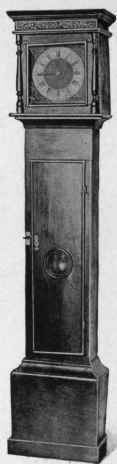
Figure 833. Tall Clock, 1700-10.
The maker is "John Barnett, Londini Fecit." This Barnett was admitted to the Clockmakers' Company in 1682. The clock runs for thirty days and has the calendar attachment.
A walnut tall clock of about the same period is shown in Figure 836 and is the property of Rev. George D. Egbert, of Norwalk, Connecticut. The top quite closely resembles the Dutch type of case, but the base has the straight sides in English fashion instead of the Dutch bombe. The case stands on ball feet similar to those appearing on chests of drawers. On the top are gilded figures representing at the centre Atlas, at the left Gabriel, and at the right Father Time. The dial has the arched top within which is the dial which controls the strike. The spandrels consist of cupids holding a crown, as in Figure 834. The clock runs for thirty days and strikes the half-hour on a different bell from the one used to indicate the hour. There is the usual calendar attachment. On the face is engraved "Claudini du Chesne, Londini." He was admitted to the Clockmakers' Company in 1693.
A good dial is shown in Figure 837. The top is arched, and within it is a cartouche containing the name "Peter Stretch, Philadelphia," supported on either side by a cupid and surmounted by a crown. The spandrels are the same as those appearing in the preceding figure, two cupids supporting a crown. The fret top of the case is not original.
Figure 838 shows a tall clock with an English lacquer case, the property of the writer. The hood is arched, following the lines of the dial-plate. This clock has a thirty-day movement and the usual calendar attachment. In the arched top is the name "Shedel." On either side of the name-plates are dolphins and scrolls, and the spandrels consist of a head and scrolls.

Figure 835. Tall Clock, marquetry case, about 1700.
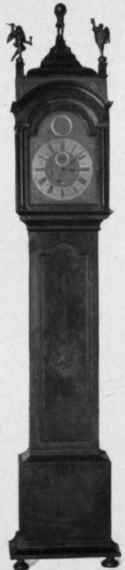
Figure 836. Tall Clock, about 1700.
Nearly all of the early clocks found in this country were made in England and imported. There were, however, a few clockmakers here, and probably one of the best of these was William Claggett. He was born in 1696, was admitted as a freeman at Newport in 1726, and died at Newport in 1749. His dials were especially good and are found in three forms, as shown in the three succeeding figures.
The earliest of his clocks is shown in Figure design found on Claggett clocks and the name is in a circular plate arched above the calendar. An eight-pointed star is engraved inside the second-dial. In the dome is a dial which indicates the phases of the moon.
839. The dial is square and the case has the square door with single-arch mouldings and a bull's-eye glass. The design of the spandrels is a vase and flowers, with birds and scrolls on either side, similar to that used by the Marot school, and this form was almost invariably used by him (Figure 841). The name-plate is square and is placed just above the calendar. This clock is the property of Mr. G. Winthrop Brown, of Chestnut Hill, Massachusetts.
Another Claggett clock, which is owned by the Rhode Island Historical Society, is shown in Figure 840. The dial is domed and the spandrels are the same as those shown in the succeeding figure. In the dome is a dial which regulates the strike. The name-plate is square and is placed just above the calendar, as in the preceding figure. The door is domed, and it is interesting to note in passing that the almost universal rule is that if the dial is domed the door is also.
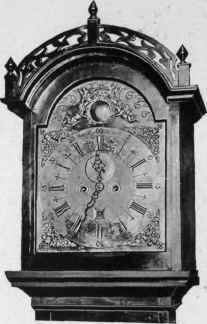
Figure 837. Dial of tall clock, showing arched top, 1725-30.

Figure 838. Tall Clock with japanned case, 1700-25.

Figure 839. Tall Clock made by Claggett, about 1725.

Figure 840. Tall Clock made by Claggett, 1725-35-.
Continue to:


My Books

