


Chippendale. C. 1705 - 1779. Part 12
Description
This section is from the book "The Practical Book Of Period Furniture", by Harold Donaldson Eberlein And Abbot McClure. Also available from Amazon: The Practical Book Of Period Furniture.
Chippendale. C. 1705 - 1779. Part 12
Types Of Decoration
The types of decoration employed by Chippendale and his school must be divided into four classes: English, French, Chinese, and Gothic.
English Lions, so freely employed in the furniture and decoration of Early Georgian times, were retained by the Chippendale school, and appeared in various forms as heads on seat rails, underframing of tables and the knees of chair and settee legs.
Masques, both human and grotesque, were freely employed for the embellishment of elaborate pieces, but are not commonly found (Plate XVIII, p. 170).
Evolutes, or the wave pattern, can sometimes be found on Chippendale pieces. The motif, however, belongs to an early period, and is not to be reckoned as characteristic.
Egg and Dart motifs for mouldings were of occasional occurrence and were also retained from the architectural motifs of the Queen Anne-Early Georgian style.
Claw and Ball, feet were habitually used on much of the furniture of this date.
Acanthus of a peculiarly graceful type was freely employed in both the English and French types of the Chippendale period.
French Shells were frequently used in the French type of furniture which followed Rococo motifs from general inspiration.
Chinese Pagoda motifs were the most characteristic details of the Chinese type of decoration (Fig. 4; Key VII, 1; Plate XVII, p. 166).
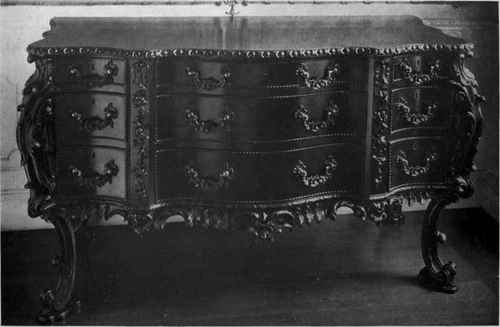
PLATE XX. CHIPPENDALE MAHOGANY CONSOLE CABINET "IN THE FRENCH TASTE" (Of authentic Chippendale origin)
By Courtesy of Richard A. Canfield, Esq., New York City.
Gothic Pointed Arches and Quatrefoils were the essential elements on which the Gothic type of decoration was based.
Structure
Chippendale's furniture is structurally honest. It is not only apparently strong but is actually so. Otherwise so much of it could not have remained to the present date in a perfect state of preservation.
The carcase work is all most carefully fitted and joined; that is to say, it is mortised and tenoned or else dove-tailed together, and as only well-seasoned timber was used it is quite as strong to-day as it ever was, except in cases where it has been subjected to ill-usage. Even in the most delicate work which sometimes has the appearance of being fragile, the parts are all so well-proportioned that the support for weight and the resistance to strain come exactly where they are most needed. As we have said before, Chippendale's chief title to fame rests upon his chairs. In these he displayed not only sound knowledge but common sense in making his designs fit structural needs. The point of greatest strain in a chair is at the junction of the seat and back, and it is just at this point that Chippendale's chairs are strongest. The broad base of the splat is brought down to a firm junction with the back seat rail, and this with the strength of the uprights gives the necessary stiffness to chairs of the Chippendale type and makes them peculiarly strong and enduring. Even in the most delicate fretwork care was taken to secure the maximum of strength.
Instead of cutting a fret from one solid piece, Chippendale's method was to cut three thicknesses which were glued together, the "way" of the central thickness running in the opposite direction to the "way" of the two other thicknesses.
All the cabinet-work was most carefully fitted, and even in writing tables with bombe fronts and sides, the drawers were shaped so that their sides conformed to the outlines of the piece instead of being ordinarily perpendicular and horizontal.
Mounts
It was a favourite theory of Chippendale's that the brass mounts, that is to say, the handles and key-plates, should lend a decorative effect to the general appearance of the piece of furniture to which they were attached. On most of the furniture of the ordinary or "inexpensive" type, the handles, scutcheons and key-plates were of the plain type that had been in use for some time. They were either pierced and fretted or else altogether plain. Not so, however, with the more elaborate furniture, particularly pieces made after the French pattern. Here we find handles, scutcheons and key-plates of the most elaborate and fanciful Rococo pattern, equalling in intricacy the Ormolu mounts of contemporary French furniture (Plate XIV, p. 148, and XX, p. 180). In a few rare instances fretwork mounts of brass were used purely for purposes of embellishment quite apart from their utilitarian furniture as handles, key-plates or scutcheons.
Finish
The finish applied to the mahogany furniture of the Chippendale period was to all intents the same as that used during the Queen Anne-Early Georgian period. Towards the end of the period no doubt some of the mahogany pieces were finished in the manner indicated in the section on Finish in the Sheraton chapter.
It may be of value to note that in the present care of old mahogany a weekly rubbing with a little double boiled linseed oil on a soft woollen cloth will be found highly beneficial. It may be added that this is the method used by Mr. Canfield, whose collection of Chippendale furniture is surpassed by none in America, Fresh air is also a vital necessity in preserving the healthy tone of the surface of old furniture.
Continue to:


My Books

