


Painted Furniture. Part 3
Description
This section is from the book "The Practical Book Of Period Furniture", by Harold Donaldson Eberlein And Abbot McClure. Also available from Amazon: The Practical Book Of Period Furniture.
Painted Furniture. Part 3
Both Hepplewhite (Key XI, 5; XII, 2) and Sheraton followed the lead of the Adams in designing and advocating painted furniture at the same time they were putting forth their best productions in mahogany and inlaid woods. The classic influence of the middle of the eighteenth century brought in a taste for paler and more subdued colouring. Then, too, the colour was often concentrated in one or two places, as was mostly the case where medallions and plaques were employed. Nevertheless, a considerable quantity of furniture continued to be wholly painted till the end of the century and, in the days of his decadence, Sheraton sometimes sacrificed form, and depended on paint to make up for the deficiencies of shape and proportion.
During the Empire period a good deal of furniture was painted in both England and America. Usually dull tones were selected as body colours and then a more or less elaborate ornamentation of gilding was added and sometimes other colours besides were included in the scheme of embellishment.
Following the prevalence of the Empire style we see the advent of the Biedermeyer type of painted decoration (Fig. 1). Chairs, sofas, tables and other objects were adorned with dainty devices in which floral wreaths, festoons and drops, oval medallions and, above all, silhouette forms of figures, birds, animals and flowers played an important part. In Germany, where the style particularly flourished, the painted decorations appeared on satinwood, maple and the. like or on wood that had been painted a ground colour. In America, where the style enjoyed considerable vogue, it was more usual to apply the devices on chairs, settees or tables that had previously been painted black, grey, green, blue, canary yellow or some other bright colour. Both the chairs shown in Fig. 2 well exemplify the style.
One more sort of painted furniture, and in some respects the most interesting because the most spontaneous, remains to be considered. It is the painted furniture of the "Pennsylvania Dutch," and the decorative traditions which it has perpetuated were brought from the German principalities by the immigrants who came thence and settled in Bucks, Berks, Lehigh, Lancaster, Montgomery and parts of other counties in Pennsylvania during the latter part of the seventeenth and the first half of the eighteenth centuries. It is, of course, peasant furniture and not to be ranked with the sorts considered earlier in the chapter but it is highly decorative in character and rich in the charm of naivete (Plate XLVII, p. 324; Frontispiece).
Fig. 1. Birch Mirror Frame with Biedermeyer Design in Black.
The pieces of furniture which the Pennsylvania Germans adorned with painted devices were usually chests (Plate XLVII, p. 324) and small boxes given to the bride by the bridegroom on the occasion of their marriage. A comparison of these painted chests and boxes with those executed by the peasants of Germany, and particularly of Bavaria (see Frontispiece), will show much in common. Although the colouring of Pennsylvania Dutch chests is sometimes more subdued than that of similar pieces found in Germany, there is a remarkable correspondence in the decorative motifs employed - stiff, conventional flowers and fruits, birds, and decorative bands. The favourite flower motif in chest painting of the Pennsylvania Dutch was the tulip (Plate XLVII, p. 324). Next in popularity came the fuchsia and pink. Though these predominated, other flowers and fruits also were used. The favourite bird was the dove, although pelicans and other species are to be discovered. Texts and dates (Frontispiece; Plate XLVII, p. 324) and initials (Frontispiece; Plato XLVII, p. 324) also frequently occur.
This style of furniture decoration has recently been winning a degree of popular appreciation and decorators are producing all manner of articles on which the traditional German colour schemes and designs or modifications of them are employed.
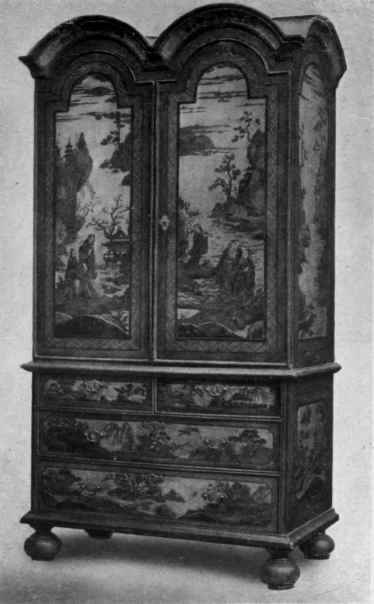
WILLIAM AND MARY SILVER AND BROWN LACQUER DOUBLE-HOOD CABINET.
By Courtesy of Messrs. Gill & Reigate, Oxford Street, London.

PAINTED "PENNSYLVANIA DUTCH" DOWER CHEST By Courtesy of Pennsylvania Historical Society, Philadelphia.
PLATE XLVII.

BAVARIAN DOWER CHEST FROM NATIONAL MUSEUM, MUNCHEN, SHOWING CONNEXION WITH PENNSYLVANIA-GERMAN PAINTED FURNITURE.
From a colour drawing by Abbot McClure.
For the sake of greater clearness the following sections are devoted to the individual peculiarities of the painted furniture of the periods just alluded to.
Continue to:


My Books

