


Queen Anne And Early Georgian. 1702-1750. Part 5
Description
This section is from the book "The Practical Book Of Period Furniture", by Harold Donaldson Eberlein And Abbot McClure. Also available from Amazon: The Practical Book Of Period Furniture.
Queen Anne And Early Georgian. 1702-1750. Part 5
Tables
Queen Anne's day was a time of small tables or tables to be used at the side of a room. In the more pretentious houses we have the gorgeously carved and gilt structures with marble tops, but they were not articles of common use. Gate tables, of course, continued to enjoy great popularity and were always made in considerable numbers to supply a constant demand. The tables of most general utility that seem to have been used for dining tables, when gate tables were not used, were the cabriole-legged, drop-leaf (Fig. 10) tables with club feet or claw and ball feet and ogeed aprons at the ends. They were ordinarily four or five feet long and when the leaves were extended and the legs, one at each end, pulled out to support them, six or eight people could be accommodated very comfortably. From about 1715 onward they were in common use for dining purposes. There were also larger tables made on the same principle with more legs for extension.
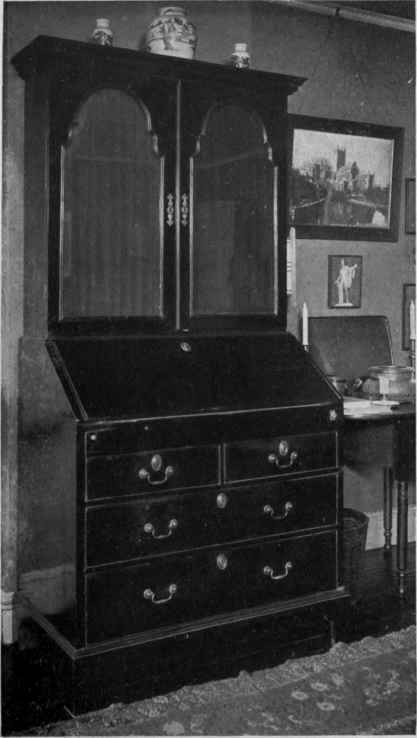
QUEEN ANNE WALNUT BUREAU BOOKCASE.
In Possession of Abbot McClure, Esq., Philadelphia.
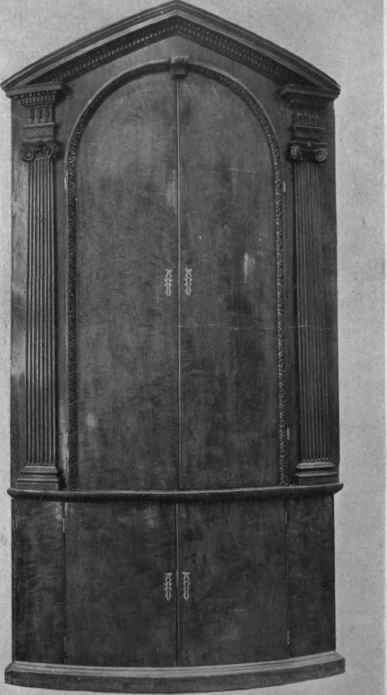
QUEEN ANNE MAHOGANY CORNER CUPBOARD EXAMPLE OF "ARCHITECTS' FURNITURE".
By Courtesy of Messrs. Gill & Reigate, Oxford Street, London.
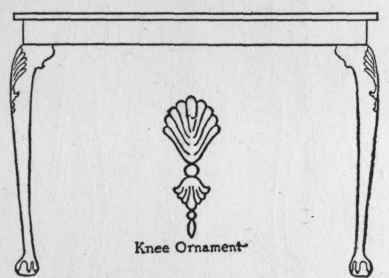
Fig. 9. Small Table of Hogarthian Lines. By Courtesy of Mr. R. W. Lehne, Philadelphia.
Tea tables of oblong shape had slender cabriole legs and occasionally had a raised rim, while others had the edges shaped with the accustomed ogee, cyma-curve and semi-circle forms. The underframing was shaped in the same way. Card tables with turn-over hinged tops made their appearance. The corners were "dished" to hold candlesticks and there were four shallow oval wells for coins or chips. In some cases the corners were blocked or rounded where the legs joined the underframing. There were also circular tripod tables later in the period. Small bedside tables or work tables with shallow drawers were found, and some of the "turned" tables with straight legs continued to be made.
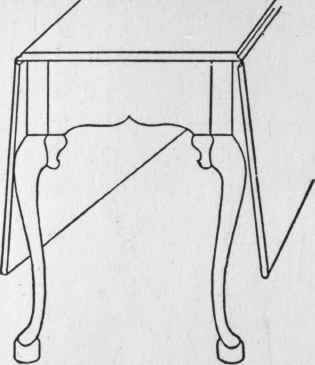
Fig. 10. Walnut Cabriole-legged, Drop-leaf Table, commonly used as a Dining Table.
In the Possession of H. D. Eberlein, Esq.
Many of the sideboard and console tables with marble tops were very sumptuous affairs with ornately carved and gilt bases in which sphinxes, eagles, griffins, human figures, animals, flowers and conventional rococo ornament played a part.
Continue to:


My Books

