


The Brothers Adam. C. 1762-C. 1792. Part 5
Description
This section is from the book "The Practical Book Of Period Furniture", by Harold Donaldson Eberlein And Abbot McClure. Also available from Amazon: The Practical Book Of Period Furniture.
The Brothers Adam. C. 1762-C. 1792. Part 5
Mirrors
The Brothers Adam would always be gratefully remembered for the mirror frames they designed, even though all their other work were forgotten. In shape the mirrors were vertically or horizontally oblong, round, or oval. The body of the frame was carved and gilt and, in addition, light and graceful embellishments, too airy to be executed in wood, were wrought in compo on a wire core or frame. The graceful Adam urn frequently formed the central ornament (Fig. 1, C) at the top, from which all the other embellishments seemed to radiate. Girandoles and sconces were designed to match and accompany the mirrors. These mirrors were often placed in a formal manner between windows while below them stood a pier or console table (Plate XXIII, p. 194).
Clocks
Tall case clocks seem not to have occupied the attention of the Adelphi to any great extent. Such clocks as they did design were chiefly of the small mantel or bracket type, and carried out the decorative motifs and forms they commonly employed.
Materials
The materials used in the manufacture of furniture of Adam design fill a comprehensive list.
Mahogany was too generally established in public favour and possessed too many sterling qualities not. to be employed extensively. It afforded an excellent medium for the special type of carved decoration in which the Brothers Adam delighted.
Satinwood came next as a close second in popularity. It was owing to the influence of the Adelphi that satinwood, and other light and varied woods as well, became so popularised that this epoch has been fittingly called the "Age of Satinwood."
Sycamore, either in its natural state, or treated with chemical stain, was often used as a base for decorative surfaces. Harewood was merely sycamore wood stained.
Amboyna, owing to its beautiful grain and mellow colour, was much esteemed as a veneer for some of the finer cabinet-work.
Tulipwood was also esteemed for colour and grain.
Holly and Ebony, as well as other precious woods, were used for inlay.
Pine and Lime were used for elaborate carving that was to be painted or gilded.
Wedgwood Plaques were employed as inserts.
Marble was used extensively for console, table and cabinet tops.
Compo, as a plaster composition is commonly called, was used for delicately moulded ornaments for mirrors and girandoles where wood would have been too brittle. The compo was applied on a wire core or frame.
Decorative Processes
The decorative processes made use of in the execution of Adam furniture were:
Carving, which was usually applied to mahogany or else to the pine and lime objects that were to be gilded.
Turning was used only sparingly and on table, chair and sofa legs of simpler pattern.
Inlay and Marqueterie afforded a valuable resource for the delicate embellishment of flat surfaces of satin-wood in such articles as chairs, settees, table tops, and cabinets. The character of this marqueterie was quite different to, and infinitely more delicate than, that of the William and Mary period.
Veneer was used for the rich effects of the grain arranged in symmetrical patterns. Table and cabinet tops, cabinet doors, and spandrel fans were commonly made of veneer, and veneering in such cases was often used in conjunction with painting.
Painting as an adjunct to the cabinet-maker's art was never before so extensively and effectively employed. In addition to the delicate floral wreaths, ribbons and minute Pompeian motifs, the small panels, plaques and cartoons painted by Angelica Kauffmann, Cipriani and other noted artists (Plate XXII, p. 190), were masterpieces in themselves. Satinwood furniture was only partially painted, as the wood itself made a most desirable background. Articles intended to be wholly covered with paint and gilding were made of baser woods; greens, whites, and other colours were used as a base for gilded decoration in such cases (Plate XXII, p. 190).
Gilding was used in the cases just mentioned and also for entirely covering mirror frames, girandoles and pier tables (Plate XXIII, p. 194).
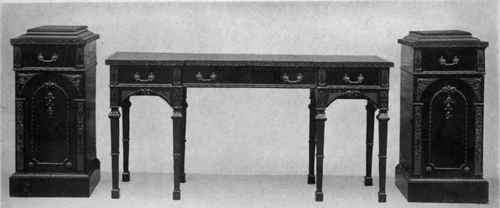
PLATE XXIV. ADAM SIDEBOARD TABLE WITH PEDESTALS.
By Courtesy of Messrs. Hale and Kilburn, Philadelphia.
Continue to:


My Books

