


The Empire Period. French And English. 1793-1830. Part 2
Description
This section is from the book "The Practical Book Of Period Furniture", by Harold Donaldson Eberlein And Abbot McClure. Also available from Amazon: The Practical Book Of Period Furniture.
The Empire Period. French And English. 1793-1830. Part 2
Articles
The articles of furniture in ordinary use during the Empire period were chairs, stools, sofas and settees, couches, bedsteads, tables, chests of drawers, bureaux, cabinets, secretaries, bookcases, cupboards, sideboards, and wardrobes.
Contour
The contour of Empire furniture was quite distinct from that of the furniture of preceding periods. Carcase work was ordinarily rectangular and apt to be of heavy and cumbrous proportions. Mouldings and cornices were heavy and impressive, though often lacking in grace. The legs of tables and chairs were straight and turned; with mouldings often of meaningless pattern. Table legs were also frequently carved in spirals somewhat like those we find in the last stage of really good Sheraton designs, only the proportions were heavier. We likewise have large pedestal tables, the pedestals supported on a plinth borne up by four feet. Head and foot boards of bedsteads and ends of sofas were scrolled over in many cases with a Greek curve. When chair legs were not straight they were curved forward and the back legs backward much in the manner of the old Romain curule chairs (Fig. 1). Nearly all of the cabinet-work, as well as chairs, sofas and tables, was bulky in line.
Chairs
The arm-chairs of the Empire period professedly followed classic models in so far as they were able, and in other instances were designed with a full complement of classic motifs. The backs were sometimes completely rounded, and the seats also (Key XV, 3). In other cases the arms of these rounded and upholstered backs were supported in front with fantastic figures of birds or beasts (Fig. 2, and Key XV, 2), the front legs being straight, sometimes fluted (Fig. 2), and the back legs curved outward. In other arm-chairs the seats were square, tapering slightly towards the back; the backs were crested with broad, straight rolled over top rail slightly (Fig. 1) curved to fit the back. There was also an upright splat of lyre form or else a cross rail midway between the top rail and seat. The arms were shaped from the top rail and came forward parallel to the sides of the seat, terminating in a flowing downward scroll.
The legs of such chairs were generally of the curule pattern. Similar chairs occurred with rush bottoms. In the latter, however, the front legs were generally straight and turned. Side chairs were made with broad top rails (Fig. 3) perceptibly curved to the shape of the back, like the top rail of a curule chair, and the uprights were curved slightly forward or else the broad flat top rail was rolled over and supported on uprights scrolled slightly backward in Greek manner. Forelegs were straight and turned or curved forward curulewise. Stretchers were often used, though not invariably, and when used the front stretcher was rarely recessed. These chairs with broad top rail had either a flat, solid splat of vase or lyre shape or else a carved and moulded cross rail. The latter was the better and more representative type. Other chairs of fantastic form adorned with excessive carving were designed, but the forms mentioned are those which are typical.

Fig. 1. Sheraton Chair in Empire Taste.

Fig. 2. Empire "Chariot" Chair.
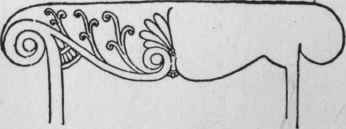
Fig. 3 Broad Top-Rail Characteristics.
Continue to:


My Books

