


Thomas Sheraton. 1750-1806. Part 2
Description
This section is from the book "The Practical Book Of Period Furniture", by Harold Donaldson Eberlein And Abbot McClure. Also available from Amazon: The Practical Book Of Period Furniture.
Thomas Sheraton. 1750-1806. Part 2
Articles
Besides the usual tale of household articles that we expect to find enumerated - a list which it is scarcely necessary to rehearse in detail - Sheraton designed, as previously stated, many ingenious multum in parvo pieces of furniture and also brought sideboards to their highest stage of perfection. Otherwise the items to be considered are the same as in the Hepplewhite chapter.
The objects of standard household use will be dealt with in their regular rotation, so that further specific allusion is not needed at this point.
Contour
Much reference has been necessarily made to Sheraton characteristics of contour in the Hepplewhite chapter, for the designs of the two men are so closely parallel (Key XIV, 1, and Key XI, 6) in many respects that it is not only natural to consider them jointly by comparison but well nigh impossible to avoid doing so. There is no occasion to repeat what has been said before of peculiarities of contour common to both. We shall, therefore, call attention only to points of difference. Sheraton, as already stated, is regarded as the exponent of the straight line and his preference for the straight line he emphasised very distinctly in his chair-back designs, nearly all of which were severely rectangular (Key XIII, 1-6; Figs 1 and 2). When he was not using vertical or horizontal lines he could and did use diagonal lines with telling effect. He rejoiced in perpendicular effects, and much of the Sheraton cabinet-work has a high-shouldered appearance (Key XIV, 5, and Plate XXXII, p. 240), due to emphatic perpendicular lines of contour and tall proportions. Legs were often slender almost to tenuity (Plates XXXI and XXXIV, pp. 236 and 248) but never were they ill proportioned. Sheraton knew exactly when to stop paring proportions down.
We have said that both Hepplewhite and Sheraton used square and round legs for chairs and tables and also that the square tapered leg might be considered as typical of Hepplewhite designs. In the same way the round, tapered and reeded legs (Plate XXXI, p. 236) may be considered as characteristic of Sheraton. By reedings and fluting in the stiles of cabinet-work and in the legs and edges of tables (Figs. 5 and 6) and chairs Sheraton added not a little to the perpendicular aspect of his furniture.
Sheraton's use of curving tracery (Fig. 7) for glazed doors has been noted, but attention must be called to another particular in which he employed curving lines - the scroll swan-neck pediments with which some of the bookcases, cabinets and presses were surmounted and which Sheraton used to a greater extent than Hepplewhite. Sheraton also made more use of stretchers than Hepplewhite, and in the tables the stretchers are apt to be set saltire wise (Fig. 4). The differing and inferior contour of furniture during Sheraton's decadent stage will not be considered, for such furniture ought not to be known by the name of Sheraton.
Chairs
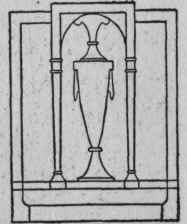
Sheraton was quite as successful in the designing of chairs as was Hepplewhite. His most distinctive creation was the square back (Key XIII; Figs. 1 and 3). By a skilful manipulation of his straight lines he succeeded in imparting to his chairs, and other articles as well, a remarkable sense of dignity and refinement. Whatever may have been his motive in confining himself almost exclusively to straight lines, the result was highly satisfying from both artistic and practical considerations. It is to be particularly noted that Sheraton had a fine sense of proportion and that in all his work, but especially in the embellishment of his chair backs, the distribution of ornament is always well balanced and contributes to the general impression of staunchness and repose.
A
B
C
E
F
H
X
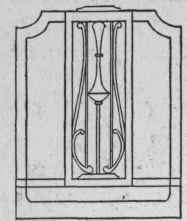
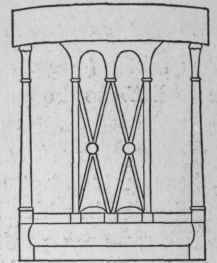
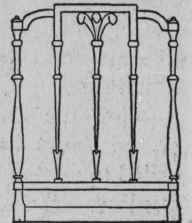
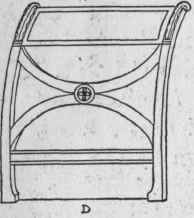
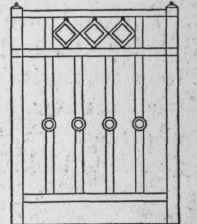
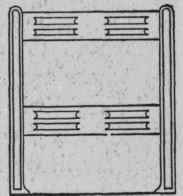
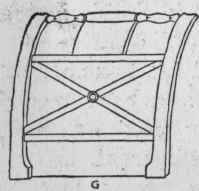
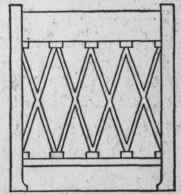
Fig. 1. Characteristic Sheraton Chair Backs.
Legs were either square and tapered with the surfaces flat or grooved (Key XIII, 2) or else round,turned and fluted or reeded (Key XIII, 1 and 4), also with a perceptible taper towards the foot. Stretchers, though of occasional occurrence, were not commonly used. Seats were square, with a taper towards the back uprights (Key XIII, 2, 3, 4, 5 and 6; Fig. 2) or rounded in front and at the fore part of the sides (Key XIII, 1). Sometimes the square seats had either a slightly bowed or serpentine front (Key XIII, 4 and 5).
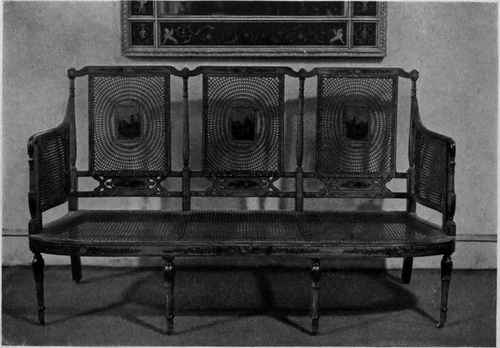
PLATE XXXIII. SHERATON PAINTED SATINWOOD AND CANED SETTEE By Ccurtesy of Messrs. E. J. Holmes & Company, Philadelphia.
The arms, slightly shaped from their junction with the back uprights (Key XIII, 4 and 6; Fig. 2; and Plate XXXIII, p. 244), came forward in a straight line horizontally, and at a right angle (Key XIII, 4) were dowelled to a vase-shaped baluster support (Key XIII, 4 and 7; Fig. 3, and Plate XXXIII, p. 244) which was either an extension of the front legs (Key XIII, 7; Fig. 3, and Plate XXXIII, p. 244), or rose from the side rails of the seat frame a little back from the front (Key XIII, 4; Fig. 2, A). Another form of arm support is shaped and moulded in a receding curve from the tops of the front legs to the fore ends of the arm. In some of the later chairs the fore end of the arm curves rapidly down, and, in unbroken line, joins the support formed by the turned extension of the forelegs above the seat (Key XIII, 6; Fig. 2, B; Fig. 3; and Plate XXXIII, p. 244).
It might be more accurate to call the filling of Sheraton chair backs fretted panels rather than splats, for they always filled fully one-third (Fig. 1, A, B and I) of the entire back and oftentimes occupied nearly the whole width (Fig. 1, C, E and G), the latticing (Fig. 1, H) or barring (Fig. 1, E) being evenly distributed.
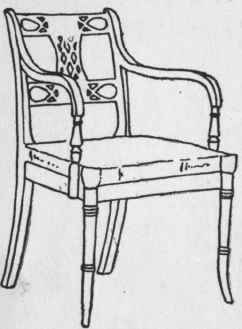
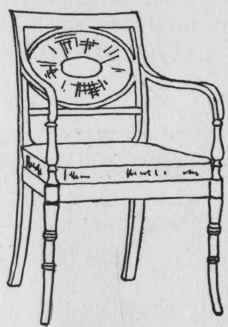
Top rails were straight (Key XIII, 4 and 6; Fig. 1, D, E, F, G and E) or raised (Key XIII, 3; Fig. 1, A, C, and 7) in the centre. The central rise was either abruptly angular from a vertically straight rail (Fig. 1, 7) or the sides of the rise were slightly shaped (Fig. 1, A and C); the top being perfectly straight. In a few instances the top of the rise is slightly bow curved. Some chairs also have the whole top rail very slightly bowed (Fig. 1, B). On the chairs intended for painted adornment there was sometimes a broad panelled top rail (Key XIII, 4; Fig. 1, B; and Fig. 2, A).
A
B
Fig. 2. Late Types of Sheraton Chairs.
Uprights were either turned and moulded (Fig. 1, B and C) or flat and moulded (Fig. 1, A, 7; Fig. 9) and the tops were dowelled to them. The backs were filled with vertical balusters or bars (Key XIII, 3; Fig. 1, C and E), with diagonal lattices (Fig. 1, B and 77), with vase or lyre motifs (Key XIII, 1 and 2; Fig. 1, A and 7), with horizontal bars (Key XIII, 4; Fig. 1, F), with cane work (Key XIII, 6; Fig. 2, B, Plate XXXIII, p. 244), or with combinations of these elements.
In the latest chairs, just before the period of his decadence, the top rail is turned and hollowed (Fig. 1, G) with a small panel for the central part (Key XIII, 4) or else it is flat with a slight concave sweep (Fig. 2, A and B), and in the latter case it is sometimes pierced (Fig. 2, A), The bars or balusters instead of being vertical are horizontal (Key XIII, 4; Fig. 1, D, F and G; Fig. 2, A and B) and joined to the uprights instead of running from top rail to rear seat rail. The turned legs of these late chairs are sometimes splayed outward at the feet (Fig. 2, A and B). The backs at the end of the century are also lower and more squat (Key XIII, 4; Fig. 2, A and B, and Fig. 9).
Continue to:


My Books

