


Thomas Sheraton. 1750-1806. Continued
Description
This section is from the book "The Practical Book Of Period Furniture", by Harold Donaldson Eberlein And Abbot McClure. Also available from Amazon: The Practical Book Of Period Furniture.
Thomas Sheraton. 1750-1806. Continued
In his ideals and consistent fidelity to the sources of his best inspirations, Sheraton was far more of a classicist than Hepplewhite, while in his admiration for geometrical forms and principles he anticipated, in a sane, agreeable and well-mannered way, the ultramodern cubistic tendency in furniture designing as exemplified in some of the recent German styles. He was, in very truth, the champion and exponent of the straight line in furniture-making, and his vertical tendency is one of the most strongly distinctive characteristics of the pieces he designed. While he was indebted to sundry sources for the springs of his inspiration, he drew most copiously from the classic Renaissance forms as interpreted in the Louis Seize style. So closely does much of his work resemble its Gallic prototype that Sheraton furniture has sometimes been dubbed "English Louis Seize."
But though it is true that Sheraton studied French fashions in furniture more closely than any of his predecessors, he, nevertheless, before the day of his decadence set in, clothed all his designs with such a distinctively individual form that his originality cannot be challenged. He "translated" French furniture forms into good, idiomatic English and added something of grace in the process that was not there before. His originality is chiefly evident in his chair designs, while in cabinet-work he appears rather as a correcter and reviser of the styles in common use in his time. Witness his treatment of certain Shearer designs. He was possessed of the keenest critical insight in matters pertaining to cabinet-making, combined with an excellent sense of proportion, sound judgment and purity of taste, so that his influence was based on the most sterling qualifications. It is to his reconstructive and critical position, no doubt, that much of the confusion between some of his work and Hepplewhite's is attributable, for he did not hesitate to borrow and slightly alter designs by the joiner of Cripplegate while affecting to despise both him and them.
Key Plate XIII. Sheraton Style - Continued

Fig. 1. Shaped-Front Sideboard, Tapered Legs, Spade Feet, Tambour Work in Lower Part of Central Section.
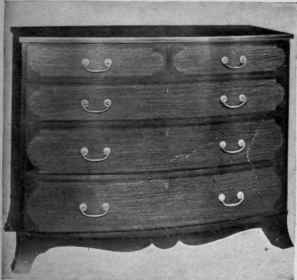
Fig. 2. Swell or Bow Front, French Feet, Shaped Apron, Satinwood Inlay.
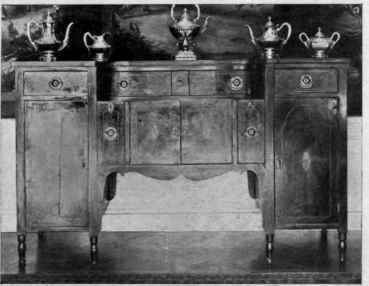
Fig. 3. Straight-Front Sideboard, Deep Ends, Short Turned Legs, American Type.

Fig. 4. Secretary Cabinet, Tambour Work, Shaped Top, Spiked Ball Finials.
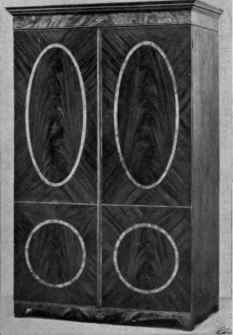
Fig. 5. Veneered and Inlaid Wardrobe, Oval and Round Panels, Shaped Apron.
Sheraton was particularly the champion of inlay (Key XIV, 5; Plate XXXI and XXXII, pp. 236, 240) as . against painted furniture, which he considered perishable, an objection reasonable enough in certain cases, but by no means of universal application. Indeed, Sheraton's designs were often intended for such decoration, notwithstanding his predilection for inlay instead (Key XIII, 4; Plate XXXIII,p. 244, and Fig. 1, B).
Sheraton's mechanical ingenuity and versatility of contrivance were remarkable, and some of the combination pieces of furniture he devised fill us with amazement if not altogether with admiration. Many of them may be said to belong to the multum in parvo type and were called forth in response to a common demand at the end of the eighteenth century for furniture whose real purpose might be readily disguised by its outward appearance or which might unite two utterly different uses under one aspect. This was because of the custom then obtaining of often using the bedroom during the day as a parlour. Consequently folding bedsteads, washstands that might be made into bookcases, couches that might be metamorphosed into tables at the touch of a spring, and many more such ingenious devices, were highly esteemed and sought for.
Notwithstanding his fondness for contriving these intricate mechanical surprises - or shall we call them disguises? - Sheraton's whole influence, so far as form was concerned, made for greater simplicity, one might almost say severity, of line and restraint in the placing and quantity of carved decoration. Indeed, simplicity of outline may be considered one of the most salient traits of his work. He sedulously eschewed the graceful curving lines so characteristic of the Hepplewhite style and confined himself almost entirely to straight lines. Much of his work might be said to be executed in a "perpendicular" mode (Key XIV, 3 and 5, and Plate XXXII, p. 240), a term particularly applicable to some of the pieces presenting an unmistakably "high shouldered" as well as graceful aspect.
Whether he thus cultivated the straight line from a desire to strike into an untrodden field, from artistic conviction or, perchance, with a view to avoiding some of the constructional difficulties imposed upon cabinetmakers by the rounded forms, we cannot certainly say. Whatever may have been his motive, the result was most satisfying from both artistic and practical considerations. In his square chair backs, for example, it mattered not whether Sheraton filled them with vertical balusters (Fig. 1, (7), diagonal lattices (Fig. 1, H) of geometrical severity or ornate splats (Fig. 1, A and B) that might more fitly be called fretted panels, for they usually filled one-third of the entire back or even more, the distribution of ornament was always well balanced and gave an impression of both staunchness and repose. And it was so, indeed, with almost everything he did. By a most skilful manipulation of his straight lines and a due proportioning of his masses he succeeded in imparting to all his designs a remarkable sense of dignity and refinement, and we may well admire the furniture produced when he was in the heyday of his powers.
Its delicacy of outline and detail render this furniture eminently fit for reception rooms, boudoirs and small salons, where it might well take the place of the modern adaptations of Louis Seize furniture so greatly at present overdone.

SHERATON INLAID MAHOGANY CUPBOARD By Courtesy of Mr. H. Burlingham New York City.
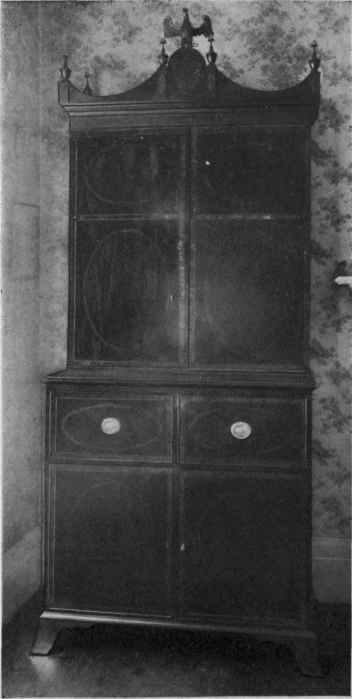
SHERATON INLAID MAHOGANY BUREAU BOOKCASE OR SECRETARY.
By Courtesy of the Rev. Louis Cope Washburn. S.T.D.
PLATE XXXII.
Continue to:


My Books

