


Gauges
Description
This section is from the book "Handcraft In Wood And Metal", by John Hooper, Alfred J. Shirley. Also available from Amazon: Handcraft In Wood And Metal.
Gauges
The Mortise Gauge (11), is made in several qualities and styles of finish, chiefly in rosewood or ebony with brass fittings. The type illustrated is most serviceable, and does not require the use of a screwdriver when the points have to be adjusted. This is the best type owing to its simple action.
(12) is a Cutting Gauge with brass-cased head and screw adjustment. This tool is used for splitting thin material, and may be used to advantage in almost every instance where gauging is necessary-making a thinner and cleaner line than the marking gauge. All gauge heads are better when faced up with brass, lasting longer, but working rather heavier owing to the extra grip of the metal-facing.
A Marking Gauge is shown in (13). Used for gauging up material previous to planing, and also for the production of lines parallel to an edge from which the gauge is operated. The marking point consists of a small round piece of steel filed to a sharp point. Brass strips are sometimes cut into the face of the stock (see illustration) and add to its wearing qualities. Other gauges of a special character are described in the succeeding chapters.
(9) illustrates a pair of Steel Compasses used for marking circular arcs, etc., upon wood. An alternate pattern, which permits of a more speedy adjustment, is called Spring Dividers. In addition to their use in striking arcs, the latter pattern are specially suited to the divisions of lines by trial.
Cramps
(14) illustrates an iron type which has obvious advantages over the wooden pattern. They are stronger and truer, easier to adjust, and do not necessitate the frequent renewal of the screws. They are used for cramping up joints and framing, and are made up to 6 ft. long. Lengthening bars can also be obtained to extend the action of the cramp.
(19) is a Gee Cramp for small work-fixing mouldings and slips in drawers.
(20) illustrates the English pattern Handscrew, usually made with beechwood chops and split English ash handles. Split material for the screws is essentia], or frequent breaking is bound to occur. Hickory, being close-grained, strong, and easy running, is a superior wood for these screws and chops.
The German pattern is illustrated in (16), made of hornbeam. A strong handscrew, and more popular with most craftsmen than the English type. Sizes of both vary from 4 in. chops.
A Glue-pot is shown in (10). The example is of iron with galvanized lining. Copper glue-pots, although more expensive, are better because of the
Description of Fig. 10 {continued}. quicker heating qualities and freedom from breakage to which the cast-iron type is particularly susceptible.
A Holdfast is illustrated in Fig. 10 (15), and is used to secure boards and general work to the bench.
(18) is a suitable kind of Oil-can, and that most important tool, the Try Square, used for a very large number of purposes, is shown in Fig. 10 (17).
The Straightedge, of which several are necessary in the general equipment of a well-ordered handcraft shop, is illustrated in Fig. 11. They are best made of mahogany with rosewood or satinwood or ebony edging; length varying from 2-5 ft. 6 in.

Fig. 11.-Straightedge.
Winding Strips are shown in Fig. 12. Made from mahogany with ivory or ivorine sights. Short dowels are fixed as shown to keep a pair together when not in use.
A large Wooden Square is shown in Fig. 13. One of this type should be included in general equipment. Length of stock and blade varies; the latter ranges from 10-24 in. in length.
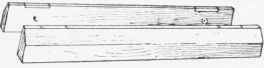
Fig. 12.-Winding strips.
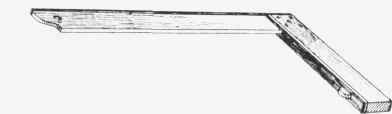
Fig. 13.-Large wooden square.
A Shooting Board is illustrated in Fig. 14. It is best made in mahogany.

Fig. 14.-Shooting board.

Fig. 15,-A horizontal vice.
A mitre attachment is dowelled to the board, this being used for shooting mitre in clamps, flat mouldings, etc. It can be removed at will.
Fig. 15 is a horizontal vice, one of which should be in every equipment. It is invaluable for holding metal or tools whilst cutting or repairing.
Continue to:


My Books

