


Types Of Milling Machines. Bench Miller
Description
This section is from the book "Machine Shop Work", by Frederick W. Turner, Oscar E. Perrigo, Howard P. Fairfield. Also available from Amazon: Machine shop work.
Types Of Milling Machines. Bench Miller
In taking up the subject of machines devoted especially to milling, it is well to consider that the transition from milling in the lathe to the special milling machine was bridged by an attachment to the lathe by which the functions of the milling machine are well served. This is especially noticeable in the milling attachment attached to bench lathes, Fig. 222, said attachment being mounted on the bed of the lathe and the spindle provided with a milling cutter. This arrangement is used for simple milling operations. Such devices led to the introduction of the bench miller, Fig. 223, which is naturally intended for small work only, and therefore is not provided with automatic feeds, hand-feeding by means of levers being used.

Fig. 222. Rivett Lathe with Milling Attachment Courtesy of Rivett Lathe Manufacturing Company, Boston, Massachusetts.
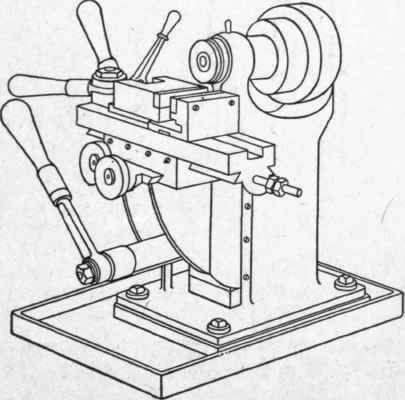
Fig. 223. Bench Miller.
Horizontal Milling Machine
The horizontal milling machine, Fig. 224, consists of a frame or box structure carrying a horizontal spindle in the upper portion, together with brackets or an overhanging arm to steady the spindle. The front of the frame is carefully machined and hand-scraped at right angles to the spindle; and there is mounted on the front a knee, the upper surface of which is parallel to the spindle in the horizontal plane and capable of movement in a vertical direction. This knee carries what is known as the saddle, the upper portion of which is also parallel to the spindle. The movement of the saddle is toward and from the frame of the machine, and therefore parallel to the spindle. The saddle, in turn, carries the table, to which the work is attached by means that will be described. The upper surface of the table is parallel to the spindle, and the table movement is at right angles to the spindle in the horizontal plane.

Fig. 224. Horizontal Milling Machine-Column Type Courtesy of Brown and Sharpe Manufacturing Company, Providence, Rhode island.
The combination of these three motions at right angles to the spindle in the vertical plane, parallel to the spindle in the horizontal plane, and at right angles to the spindle in the horizontal plane, gives to the milling machine what is known as its range. It allows any portion of the table to be brought under the cutter at any distance covered by the vertical feed.
Continue to:


My Books

