


Dehli, Or Dilhi Delhi
Description
This section is from "The American Cyclopaedia", by George Ripley And Charles A. Dana. Also available from Amazon: The New American Cyclopædia. 16 volumes complete..
Dehli, Or Dilhi Delhi
Dehli, Or Dilhi Delhi, a city of British India, capital of a commissionership and a district of the Punjaub, and formerly of the Mogul empire, situated on an offset of the Jumna, about a mile from the right bank of the main stream, 115 m. N N W. of Agra, 40 m. S. W. of Meerut, and 830 m. N. W. of Calcutta; lat. 28° 39' N, lon. 77° 18' W.; pop. about 160,-000, mostly Hindoos and Mohammedans, in nearly equal proportions. The city, which is 7 m. in circumference, is built on two rocky eminences, and enclosed, except on part of the water front, by a wall of red sandstone 30 ft. high, with bastions, martello towers, and 11 gates, four of which face the river. The seven landward gates are all colossal arches of freestone, defended by round towers. There is also a dry ditch 20 ft. wide, and on the island formed by the Jumna and its offset stands the old fort of Selimgurh, whence a bridge of boats crosses the main stream. The defences were erected by Shah Jehan, and have been improved by the British. The streets are all narrow, with the exception of two, which are respectively 90 and 120 ft. in width, and both of which are provided with a small raised watercourse bordered with trees.
The Chandnee Chowk, or silversmiths' street, the. main thoroughfare, is lined with gay bazaars, and is usually thronged with busy crowds. At its head, abutting on the river and defended by a broad moat, stands the imperial palace of Shah Jehan, once of almost unparalleled magnificence, but now filthy and neglected. It is a collection of buildings surrounded by a wall 40 ft. high and three fourths of a mile in circuit, including a private royal mosque, large gardens, and apartments for several thousand persons. Here, too, are the white marble council chamber with its four cupolas, and the public audience hall in which stood the famous "peacock throne," formed entirely of gold and jewels, and valued at $30,000,000. The jumma musjid, or chief mosque, in Mohammedan eyes the wonder of the world, built by Shah Jehan in six years (1631 - '7), stands on a paved platform 450 ft. square, on a rocky height near the centre of the city. It is approached by broad stone steps, and makes one side of a quadrangle, the other sides of which are formed by pavilions and arcades. It is 261 ft. long, lined and faced with white marble, surmounted by three domes of the same material striped with black, and having at each end of the front a high minaret.
This magnificent building has been restored of late years by the British government. Scattered through and around the city are more than 40 other mosques, some mean Hindoo temples, and tombs of the emperors and Mussulman saints. The Cuttub (Kut-tub or Kutb) Minar, 9 m. S., is 242 ft. high; and close to it is the country residence of the former emperors. Among the European buildings are the British residency, St. James's and several missionary churches, a bank, a lunatic asylum, the courts of justice, and a government college attended chiefly by native students. The last is managed by a council of Europeans and natives, and is divided into four departments: English, Arabic, Persian, and Sanskrit. There are, moreover, in and near the city, about 300 schools, besides a number of missionary schools. There are two arsenals, one outside the walls, the other within. The latter before 1857 was the most important in India, and contained 300 guns and mortars, 20,000 stand of arms, and 200,000 shot and shells, besides gunpowder and other warlike stores.
The Jumna is impregnated with natron, but the city is supplied with water by a canal 70 m. long, built under Shah Jehan and restored by the British. Another, called the Doab canal, for irrigation, built by the same emperor, fed by the Jumna, and joining that river again near here after a course of 135 m., was also repaired by the British in 1830. Delhi has manufactories of cotton cloths, indigo, and shawls, and carries on an active trade in silks and jewelry. The bazaar called Chadni Chauk is described as one of the best in India. The exports and imports of the city, exclusive of railway traffic, are valued at £3,250,000 annually. Delhi is situated on the grand trunk road from Calcutta to Lahore, being the northern terminus of the East Indian railway, and being connected with Amritsir by the Delhi railway. - According to Abul Fazl, no less than seven cities have occupied the site of Delhi. The first was In-draprastha, or Indraput, where the Hindoo rajahs had their capital at least as early as the 10th century. It must have been a magnificent city, judging from its vast ruins, which overspread the country around modern Delhi, on both sides of the river.
About 1193 it was captured by Mohammed of Ghor; and Cuttub ud-Din, a lieutenant of the victor, founded here a dynasty known to Europeans as the Patan or Afghan, and to oriental historians as that of the "slaves of the sultan of Ghor." In 1398 the city was desolated by Tamerlane, and in 1526 it was seized by Baber, the founder of the long line of Mogul emperors. With the changes of the sceptre the empire alternately waxed and waned, at one time (1340) embracing almost the whole peninsula, at another (1398) restricted to a few miles around the capital. Under the Moguls it recovered more than half its former possessions. Akbar removed the throne to Agra, but Shah Jehan in 1631 built the present city close to old Delhi, and made it the royal residence. The Mohammedans still call it Shahjehanabad, the " city of the king of the world." Nadir Shah, the Persian usurper, captured it in 1739, massacred thousands of the inhabitants who had rashly attacked his troops, and bore away plunder to the value of nearly $100,000,000, including the famous peacock throne and the great koh-i-noor diamond, now in the possession of the British crown. From this time dismemberment rapidly went on.
The Great Mogul lost all but the shadow of sovereignty, and at last fell into the hands of the Mahrattas, who were defeated near Delhi in September, 1803, by the British under Lord Lake. The titular emperor was released from captivity, a pension of £100,000 a year was assigned him, a resident was appointed at his court, and the British exercised the government in his name. In 1827 the empty show of power was taken from him, £50,000 being added to his allowance; and though still revered by Mohammedans as the descendant of Timour, his sway was thenceforth confined to the 12,-000 members of his family who filled his palace and swallowed up his pension. When the sepoy mutiny broke out in 1857, Shah Mohammed Bahadour, then 90 years old, took command of the city, appointed officers, and resumed the imperial state to which he had long been a stranger. The British lost no time in preparing for the reconquest of a city on which the fate of India was thought to hang. A force arrived before Delhi June 8, but for many weeks was not strong enough to risk an assault; and it was not till September that a general attack was made. The army then numbered about 10,000 men. The siege guns opened fire on the 11th, and on the 14th, a breach having been effected, the assault was ordered.
Several positions were carried, but it was not until the 20th that the entire city was secured. The insurgents fled, and with them the king, who took refuge in the suburban palace near the Cuttub Minar, where he surrendered the next day on promise of his life. He was subsequently tried for participation in the mutiny; his nominal sovereignty was declared extinguished, and he himself sentenced to transportation for life. A large part of the city was reduced to ruins during the siege, but it has since almost entirely recovered its former importance.
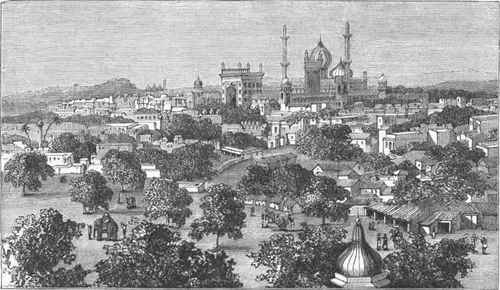
Delhi.
Continue to:


My Books

